
SEO and Internet Marketing Newsroom – Trends, Guides and AI Search
How to Promote a Website Without a Budget? The Complete Guide to SEO and AI Search Optimization
Is it possible to promote a website without a budget?
Yes – provided certain requirements are met.
Promoting a website without financial outlays is feasible, but it requires consistency, appropriate skills, and time. In practice, this means trading financial resources for your own work. Carefully planned organic activities can generate traffic from Google, Bing, AI search engines, YouTube, Reddit, LinkedIn, and local search—without having to invest in advertising.
The most common mistake new website owners make is believing that "SEO is free." SEO is free only if you implement:
- keyword analysis,
- content creation,
- technical optimization,
- link building,
- content distribution,
- data analysis.
The good news is that small websites have a better chance today than they did a few years ago. This is due to the fact that search engine algorithms increasingly reward:
- expertise,
- authenticity,
- author's experience,
- niche knowledge,
- useful answers,
- well-organized information.
This means that even a small website can compete effectively with large portals.
How does website promotion work without a budget?
The simplest operating model is as follows:
- You create content that answers real user questions.
- You optimize them for SEO and AI search engines.
- You post regularly.
- You get the first links and mentions.
- Google and AI systems begin to index and cite your website.
- Organic traffic is growing.
This is a long-term process. The first results usually appear after:
- 2–6 weeks for local niches,
- 3–6 months for standard SEO,
- 6–12 months in more difficult industries.
The Foundation: Choosing the Right Niche and User Intent
Without a budget, the winner is not the one who publishes the most content, but the one who best responds to the specific needs of users.
Wrong approach:
- "I write about marketing."
- “I have a health blog.”
- "I'm creating a business portal."
This is too general.
Effective approach:
- SEO for local dental offices,
- diet for people with insulin resistance after 40 years of age,
- accounting for IT freelancers,
- strength training for runners,
- sales automation for small e-commerce.
The more precise your specialization, the easier it is to gain visibility without a budget.
SEO without a budget - where to start?
1. Choose low-competition keywords
Long tail phrases work best.
Examples:
- instead of: "SEO",
- better: "how to do SEO of an online store yourself".
Free keyword sources
- Google Autocomplete – enter questions and analyze suggestions,
- "Similar Questions" section - one of the best free sources of topics,
- Google Search Console – allows you to find phrases for which the page is already displayed,
- Reddit and Quora – perfect for learning the real language of users,
- YouTube Search - Users are typing the same problems there as in Google.
How to create content that ranks in Google and AI?
In 2026, it won't be enough to just "write an article." The content must also meet the following requirements:
- SEO,
- AI Search,
- UX,
- EEAT,
- semantics,
- user intent.
Key Principle: Write so that AI can easily understand:
- topic,
- context,
- dependence,
- information structure,
- answers to questions.
The structure of the perfect SEO + AI article
H1 Title - Should contain the main phrase.
Example:
How to promote a website without a budget?
A strong introduction —the first 100-150 words are crucial. Google and its AI models analyze:
- topic,
- intention,
- quality of response,
- accuracy.
Heading Hierarchy - Use:
- H2 for main sections,
- H3 for expansions,
- bulleted lists,
- tables,
- FAQ sections.
Answers to user questions – AI models often quote passages that answer specific questions.
Example:
How long does it take to promote a website?
In most industries, the first SEO results appear after 3–6 months of regular activities.
This format increases the chance of:
- featured snippets,
- AI Overviews,
- quotes by AI chatbots.
AI search optimization
This is one of the key elements nowadays.
AI systems:
- analyze semantics,
- they draw answers,
- compare sources,
- are looking for experts,
- assess credibility.
How to increase your chances of being cited by AI?
- Write specifically
Instead of: “SEO is important.” Better: “Regularly publishing long-tail content can increase organic traffic even with zero advertising budget.” - Add data and examples
AI prefers content containing numbers, procedures, checklists, comparisons, and step-by-step instructions. - Build topical authority
Don't publish random articles. Create entire topic clusters.
Example:
Local SEO Cluster:- SEO for restaurants,
- Google Business Profiles,
- customer reviews,
- local linking,
- Google Maps,
- local long tail phrases.
The more related content, the greater the credibility of the domain.
- Use natural language
AI models prefer a natural style. Avoid excessive keyword stuffing, artificial phrases, and unnatural headlines.
Free website promotion channels
- Google Search Console – the absolute foundation, allows you to monitor visibility, analyze CTR, phrases and detect indexation problems.
- Google Business Profile – crucial for local businesses; a well-optimized profile can generate traffic even without a complex website.
- LinkedIn – an underrated SEO channel; expert publications build authority, generate traffic, acquire links, and increase brand citations.
- Reddit — increasingly appears high in Google results; valuable answers generate traffic, build expertise and domain recognition.
- YouTube – Google strongly promotes video; even simple how-to materials, tutorials, case studies, or screen recordings can generate organic traffic.
Link building without a budget
Link building remains one of the most important ranking factors.
How to get links for free?
- Guest posting — publishing expert articles on other blogs,
- Expert comments – substantive, non-spammy comments under industry articles,
- Forums and communities – valuable answers often generate natural links,
- Creating data and reports - statistics are readily quoted,
- Free tools – a simple calculator or checklist can earn you links over time.
Technical SEO You Can Do Yourself
- Page speed – the faster the better. Key elements include image compression, caching, a lightweight theme, and limiting the number of plugins.
- Mobile First - most traffic comes from mobile devices; the website must be responsive, fast, clear and convenient,
- Core Web Vitals – Google analyzes LCP, CLS and INP metrics,
- URL structure — good: domena.pl/seo-lokalne-restauracji; bad: domena.pl/post?id=1849.
Will AI take traffic away from Google?
Partly yes, but at the same time a new opportunity arises.
AI models need credible sources. If your website:
- contains expert content,
- answers questions effectively,
- has high semantic quality,
- has thematic authority,
can be cited by ChatGPT, Gemini, Perplexity, Copilot and AI Overviews, which is a new kind of organic visibility.
The most common mistakes when promoting a website without a budget
- Posting random topics - no topical authority strategy,
- Copying AI content without editing - low-quality materials rank worse,
- Lack of regularity - SEO rewards consistency,
- Ignoring user intent – content must respond to real needs,
- Writing purely for the algorithm – content created with people in mind achieves the best results.
90-day strategy for a website without a budget
Days 1–30:
- competition analysis,
- keyword research,
- Search Console configuration,
- publication of 10–15 articles,
- technical optimization.
Days 31–60:
- developing thematic clusters,
- acquiring first links,
- activity on LinkedIn and Reddit,
- updating older content.
Days 61–90:
- data analysis,
- improving CTR,
- expansion of the best articles,
- publication of case studies,
- creating FAQ content.
Is it possible to achieve high traffic without financial outlay?
Yes, but it usually requires:
- knowledge,
- patience,
- regularity,
- high-quality content,
- good knowledge of user needs.
Modern SEO is becoming less about manipulating algorithms and more about building an expert brand, creating the best answers online, organizing knowledge, and building trust. This is precisely why small websites can still achieve success.
FAQ
Does SEO without a budget really work?
Yes, especially in local and specialized niches. However, it requires time and the regular publication of valuable content.
How long does it take to promote a website?
The first results may appear after a few weeks, while stable organic traffic usually takes 6–12 months to build.
Is it worth writing AI articles?
Yes, but only to support the creation process. Content requires editing, experience, and expert context.
What is more important: SEO or social media?
Ideally, both channels complement each other. Social media supports content distribution, while SEO builds long-term traffic.
What content performs best in AI Search?
Guides, checklists, answers to questions, case studies, analyses and expert content have the greatest chance of being cited.
Summary
Promoting a website without a budget is possible and can still be very effective.
Of key importance are:
- topical authority,
- regular publications,
- SEO optimization,
- clear information structure,
- responding to user intentions,
- optimization for AI Search.
The greatest advantage today lies with sites that don't attempt to manipulate algorithms but genuinely support users. It's precisely this type of content that most often achieves success with both Google and AI systems.

Will AI Chats Start Paying for Content? The AI Content Monetization Revolution Is Already Underway
Until recently, tech giants trained AI models primarily on publicly available internet data. This situation is now changing rapidly. Companies like Meta, OpenAI, and Google are increasingly entering into multi-million dollar licensing agreements with publishers, media outlets, and content creators. The reason is clear: high-quality content is becoming a key resource for the development of artificial intelligence.
This means that the era of free content use by AI is slowly coming to an end.
Meta begins to reward publishers for AI content
According to industry information from WirtualneMedia.pl and other sources, Meta has signed licensing agreements with major media publishers. This content will be used both to train AI models and to generate responses in Meta AI chatbots. ( LEX )
In practice, this means a fundamental change in the way the internet functions:
- so far, platforms aggregated traffic,
- Currently, AI requires legal access to reliable sources,
- In the future, high-quality content may become one of the most valuable digital assets.
According to information published by Engadget, the deal between Meta and News Corp could be worth up to $50 million annually. ( Engadget )
Why is AI starting to pay for content?
There are several key reasons.
- AI needs reliable data
Language models are increasingly experiencing so-called "model collapse," a phenomenon where AIs are trained on content generated by other AIs. This leads to lower response quality and increases the risk of errors.
Therefore, the original:
- expert articles,
- reports,
- analysis,
- industry data,
- premium materials
are becoming strategically important for the development of artificial intelligence.
- Increase in lawsuits and regulatory pressure
A battle is raging in Europe and the US over copyright in the AI era. In May 2026, a European court ruled that publishers are entitled to compensation for the use of their content by digital platforms. ( Business Insider Polska )
This ruling could set a precedent for the entire AI industry. - AI Search Engines Are Changing the Internet
More and more users use the following instead of traditional Google:
- OpenAI ChatGPT,
- Google Gemini,
- Microsoft Copilot,
- Perplexity AI.
This means that AI becomes the new intermediary between the user and the content.
If a chatbot answers a user's question based on a publisher's article, a natural next step is to compensate the author or owner of the content.
Will bloggers and creators also make money from AI?
Most likely yes – but not everyone.
AI will reward content that is:
- unique,
- expert,
- current,
- copyright,
- reliable,
- having thematic authority.
Mass-produced SEO texts devoid of substantive value may gradually lose their relevance.
This is a significant change for the content marketing market.
SEO is no longer enough. GEO and AEO are coming.
Traditional SEO focused on Google rankings. Currently, the importance of:
- AEO (Answer Engine Optimization),
- GEO (Generative Engine Optimization),
- optimization for AI Overviews,
- visibility in chatbot responses.
New AI algorithms reward:
- citation rate,
- expertise,
- own data,
- clear structure,
- semantic content connections,
- strong author branding.
How to create content for AI and generative search engines?
Key elements:
- Create expert content
AI prefers sources with high EEAT levels:
Experience, Expertise, Authority, Trustworthiness. - Answer questions specifically
FAQ structure, definitions, and short, precise answers increase the chances of being cited by AI. - Build topical authority
Instead of individual articles, create extensive thematic clusters. - Add your own data
Research, case studies and statistics are particularly valuable for AI models. - Build your author brand
AI is increasingly analyzing not only the website, but also the reputation of the author and brand.
Will AI take away traffic from websites?
This is already happening in part.
Users are receiving more and more answers directly in:
- AI Overviews Google,
- chatbots,
- AI assistants,
- generative results.
This leads to a decline in classic clicks from search engines.
At the same time, a new model appears:
- AI quotes source,
- directs the user to an expert,
- promotes brands that are considered credible.
In the future, the greatest value may not be the movement itself, but being a source for artificial intelligence.
Who has the most to gain?
The biggest beneficiaries may be:
- premium publishers,
- industry experts,
- creators of niche analyses,
- specialized services,
- authors with unique data.
The Internet is entering a stage where quality begins to dominate over mass.
Will AI actually pay its creators?
There are many indications that this is the case.
This model is already being implemented by major technology companies. Meta is no exception, but it is starting a new trend. ( LEX )
The coming years could completely transform the internet economy:
- creators will become data providers for AI,
- high-quality content will be a licensed resource,
- Chatbots will begin to function as the next generation of search engines.
The question is no longer “will AI pay for content?” but rather: who will be paid the most?
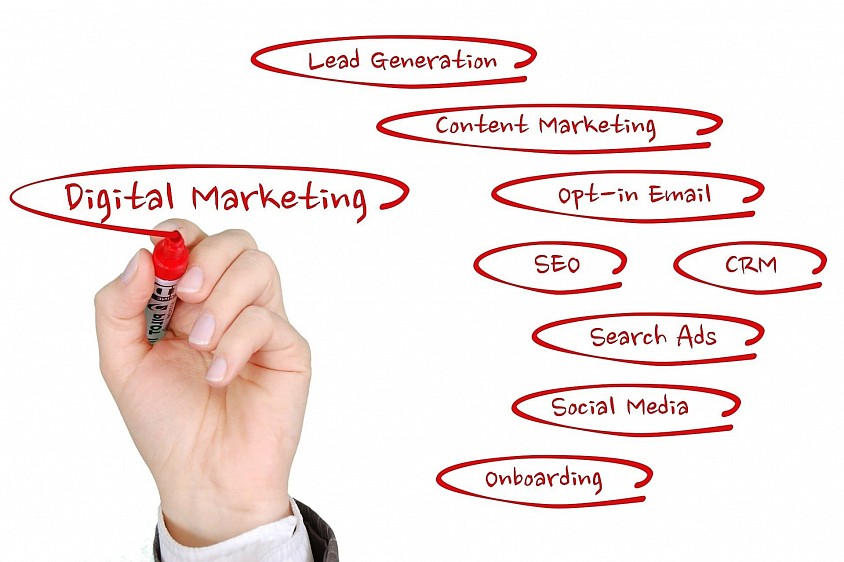
Digital Marketing Automation in 2026 – The Complete Guide for Businesses
Yes, internet marketing can be automated, but not fully and not 100%.
Digital marketing automation is no longer a luxury reserved for large corporations. By 2026, it has become standard for e-commerce, service companies, SaaS, and local businesses alike. Thanks to the development of artificial intelligence, no-code tools, and marketing automation platforms, it is now possible to automatically:
- lead acquisition,
- customer segmentation,
- sending email campaigns,
- publishing content,
- running advertisements,
- data analysis,
- personalization of communication,
- customer service,
- SEO content creation,
- and real-time campaign optimization.
At the same time, it's important to emphasize that automation doesn't replace marketing strategy. The best results are achieved by companies that combine automation with business analysis, marketing expertise, and a carefully designed sales funnel.
In this article we will discuss:
- the scope of automation in online marketing,
- tools used by modern enterprises,
- step-by-step marketing automation implementation process,
- the most common mistakes made by entrepreneurs,
- and preparing marketing for SEO and AI-based searches.
What is internet marketing automation?
Marketing automation is the use of technology, data and algorithms to implement marketing activities without the need to manually manage each process.
In practice, this means that the system can independently:
- respond to user behavior,
- send messages,
- analyze campaign effectiveness,
- run ads,
- recommend products,
- assess the quality of leads,
- personalize communication.
Marketing Automation Example
User:
- visits the website,
- downloads e-book,
- subscribes to the newsletter,
- receives an automatic series of emails,
- the system analyzes its activity,
- AI assesses the likelihood of purchase,
- the user is sent to a remarketing campaign,
- chatbot answers questions,
- CRM assigns the lead to a salesperson.
The entire process can take place without human intervention.
What areas of marketing can be automated?
1. Email Marketing Automation
This is one of the most popular areas of marketing automation.
Possible actions are automatic:
- sending newsletters,
- launching welcome campaigns,
- recovery of abandoned carts,
- payment reminders,
- sending product recommendations,
- conducting lead nurturing campaigns.
Example scenarios include:
- welcome e-mail after subscribing to the newsletter,
- a message confirming the purchase,
- reminder after 30 days of inactivity,
- automatic cross-selling,
- seasonal campaigns.
2. Social media automation
Modern tools enable planning and automatic publishing of content.
The most common functions include:
- publication schedule,
- automatic reposting,
- generating descriptions using AI,
- engagement analysis,
- automatic responses,
- brand monitoring.
Social media automation saves significant time, especially when managing multiple channels simultaneously.
3. Online Advertising Automation
Advertising platforms are increasingly using artificial intelligence, including Google Ads, Meta Ads, TikTok Ads, LinkedIn Ads, and YouTube Ads.
Automatic algorithms:
- select target groups,
- optimize budgets,
- they test advertising creations,
- analyze conversions,
- predict the effectiveness of the campaign.
4. SEO Automation
SEO can be partially automated, including activities such as:
- keyword research,
- topic clustering,
- generating content briefs,
- competition analysis,
- position monitoring,
- technical optimization,
- internal linking,
- content update.
AI significantly accelerates content creation, but the following remain key:
- substantive quality,
- author's experience,
- expertise,
- credibility,
- unique data.
5. Customer service automation
Chatbots and voicebots can handle a significant portion of customer communication.
The most common uses are:
- FAQs,
- arranging meetings,
- order processing,
- lead qualification,
- technical support,
- after-sales service.
Thanks to AI, chatbots conduct natural conversations and integrate with CRM systems.
6. Marketing Analytics Automation
Reporting can be almost completely automated.
Systems analyze:
- website traffic,
- conversion sources,
- campaign ROI,
- user paths,
- customer behavior,
- content effectiveness.
Thanks to this, decisions are made faster and based on data.
How does marketing automation work step by step?
Step 1. Data Collection
The basis of automation is data that the system obtains from:
- forms,
- website,
- online store,
- CRM,
- advertising campaigns,
- social media,
- newsletters,
- mobile applications.
Step 2. User segmentation
Users are grouped by:
- behaviors,
- interests,
- location,
- purchase history,
- sales funnel stage,
- activity.
Step 3. Creating automation scenarios
Example:
IF a user visits a product page but does not make a purchase, the system will trigger remarketing and send a reminder email.
Step 4. Personalize communication
Modern systems use AI for personalization:
- content,
- offers,
- recommendations,
- shipping hours,
- communication channels.
Step 5. Analysis and optimization
Automation is a continuous process – the best systems constantly:
- they test effectiveness,
- analyze data,
- optimize campaigns,
- improve conversion.
What marketing automation tools are worth knowing?
Email marketing tools
Popular platforms include:
- MailerLite,
- ActiveCampaign,
- GetResponse,
- Klaviyo,
- Brevo,
- HubSpot.
Process automation tools
The most commonly used are:
- Zapier,
- Make,
- n8n,
- Pabbly,
- Microsoft Power Automate.
AI tools for content marketing
Modern marketing increasingly uses AI to:
- content creation,
- generating graphics,
- SEO research,
- data analysis,
- copywriting automation.
SEO tools
The most commonly used are:
- Ahrefs,
- Semrush,
- Surfer SEO,
- Screaming Frog,
- Google Search Console,
- Google Analytics 4.
CRM tools
Popular systems include:
- HubSpot CRM,
- Pipedrive,
- Salesforce,
- Zoho CRM,
- Livespace.
Can AI completely replace marketers?
NO.
AI is excellent at:
- data analysis,
- process automation,
- content generation,
- campaign optimization,
- personalization.
However, the following remain a challenge:
- brand strategy,
- business creativity,
- building emotions,
- brand positioning,
- crisis communication,
- creating competitive advantage.
The most effective companies use the following model:
Human + AI + automation
This is currently the most effective approach.
How to implement marketing automation in your company?
1. Map your sales process
First you need to understand:
- where do customers come from,
- how they make decisions,
- where you lose leads,
- which actions are repeatable.
2. Select the most important processes
It is not worth automating everything at once.
The highest return on investment is usually provided by:
- email marketing,
- CRM,
- remarketing,
- reporting,
- lead nurturing.
3. Integrate tools
The key is the connection:
- websites,
- CRM,
- mailing system,
- advertising,
- analytics,
- online store.
4. Build automation scenarios
Effective workflows should respond to specific user behavior.
5. Measure the results
The most important KPIs are:
- customer acquisition cost,
- conversion rate,
- customer value,
- campaign ROI,
- number of leads,
- response time.
The most common mistakes in marketing automation
Automating chaotic processes
If a process runs inefficiently manually, automation will only accelerate errors.
No strategy
Tools will not replace a well-thought-out business strategy.
Too aggressive automation
Excessive messages and automated actions can reduce customer trust.
No segmentation
Uniform communication to all recipients usually reduces effectiveness.
Ignoring data
Automation without analytics leads to bad decisions.
Marketing Automation vs. SEO and Search AI
This is one of the key topics right now.
Search engines increasingly use:
- AI Overviews,
- generative responses,
- language models,
- semantic understanding of content.
Therefore, modern content must be optimized not only for Google, but also for AI systems.
How to create content for SEO and AI?
- Answer specific user questions
Content should respond to real search intent.
Examples:
Can marketing be automated?
How does marketing automation work?
Which tools should you choose?
How much does marketing automation cost? - Build topical authority
Create extensive thematic clusters.
Examples of related articles:
AI in marketing,
sales automation,
CRM for companies,
SEO automation,
AI chatbots,
lead generation. - Use semantic structure
Key elements:
H1–H3 headings,
FAQs,
bulleted lists,
short paragraphs,
data and examples,
natural language. - Add experience and expertise
AI is increasingly better at assessing the substantive quality of content.
It is worth giving examples, presenting case studies, citing data and showing practical experience. - Update content
Marketing automation content becomes outdated quickly.
Regular updating increases your visibility in search engines.
How much does marketing automation cost?
Costs depend on:
- scale of the company,
- number of processes,
- number of customers,
- level of integration,
- use of AI.
Approximate costs:
Small company
200–1500 PLN per month,
basic email marketing,
CRM,
automatic campaigns.
Medium-sized company
1500–10000 PLN per month,
extensive workflow,
integration,
sales automation.
Large organizations
several tens of thousands of zlotys a month,
advanced personalization,
AI predictive marketing,
data-driven automation.
Is marketing automation profitable for small businesses?
Definitely yes.
In many cases, small businesses benefit the most because automation:
- saves time,
- reduces costs,
- improves customer service,
- increases sales,
- allows you to compete with larger brands.
Even simple implementations can significantly increase the effectiveness of marketing activities.
The future of marketing automation
The coming years will be dominated by:
- AI agents,
- hyperpersonalization,
- predictive marketing,
- automatic campaign generation,
- conversational AI,
- autonomous marketing systems.
Companies that implement automation earlier will gain a competitive advantage.
FAQ - Frequently Asked Questions
Can internet marketing be completely automated?
Not 100%. Many operational processes can be automated, but strategy, creativity, and brand development still require human involvement.
What are the best marketing automation tools?
Popular solutions include HubSpot, ActiveCampaign, MailerLite, Zapier, Make, and Klaviyo.
Will AI replace marketing specialists?
AI will change the way marketers work, but it will not eliminate the need to create strategies and supervise activities.
Is marketing automation expensive?
Not always. Small businesses can start with simple tools for just a few hundred zlotys a month.
Does automation help with SEO?
Yes. You can automate keyword analysis, position monitoring, content updates, and some content marketing processes.
Summary
Online marketing can be effectively automated – for many companies it is no longer just a competitive advantage, but a necessity.
The biggest benefits of automation are:
- saving time,
- greater scalability,
- better personalization,
- faster data analysis,
- higher campaign effectiveness,
- improving customer experience.
At the same time, a strategic approach remains crucial.
The best results are achieved by companies that treat AI and automation as business support, not as a complete replacement for people.
In 2026, marketing automation is no longer a question of “is it worth it?”, but rather “how to implement it faster and more effectively than the competition?”
How has online advertising evolved over the years?
An expert guide for marketers, business owners, and creators
Online advertising has undergone a transformation over the past three decades that surpasses most other communication channels in the history of marketing. From simple banners in the 1990s, through the dominance of search engines and social media, to AI-powered automation, technologies, business models, user behavior, and influence mechanisms have evolved.
Today, effective online advertising is not just about "buying reach." Data, personalization, advertising ecosystems, automation, and user trust are key.
Below is a comprehensive, expert guide that covers:
- the evolution of online advertising,
- groundbreaking models,
- elements that have lost their effectiveness,
- and principles of designing effective advertising campaigns in the current reality.
1. The Beginnings of Internet Advertising – The Banner Era (1994–2000)
The first forms of internet advertising were simple:
- static banners,
- pop-up windows,
- mass mailings,
- website directories.
The symbolic beginning of modern online advertising was the first banner ad published in 1994 by AT&T.
Characteristics of the era:
- The dominant model was the CPM (cost per mille) model – payment for 1,000 impressions.
- The most important were: the widest possible reach, the number of views and "brand visibility".
- Problems included a lack of precise targeting, limited ability to measure results, and high levels of user irritation.
At that time, the Internet was new, which resulted in high click-through rates (CTR) - banners could reach up to several percent CTR, while today the standard is often below 1%.
2. The Search Engine Revolution – The Birth of Intent Advertising (2000–2010)
A turning point was the emergence of search engines, especially Google.
The following model was introduced:
- PPC (pay per click),
- keyword-based advertising,
- advertising auctions,
- conversion measurability.
Online advertising is no longer just a “broadcast”; it begins to respond to the specific intention of the user.
Why was this groundbreaking?
- Previously, advertising "searched" for a recipient.
- After the appearance of search engines, the user himself revealed his needs.
Example: Typing the phrase “car insurance” meant a significantly higher purchase willingness than randomly viewing a banner.
Key innovations:
- auction systems,
- Quality Score,
- remarketing,
- web analytics,
- conversion tracking.
Marketing has become more mathematical, data-driven and performance-based.
3. Social media changed the model of influence (2010–2016)
The development of social platforms such as Meta Platforms, YouTube, LinkedIn and X has sparked another revolution.
Advertising is no longer just a response to a need – it has started to create it, build communities, have an emotional impact and engage users.
During this period the following appeared:
- algorithmic feeds,
- influencer marketing,
- content marketing,
- native ads,
- virality as a strategy.
Data became the new currency – social media platforms collected vast amounts of information about users’ interests, behaviors, locations, social relationships, and purchasing activity.
Advertising has become hyper-precise, enabling targeting of, among others, young mothers, owners of specific cars, people who have just moved, investors, or those planning a vacation.
This was the beginning of the era of micro-segmentation, psychographics and advertising personalization.
4. Mobile first — the smartphone dominates the internet
With the widespread use of smartphones as the primary device for accessing the internet, advertising has had to adapt.
The formats, message lengths, content consumption methods, and attribution models have all changed.
The most important consequences:
- Shorter attention spans – users consume content faster, impulsively, and in constant scrolling mode.
- The rise of video – formats such as short video, stories, reels and live commerce have become dominant.
- Advertising has become an integral part of everyday life - the Internet is no longer a place where you sit at a computer, but has become a permanent user environment.
5. Programmatic and ad buying automation
The next stage was the automation of advertising purchases.
What is programmatic?
This is an automatic purchase of advertising space in real time, where the systems independently decide to whom, when, for how much and in what format to display the ad.
Effects:
- Advertising has become faster, scalable and more cost-effective.
- At the same time, it has become less transparent, more dependent on algorithms and more difficult to fully control.
Extensive advertising ecosystems have emerged, controlled by the largest technology platforms.
6. The Age of Privacy and the End of Wild Tracking (2018–2024)
After years of intensive exploitation of user data, there has been a regulatory shift.
Key events:
- General Data Protection Regulation (GDPR),
- restrictions on third-party cookies,
- privacy changes in iOS,
- growing user awareness.
Changes in practice:
- Advertisers lost some data – tracking users between sites became difficult.
- The use of first-party data, newsletters, CRM, own communities and marketing automation has gained importance.
- Brands began to invest in loyalty, trust, expert content and building their own audience ecosystems.
7. AI is changing online advertising right now
Another revolution driven by artificial intelligence is currently underway.
Companies such as OpenAI, Google, Meta Platforms and Microsoft are intensively automating the processes of ad creation, targeting, budget optimization, image and video generation, and performance analysis.
The most important changes introduced by AI:
- Creative: Ads can be generated automatically – text, graphics, video, voice-over and personalization of variants.
- Targeting: Algorithms independently find audiences, predict conversions and optimize campaigns without the need to manually define groups.
- Scale of production: Brands can test hundreds of ad versions, micro-segments, and dynamic messages.
8. What stopped working?
Excessive advertising aggression: users are now much more resistant to clickbait, flashy banners, spam and low-quality lead magnets.
“Cheap traffic”: Traffic itself has lost its value – what matters is user quality, retention, LTV and customer profitability.
Universal messages: mass communication loses out to personalization, authenticity and context.
9. What does effective online advertising look like today?
An effective model is based on five pillars:
- First-party data: build your own customer database, newsletter, community and CRM.
- Content + advertising: the strongest brands educate, build expertise, and combine advertising with valuable content.
- Multi-channel: Don't base your business on a single platform – combine SEO, PPC, social media, email marketing, video and remarketing.
- Automation: Use AI, automated campaigns, dynamic creatives, and predictive analytics.
- Trust: The most valuable asset in modern marketing is brand credibility.
10. What will online advertising look like in the future?
Potential directions of development:
- Conversational advertising: AI interactions will become the new sales channel.
- Even greater personalization: messages will be dynamically generated for a specific person, moment, emotion, and context.
- Less visible advertising: the lines between content, recommendation and sales will become increasingly blurred.
- The growing importance of the trust economy: winning brands are those that build relationships, have a community and their own communication channels.
The most important conclusions
Online advertising has gone through five key stages:
- banners and reach,
- search engines and intent,
- social media and data,
- mobile and automation,
- AI and hyperpersonalization.
The most important change is that advertising has ceased to be a mass message and has become a system for predicting user behavior.
Today, companies that understand data, build their own audiences, combine technology with psychology, and invest in trust instead of just reach are successful.
Modern online advertising is not just marketing—it's a combination of analytics, automation, attention economics, behavioral science, artificial intelligence, and user experience design.
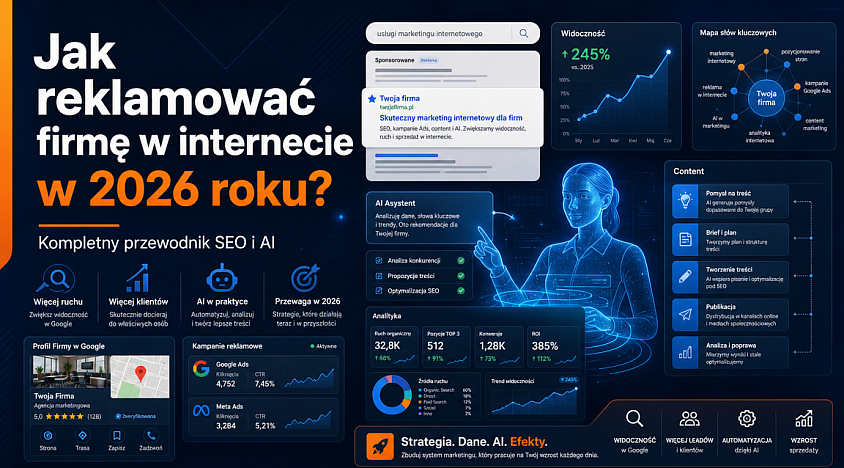
How to Effectively Market Your Business Online in 2026? The Complete Guide to SEO and AI for Business
Introduction
In 2026, online business advertising will no longer rely solely on website SEO and paid Google Ads campaigns. The dynamic development of artificial intelligence, generative search engines, and the evolution of Google algorithms now require a multi-channel approach to online marketing.
Businesses compete not only for high rankings in Google search results, but also for visibility in AI-generated answers, chatbots, local results, social media, and video platforms.
In this article we present:
- a strategy for effective company advertising on the Internet,
- the most effective marketing channels,
- a modern approach to SEO in the era of artificial intelligence,
- activities that increase sales and brand recognition,
- ways to build a competitive advantage in the online environment.
Why is online advertising essential today?
Most customers begin their purchasing process through search engines or social media. Even if the final transaction takes place offline, purchasing decisions are often made earlier, after reading reviews, watching videos, or comparing offers online.
Modern online advertising offers companies:
- the ability to precisely target recipients,
- lower lead acquisition costs,
- scalability of operations,
- measurability of effects,
- automation of marketing processes,
- building brand recognition.
For many industries, the Internet has become the primary source of customer acquisition.
How to advertise your company online in 2026?
An effective marketing strategy should integrate various communication channels.
Key areas include:
- SEO and content marketing,
- Google Ads advertising,
- social media marketing,
- video marketing,
- local SEO,
- email marketing,
- marketing automation,
- AI search engine optimization,
- building an expert brand.
Each of these elements plays an important role at different stages of the sales funnel.
SEO in 2026 - the foundation of company visibility
SEO (Search Engine Optimization) is the process of optimizing a website for search engines, with the goal of increasing visibility in Google's organic search results.
A well-optimized website:
- generates free traffic,
- increases the number of inquiries,
- builds brand credibility,
- reduces the cost of customer acquisition.
Key SEO Elements in 2026
- Content quality
Google is increasingly assessing the quality of published materials. Content should be expert, up-to-date, comprehensive, user-friendly, and semantically optimized. It's worth creating guides, case studies, rankings, analyses, FAQs, and evergreen content. - Search Intent
Modern SEO focuses on user intent. Google analyzes what the user is searching for, what problem they're trying to solve, and what content format will be most appropriate. Articles should answer specific questions and provide real value. - Core Web Vitals
Page loading speed is crucial for SEO. Key metrics include LCP (Largest Contentful Paint), CLS (Cumulative Layout Shift), and INP (Interaction to Next Paint). A slow website lowers conversions and compromises the user experience. - Link building
External links remain one of the most important ranking factors. The most effective are links from industry portals, expert publications, sponsored articles, brand citations, and natural mentions. - Local SEO
Local businesses should invest in a Google Business Profile, customer reviews, local keywords, Google Maps optimization, and local links to effectively attract customers from specific cities and regions.
Content Marketing – How to Create Content That Sells?
Content marketing involves regularly publishing valuable content that increases organic traffic, builds trust, supports sales, improves SEO, and increases visibility in AI.
The most effective forms of content are:
- blog articles - help position the website for many keywords,
- expert guides - build brand authority,
- case studies — present real effects of cooperation,
- FAQs - Perfectly respond to voice and AI queries,
- video content – increases user engagement.
Google Ads Advertising - Fast Customer Acquisition
Google Ads allows for almost immediate appearance in search results, which is especially beneficial for new businesses, online stores, competitive industries, and seasonal campaigns.
The most popular types of ads are:
- search engine ads – displayed after entering specific phrases,
- display ads – banners on Google partner sites,
- remarketing – recovering users who visited the website,
- Google Shopping – crucial for e-commerce,
- Performance Max ads – automated campaigns powered by Google AI.
Social media marketing in 2026
Nowadays, social media not only play an image-building role, but also constitute an important sales and communication channel.
The most important platforms are:
- Facebook – still effective for many local and service industries,
- Instagram – perfect for lifestyle, beauty, fashion and food brands,
- LinkedIn – a key platform for the B2B sector,
- TikTok – a dynamically growing channel with large organic reach,
- YouTube – one of the most effective content marketing platforms.
Video Marketing – Why is it worth investing?
Video content generates higher engagement than text, helps build trust, increases time spent on site, improves conversions, educates customers, and strengthens brand visibility.
The most popular formats are:
- shorts,
- guides,
- webinars,
- reviews,
- product videos,
- behind-the-scenes reports.
How to advertise a local business online?
Local businesses can effectively acquire customers online by taking the following steps:
- Google Business Profile – the foundation of local marketing; the profile should include current data, photos, opening hours, reviews, offers and location,
- customer reviews - positive reviews increase the credibility of the company, it is worth actively encouraging customers to leave them,
- local keywords – e.g. “dentist Warsaw”, “mechanic Krakow”, “restaurant Lublin”, “wedding photographer Gdansk”.
Email marketing is still effective
Despite the growth of social media, email marketing remains one of the most effective sales channels. A carefully curated newsletter increases sales, builds relationships, promotes brand awareness, and supports remarketing. Audience segmentation and communication personalization are key.
Marketing automation
Automation saves time and increases campaign efficiency. Examples include autoresponders, email sequences, chatbots, lead scoring, and automated remarketing campaigns. In 2026, more and more companies are using AI to automate customer service and marketing.
AI Search and the Future of Online Marketing
The development of artificial intelligence is transforming the way we gather information. Users are increasingly using AI chatbots, conversational search, voice assistants, and Google's generative responses. Therefore, companies should also optimize their content for AI Search.
How to optimize content for AI search engines?
- Answer specific questions
AI prefers content that clearly and precisely answers user queries. It's worth using FAQ sections, short definitions, structured headings, and bulleted lists. - Build topical authority
Google and AI reward specialized sites. It's better to create a comprehensive knowledge base in a single field than to publish random content. - Use natural language
Content should resemble a natural conversation, which is especially important for voice search. - Use structured data
Schema.org helps search engines better interpret page content. Implement the FAQ schema, Article schema, Local Business schema, and Product schema. - Publish expert content
AI is increasingly better at assessing the quality and credibility of authors. Experience, expertise, authority, and credibility are key elements of the EEAT concept.
How to measure the effectiveness of online advertising?
Without analytics, it's difficult to develop marketing activities. The most important metrics include website traffic, conversion rate, customer acquisition cost, ROAS, CTR, time spent on site, and the number of leads.
The most commonly used tools are Google Analytics 4, Google Search Console, Ahrefs, Semrush, Hotjar and Meta Ads Manager.
The most common mistakes in online advertising
- Lack of strategy - chaotic actions rarely bring the expected results,
- Ignoring SEO - Relying solely on paid advertising increases marketing costs,
- Poor content - low-quality content does not build visibility,
- Lack of analytics - without data it is difficult to optimize campaigns,
- Inconsistent brand communication – a company should present a consistent image across all channels.
Marketing trends for the coming years
The most important directions of development of internet marketing are:
- AI marketing,
- personalization of communication,
- automation,
- voice search,
- expert content,
- short video,
- omnichannel marketing,
- first-party date,
- social commerce.
Companies that quickly implement new technologies will gain a competitive advantage.
Summary
Advertising your business online in 2026 requires a strategic approach and the integration of multiple marketing channels. SEO, content marketing, Google Ads, social media, video marketing, and AI Search optimization are paramount.
Creating expert, high-quality content that meets real user needs is crucial. Companies that invest in organic visibility, build an expert brand, and leverage artificial intelligence have the greatest chance of long-term online growth.
FAQ - Frequently Asked Questions
What is the best way to advertise your company online?
The best results are achieved by combining SEO, Google Ads, content marketing and social media activities.
Does SEO still work in 2026?
Yes, SEO remains one of the most effective channels for acquiring traffic and customers.
How much does it cost to advertise a company on the internet?
Costs depend on the industry, level of competition and chosen marketing channels.
Is it worth investing in content marketing?
Absolutely. High-quality content supports SEO, builds trust, and increases sales.
How to prepare your website for AI searches?
It is worth creating expert content, using FAQ sections, implementing structured data and answering specific user questions.
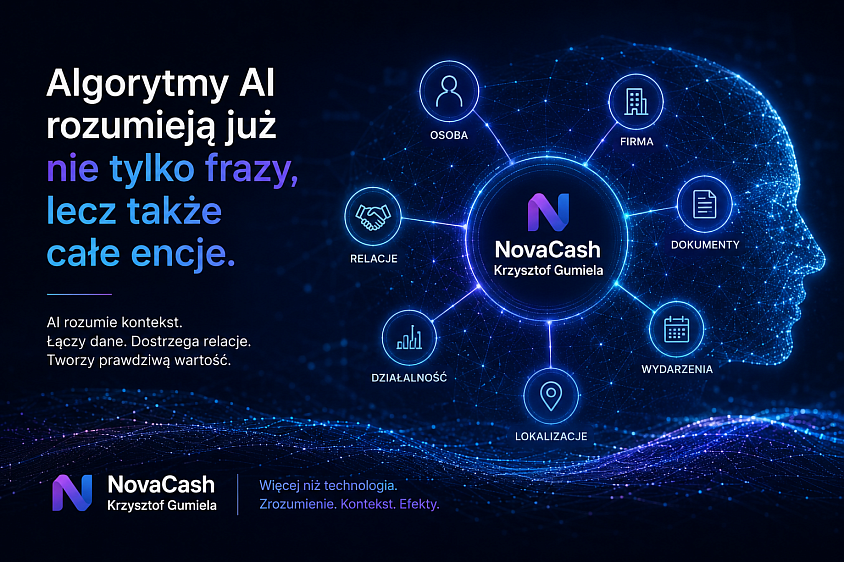
AI algorithms recognize phrases and complex entities and their relationships
AI Algorithms Understand Entities, Not Just Keywords – Modern SEO 2026
Modern AI-powered search engines analyze entities, relationships, and context instead of individual phrases. Learn about changes in SEO and how to create content optimized for AI Search and modern algorithms.
AI algorithms no longer understand just phrases, but also entire entities.
For many years, SEO relied primarily on keyword matching. Content creators analyzed keyword popularity, incorporated them into headlines, meta tags, and article content, and then competed for high rankings in search results. This model is rapidly becoming a thing of the past.
Modern AI-based algorithms understand not only individual words but also their meaning, context, and relationships between concepts. At the heart of modern SEO are entities, or specific entities: people, brands, places, products, events, and organizations.
This is a fundamental shift for website owners, marketers, and copywriters. Optimizing for AI search engines now requires creating semantic, expert, and logically connected content, not simply "saturate" text with keywords.
What are entities in SEO?
An entity is a uniquely identifiable entity with specific characteristics and relationships to other elements of knowledge. For AI algorithms, an entity can be:
- mark,
- person,
- business,
- product,
- location,
- event,
- service,
- industry concept.
For example, the phrase "Apple" might refer to a fruit or a technology company. However, AI algorithms analyze the context of the entire statement and can recognize which entity is being referred to.
If the text contains references to smartphones, iOS, Mac computers, or mobile technology, the search engine interprets "Apple" as a technology brand, not a fruit.
In practice, this means that modern SEO relies more on semantics than on mechanical word matching.
Why are AI search engines moving away from classic keywords?
The reason is simple: users communicate more and more naturally.
The development of language models has allowed search engines to analyze the full questions, intent, and context of a conversation. Users no longer simply type:
"men's running shoes".
More and more often he asks questions like:
“What running shoes are best for a beginner asphalt runner?”
For traditional SEO it was a long keyword phrase, but for AI it is a set of related entities and intents:
- running shoes,
- beginner runner,
- running on asphalt,
- depreciation,
- comfort,
- training.
The algorithm therefore interprets the meaning of the query, not just the specific words.
Semantic SEO – the new foundation of visibility
Semantic SEO is an optimization strategy based on the meaning of content, relationships between topics, and building full context.
In practice, this means creating articles that:
- exhaust the topic,
- answer real user questions,
- contain logical connections between concepts,
- they use natural language,
- build thematic authority.
Nowadays, search engines no longer analyze only the frequency of phrases. They primarily evaluate:
- quality of information,
- thematic coherence,
- expertise,
- semantic context,
- compliance with the user's intention.
Therefore, a modern SEO article should resemble expert substantive material, not a text written to suit an algorithm from a decade ago.
How does AI interpret relationships between entities?
Language models and AI search engines create extensive knowledge maps, called knowledge graphs, that allow us to recognize relationships between different entities.
Examples:
- doctor → medicine,
- Tesla → electric cars,
- Nike → sports,
- Krakow → tourism,
- ChatGPT → artificial intelligence.
The more logical relationships the content contains, the easier it is for the algorithm to understand the topic of the page.
For this reason, the following become crucial:
- topical authority,
- content clusters,
- internal linking,
- extensive FAQ sections,
- semantic structure of the content.
AI no longer analyzes a single page in isolation from the rest of the website, but increasingly interprets the entire thematic ecosystem of a website.
AI Search is changing the way content is created
The emergence of systems such as AI Overviews, generative search results, and conversational search has revolutionized the way we consume information.
Search engines increasingly generate answers by aggregating data from multiple sources. Therefore, content must be:
- precise,
- reliable,
- well structured,
- easy to interpret by AI models.
In practice, the importance of:
- Heading structures
The logical hierarchy of H1, H2, and H3 makes it easier for AI to understand the structure of information. - Structured data
Schema.org allows algorithms to identify entities, products, authors, and organizations. - EEAT
Google is increasingly assessing:
experience,
expertise,
authority,
credibility. - Semantic context
Content should naturally cover related concepts and topics.
How to write content optimized for AI and SEO?
Modern optimization requires a shift away from the “one phrase = one text” model.
Effective content should:
- respond to the user's intentions – the most important thing is to understand the recipient's real needs,
- build a full context – the article should broadly explain the topic and include secondary questions,
- use natural language – AI algorithms are increasingly effective in recognizing artificially stuffed keywords,
- create topical authority – websites publishing comprehensive content in a given field gain greater authority,
- Include conversational questions – the growing popularity of voice search and AI chat search means users formulate queries more naturally.
Is classic SEO no longer existing?
No. The basics of SEO remain important.
The following are still key:
- page loading speed,
- Core Web Vitals,
- technical optimization,
- linking,
- indexation,
- UX,
- mobile-first.
However, the way content is interpreted is changing. While algorithms previously focused primarily on phrase matching, today they play an increasingly important role:
- meaning,
- context,
- quality of information,
- relationships between entities,
- user intent.
SEO is evolving towards semantic optimization and creating content dedicated to both people and AI systems.
The future of SEO is based on knowledge and context
In the coming years, the role of AI Search will steadily grow. Search engines will increasingly understand:
- natural language,
- relationships between topics,
- credibility of sources,
- context of the statement,
- user intentions.
For brands, this means building expert content ecosystems instead of single, keyword-driven articles.
The greatest advantage will be gained by companies that:
- develop topical authority,
- publish high-quality content,
- build recognizable brand entities,
- invest in semantic SEO,
- create content that responds to the real needs of users.
Summary
AI algorithms are changing the way search engines function. Keywords remain important, but they are no longer the sole foundation of visibility.
Modern systems analyze entities, relationships, and semantic context, which means that effective SEO requires creating expert, logical, and valuable content that responds to user intent.
Companies and content creators who understand this transformation early will gain an advantage in the era of AI Search.
SEO phrases used in the article
- AI Search
- Semantic SEO
- entities in SEO
- AI algorithms
- AI search engines
- Semantic SEO
- topical authority
- AI optimization
- content for AI
- semantic search
- artificial intelligence and SEO
- modern SEO
- SEO 2026
- AI Overviews
- AI content marketing
Contact us and see how to prepare your website for AI Search.
Learn how to build topical authority in your industry.
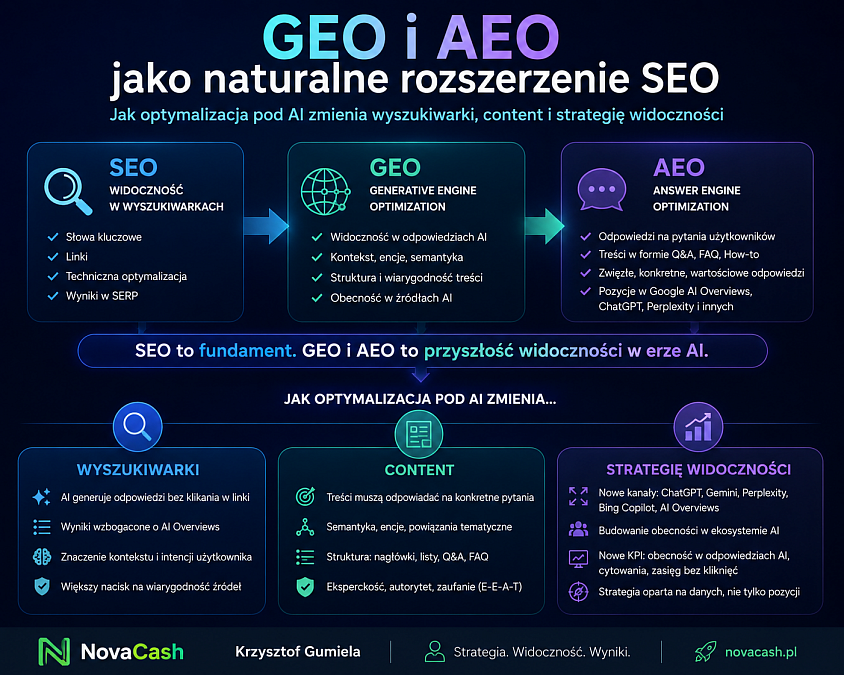
GEO and AEO – Key SEO Extensions for Generative Search Engines and AI
The Impact of AI Optimization on Search Engines, Content, and Visibility Strategy
Introduction
SEO is no longer limited to competing solely for positions in traditional search results. The dynamic development of language models, generative search engines, and AI-based response systems requires organizations to design visibility not only for the algorithms that index pages but also for the AI models that generate responses for users.
In this context, two concepts appear more and more frequently:
GEO (Generative Engine Optimization)
AEO (Answer Engine Optimization)
They are not an alternative to SEO, but its natural evolution.
A modern digital visibility strategy includes:
- SEO - visibility in classic search results,
- AEO — optimization for response engines,
- GEO — optimization for generative AI models.
Companies that understand this transformation early will gain a competitive advantage in an environment where users are increasingly presented with ready-made answers rather than lists of links.
What is SEO and why is it no longer enough?
For years, SEO (Search Engine Optimization) has focused on improving a website's visibility in organic search results.
Traditional SEO includes:
- technical optimization of the website,
- construction of information architecture,
- keyword strategy,
- link building,
- Core Web Vitals optimization,
- creating content that responds to user intentions.
The operating model was simple:
- the user enters a phrase,
- the search engine returns a list of results,
- the user clicks the link,
- traffic goes to the website.
However, this model is losing its dominance.
More and more users are using:
- AI Overviews,
- ChatGPT,
- Gemini,
- Perplexity,
- Copilot,
- voice search,
- AI assistants integrated with browsers and operating systems.
As a result, users are increasingly:
- they don't go to the page,
- they receive a ready answer,
- consume content directly in the AI interface.
This fundamentally changes the way visibility is built.
AEO - What is Answer Engine Optimization?
AEO (Answer Engine Optimization) is the optimization of content for systems whose main goal is to provide direct answers to users.
It is no longer just about page ranking, but about whether the content:
- will be properly understood,
- considered credible,
- used as a source of answers.
How do Answer Engines work?
Response engines analyze:
- content structure,
- semantics,
- context,
- relationships between entities,
- authority of the source,
- clarity of response.
They then generate a short response for the user.
Examples of AEO environments include:
- featured snippets,
- Google AI Overviews,
- voice search,
- AI chatbots,
- automatically generated FAQ systems.
Main objectives of AEO
AEO focuses on:
- answering specific questions,
- building content in the problem → answer format,
- creating a logical structure of information,
- increasing understandability for NLP models,
- amplifying EEAT signals.
How to optimize content for AEO?
- Answer questions directly
The first paragraphs should contain a specific and precise answer.
Example:
Instead:
"In today's dynamic world of internet marketing..."
Better:
“AEO is the process of optimizing content for systems that generate direct responses to users.” - Use semantic structure
AI models prefer content:
logical,
tidy,
hierarchical,
easy to parse.
The key are:
H1–H3 headings,
FAQ sections,
bulleted lists,
tables,
definitions,
summaries. - Use structured data
Schema.org supports AI systems in interpreting page content.
The most important schema types are:
FAQPage,
Article,
Organization,
Person,
Product,
HowTo. - Build topical authority
AEO rewards subject matter experts.
A single article is not enough – you need:
thematic clusters,
extensive knowledge hubs,
coherent content architecture,
full coverage of the semantic area.
GEO - What is Generative Engine Optimization?
GEO (Generative Engine Optimization) is an extension of SEO and AEO, taking into account the specificity of generative AI models.
The goal of GEO is to increase the likelihood that:
- mark,
- contents,
- data,
- quotations,
- expert positions
will be used by AI models when generating responses.
Why is GEO becoming crucial?
Generative models no longer just present links – they aggregate information, synthesize knowledge, create multi-source answers, and select the most reliable data.
This means that the fight for visibility is moving from the level of:
“will the user click on my result?”
on:
“Will the AI model consider my content as a source of answers?”
GEO vs SEO - Key Differences
| SEO | GEO |
| Ranking in SERPs | Presence in AI responses |
| Clicks | Citation and use of content |
| Keywords | Context and semantics |
| Backlinks | Authority of the entity |
| Crawler optimization | Optimization for language models |
| Page visibility | Knowledge visibility |
SEO remains the foundation, but GEO extends optimization to include:
- machine readability,
- entity optimization,
- semantic authority,
- citation of content,
- understandability for AI models.
How does GEO optimization work?
- Entity SEO and semantics
AI models operate on entities and their relationships, so it is important to:
clearly defining the brand,
building consistency in names,
strengthening presence in many sources,
entity linking across platforms.
Examples of signals include:
Wikipedia,
company profiles,
expert publications,
media mentions,
structured data,
Knowledge Graph. - Creating expert content
AI models prefer content:
substantive,
well structured,
based on experience,
contextually rich,
current.
Superficial and mass-generated content is losing its importance. - Content citation
GEO-compliant content should include:
definitions,
data,
statistics,
models,
frameworks,
clear conclusions,
expert interpretations.
AI models are more likely to use passages that are easy to quote or summarize. - Multi-channel visibility
GEO goes beyond the website.
Also important are:
LinkedIn,
YouTube,
podcasts,
industry publications,
GitHub,
expert forums,
industry media.
AI models analyze the entire ecosystem of brand presence.
Why should SEO, AEO and GEO work synergistically?
The biggest mistake is treating GEO as a separate channel.
In practice:
- SEO builds indexability and visibility,
- AEO increases the ability to respond,
- GEO strengthens presence in the generative AI ecosystem.
It's one coherent system.
Modern visibility model
Layer 1 - SEO
The technical foundation includes:
crawlability,
indexation,
efficiency,
information architecture,
linking.
Layer 2 - AEO
Response optimization includes:
FAQs,
featured snippets,
definitions,
semantics of questions,
content structure.
Layer 3 - GEO
Visibility in AI is based on:
brand authority,
entity optimization,
citations,
knowledge distribution,
omnichannel expertise.
How to create content optimized for SEO and AI?
- Write for People, But Structure for AI
The best GEO/AEO content is:
linguistically natural,
of high expert value,
easy to interpret by models.
Key elements include:
short paragraphs,
clear definitions,
logical sections,
high semantics,
consistent terminology. - Respond to intentions, not just phrases
Classic SEO focused on keywords.
AI analyzes:
context,
intention,
semantic relations,
completeness of the answer.
Therefore, modern content should include:
user questions,
problems,
objections,
usage scenarios,
business context. - Create deep and complete content
AI models prefer sources that:
exhaust the topic,
provide context,
demonstrate expertise,
contain examples and interpretations.
Superficial content loses its effectiveness. - Update content regularly
AI rewards timeliness.
Regular updates:
increase credibility,
improve freshness signals,
strengthen topical authority.
EEAT in the GEO era
Google and AI systems are increasingly evaluating:
- Experience,
- Expertise,
- Authoritativeness (Authority),
- Trustworthiness.
In practice, this means the need to build:
- a real expert image,
- transparency of authors,
- high-quality sources,
- brand reputation.
How to strengthen EEAT?
- Feature authors
Articles should include:
information about the author,
bio expert,
experience,
links to professional profiles. - Cite credible sources
Data, research, and statistics increase trust in content. - Build brand recognition
Brands present in multiple credible sources appear more often in AI responses.
How is AI changing content marketing strategy?
The End of Mass Content Production
AI models are becoming increasingly effective at recognizing:
generic content,
content devoid of value,
articles created exclusively for phrases.
The winning content is based on:
experience,
analysis,
author's conclusions,
specialization,
unique knowledge.
The growing role of experts
The key elements of the GEO strategy are:
personal branding,
company experts,
thought leadership,
expert publications,
original research.
Content as an AI knowledge base
Content is no longer just a tool for gaining traffic.
They become:
a source of knowledge for AI models,
an element of digital authority,
an asset that influences the brand's presence in AI.
The most important elements of the GEO and AEO strategy
Technical SEO remains crucial
Without proper infrastructure:
models will not read the content correctly,
indexation will be limited,
visibility will decrease.
The following are important:
page speed,
mobile-first,
structured data,
correct architecture,
security.
Content hubs and topical authority
Cluster strategy is becoming the standard.
It's worth creating:
pillar pages,
thematic clusters,
dictionaries of terms,
FAQ sections,
knowledge centers.
Optimized for conversational search
Users are increasingly searching in natural language.
Query examples:
"How does GEO work in SEO?"
“Will AI replace search engines?”
"How to optimize content for ChatGPT?"
Content should answer such conversational questions.
GEO and the future of search engines
Search engines are undergoing a transformation:
- from link indexes,
- to response engines,
- and then to the decision-making assistants.
This means that digital visibility will depend not only on the page position, but also on:
- quality of knowledge,
- brand reputation,
- semantic presence,
- expert credibility,
- AI's ability to interpret content.
Companies that still base their strategy solely on classic SEO may gradually lose their share of organic traffic.
How to prepare your company for the GEO and AEO era?
- Build an entity-first strategy
A brand should be:
clearly described,
present in many sources,
semantically coherent. - Invest in expert content
The greatest value is given to:
case studies,
reports,
analysis,
expert guides,
own data,
proprietary frameworks. - Design content for AI readability
Content should be:
logical,
modular,
well formatted,
easy to quote. - Develop an omnichannel presence
AI analyzes a brand's entire digital footprint.
It is worth developing:
industry media,
social media experts,
external publications,
multimedia,
conference speeches.
Summary
SEO doesn't disappear - it evolves.
AEO and GEO do not replace classic search engine optimization, but extend it with a new dimension related to the development of artificial intelligence and generative response systems.
Modern brand visibility requires:
- solid technical SEO,
- semantic content,
- expert knowledge,
- structuring information,
- building the authority of the entity,
- optimization for AI.
Companies that understand this shift early will not only have better visibility on Google, but also be more likely to be featured in answers generated by AI models – and this is where a user's purchasing decision increasingly begins.
FAQ - GEO, AEO and SEO
Will GEO replace SEO?
No. GEO is an extension of SEO that includes optimization for generative AI models.
What is the difference between AEO and SEO?
AEO focuses on providing direct answers to users, while SEO focuses on rankings and organic traffic.
Will AI reduce organic traffic?
We're already seeing this across many industries. More and more answers are emerging directly from AI interfaces.
What content works best in GEO?
The most effective content is expert, substantively deep, well-structured and based on real experience.
Is structured data important for AI?
Yes. Structured data helps models better interpret page content and entity relationships.
How to measure GEO effectiveness?
Currently, the following are used:
visibility monitoring in AI Overviews,
brand citation analysis,
participation in generative responses,
branded search growth,
topical authority,
visibility share in AI environments.
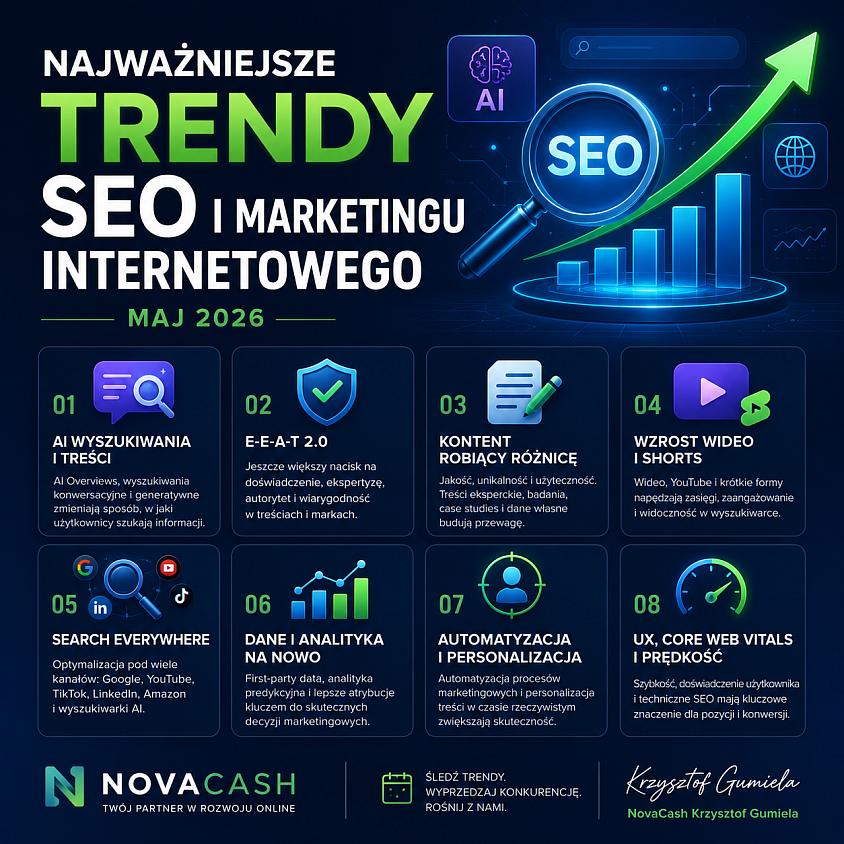
Key SEO and Digital Marketing Trends – May 2026
SEO hasn't disappeared in 2026, but the way users consume information has undergone a fundamental transformation. A growing portion of traffic isn't going directly to websites, but instead ends up in AI-generated responses, such as Google AI Overviews, Gemini, ChatGPT Search, Perplexity, and Copilot. In practice, this means a shift from the classic "ranking → click → page" model to a "AI → response → possible source" model.
For companies and marketers, this means a new reality: it is no longer enough to rank high on Google, you must become a source cited by AI systems.
1. GEO and AEO as a natural extension of SEO
The most important trend of 2026 is the development of GEO (Generative Engine Optimization) and AEO (Answer Engine Optimization), i.e., optimizing content for generative search engines and AI response engines. ( alicelabs.ai )
Just a year ago, GEO was treated as a separate field, but now Google officially announces that GEO and AEO are modern SEO tailored to AI search. ( Search Engine Journal )
Key changes include:
- content optimization for citations via AI,
- building entity authority (entity SEO),
- structuring responses,
- increasing the credibility of sources,
- creating answer-first content.
The best performing content in 2026 is:
- expert guides,
- data analysis,
- case studies,
- FAQs,
- experience-based rankings,
- content containing specific numbers and sources.
2. "Position #1" is losing its importance
In the era of AI Search, more and more users are getting answers without having to click through to search results. Industry analyses indicate that the presence of AI Overviews significantly reduces organic search CTR. ( LLM Intel )
The new key performance indicators (KPIs) are:
- visibility in AI responses,
- number of brand citations,
- share in the generated responses,
- entity recognition,
- presence in training data and retrieval systems.
Brands are starting to monitor:
- does ChatGPT know their company,
- how Perplexity describes their products,
- whether Gemini quotes their content,
- which sources AI considers most reliable.
3. EEAT and authenticity come first
The mass production of generic AI-generated content has led to a content overload. As a result, search systems are increasingly rewarding:
- author's experience,
- authentic opinions,
- unique data,
- expertise,
- reputation signals.
Reddit, industry forums, YouTube, and user reviews have become key data sources for AI search. ( Wall Street Journal )
Google and LLM systems are becoming increasingly effective at detecting:
- AI content devoid of value,
- "SEO spam",
- artificially generated rankings,
- AI search manipulation. ( The Verge )
In practice, this means the end of:
- mass automatic production of texts,
- keyword stuffing,
- thin content,
- content farms.
4. Entity SEO is gaining importance at the expense of classic keywords
AI algorithms no longer understand just phrases, but also entire entities, such as:
- brands,
- people,
- products,
- organizations,
- locations,
- relationships between them.
Effective SEO in 2026 is based on:
- building a coherent brand presence,
- using schema.org structured data,
- ensuring the consistency of information across the internet,
- digital PR,
- presence in reliable sources.
AI prefers brands characterized by:
- strong signals of authority,
- confirmed data,
- high information consistency. ( TechRadar )
5. Content designed for AI retrieval
Modern content creation has evolved. The best performing materials now include:
- modular,
- semantically ordered,
- containing short definitions,
- based on user questions,
- easy to quote.
The following are becoming increasingly popular:
- TL;DR sections,
- answer blocks,
- FAQ schema,
- data tables,
- step by step lists,
- quotable paragraphs.
AI is particularly effective at indexing:
- specific answers,
- numerical data,
- statistics,
- definitions,
- comparisons.
6. Video and YouTube are growing faster than traditional content
AI search is increasingly leveraging multimedia content. Google Gemini is heavily integrating YouTube with AI results. ( Wall Street Journal )
In 2026 the importance of:
- short expert materials,
- podcasts,
- webinars,
- video tutorials,
- SEO for transcripts.
Optimized video:
- increases brand visibility,
- improves EEAT signals,
- builds expert authority,
- supports visibility in AI Overviews.
7. The evolution of search intent into conversation intent
Users increasingly do not type phrases, but engage in conversation with AI.
Traditional SEO example:
"running shoes ranking"
Example of new AI search:
“What running shoes should I choose for asphalt for a person weighing 90 kg?”
This forces us to change our content strategy to:
- less focus on keywords,
- greater focus on real user problems.
The importance of:
- long-tail intent,
- semantics,
- natural language,
- conversational UX.
8. AI visibility monitoring is becoming standard
Companies are starting to measure:
- brand share in AI responses,
- sentiment generated by models,
- frequency of citations.
New monitoring tools are emerging:
- visibility in ChatGPT,
- presence in Gemini,
- citations in Perplexity,
- AI brand tracking. ( TechRadar )
This represents an entirely new field of marketing analytics.
9. Structured data remains crucial
Despite Google's official declarations that "magic GEO optimizations" are unnecessary, structured data still helps AI systems understand page content. ( Search Engine Journal )
The most important schema types in 2026 are:
- FAQPage,
- Organization,
- Product,
- Article,
- Person,
- Review,
- HowTo.
However, it is worth remembering that schema supports, but does not replace, the quality of content.
10. llms.txt - a loud but still ambiguous trend
One of the most hotly debated topics of 2026 is the llms.txt file, referred to by some in the industry as the "robots.txt for AI." ( seoscore.tools )
The problem is that:
- Google officially declares that it does not use llms.txt in AI Search rankings, ( Search Engine Journal )
- most major models have not confirmed full support for this standard. ( DerivateX )
Despite this, many companies are implementing llms.txt experimentally, preparing for the future development of AI search.
What does an effective SEO strategy look like in 2026?
Modern SEO currently combines:
- classic technical SEO,
- content marketing,
- digital PR,
- brand building,
- visibility in AI,
- structured data,
- optimization for language models.
The most important are:
- brand authority,
- quality and uniqueness of content,
- expertise,
- content citation,
- visibility in AI search,
- user trust.
Summary
May 2026 clearly shows that SEO is not disappearing, but evolving towards AI Search Optimization.
Companies that still focus solely on:
- positions,
- keywords,
- classic link building,
lose to brands that build:
- authority,
- expertise,
- visibility in AI responses,
- presence in generative ecosystems.
The new goal of online marketing is no longer just to get clicks, but above all to become a source trusted by artificial intelligence.
