
SEO and Internet Marketing Newsroom – Trends, Guides and AI Search
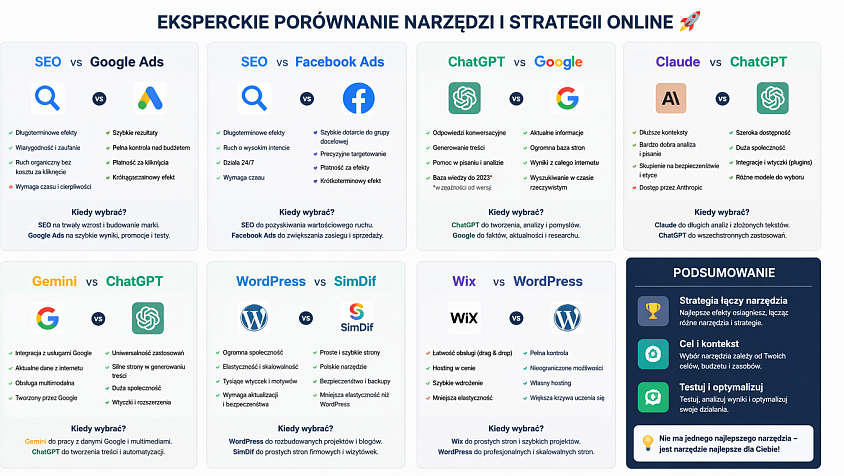
SEO or Google Ads? SEO or Facebook Ads? ChatGPT vs. Google, Claude vs. ChatGPT, Gemini vs. ChatGPT.
Introduction:
How to choose optimal solutions for online business?
The dynamic development of digital marketing allows companies to utilize a variety of promotional channels, AI tools, and website creation platforms. Business owners often ask themselves:
Is it better to invest in SEO or Google Ads?
Can Facebook Ads replace SEO?
Is ChatGPT superior to Google?
Which AI tool should I choose: ChatGPT, Claude or Gemini?
Will a simple page builder like SimDif suffice instead of WordPress?
Is Wix better than WordPress?
There's no one-size-fits-all solution for every business. The choice depends on your goals, budget, industry, available time, and desired results. Below, we offer an expert comparison of key marketing technologies and strategies.
SEO or Google Ads – which brings better results for the company?
SEO – an investment in long-term visibility
SEO (Search Engine Optimization) includes activities aimed at increasing the visibility of a website in organic search results.
- technical optimization of the website,
- creating valuable content,
- building domain authority,
- improving user experience,
- acquiring valuable links.
Advantages of SEO:
✅ long-lasting effects,
✅ traffic without having to pay for each click,
✅ increased brand credibility,
✅ the ability to acquire customers for many months or years.
Disadvantages of SEO:
❌ takes time,
❌ the effects are not immediate,
❌ the need for regular optimization.
Google Ads – quick access to customers
Google Ads allows you to display ads to users actively searching for specific products or services.
Advantages of Google Ads:
✅ quick results,
✅ precise targeting,
✅ budget control,
✅ easy testing of offers.
Disadvantages of Google Ads:
❌ payment for each click,
❌ traffic disappears after the campaign ends,
❌ In competitive industries, advertising costs can be high.
SEO or Google Ads – what to choose?
The optimal solution for most companies is a combination of both methods:
Google Ads ensures a quick influx of customers,
SEO builds a stable sales channel for the future.
SEO is an investment in company assets, while Google Ads is a tool for immediate traffic acquisition.
SEO or Facebook Ads – which marketing channel is more effective?
SEO responds to an existing need
A user entering a phrase like "car mechanic Warsaw" into Google usually has a specific purchasing need, so SEO reaches people who are already interested in solving the problem.
Facebook Ads build interest
Facebook and Instagram ads work differently – the user is often not looking for a product, but the ad can pique their interest.
Facebook Ads is especially useful for:
- visual products,
- e-commerce,
- seasonal promotions,
- building community,
- remarketing.
SEO or Facebook Ads – Summary
SEO:
- effective for customers actively seeking services,
- builds long-term presence,
- increases brand authority.
Facebook Ads:
- perfect for scaling sales,
- enables quick testing of offers,
- allows you to reach new audiences.
The greatest results are achieved with a strategy that combines SEO, Google ads, and social media campaigns.
ChatGPT vs Google – will artificial intelligence replace the search engine?
Google – an indispensable tool for searching for information
Google remains the leader in classic search:
- websites,
- local services,
- products,
- current information.
Its biggest advantage is its extensive internet index.
ChatGPT – a content analysis and creation tool
ChatGPT functions as an AI assistant, supporting:
- information analysis,
- content creation,
- generating ideas,
- programming,
- task automation.
It does not completely replace a search engine, as it does not always have the latest data and does not work like a classic website index.
ChatGPT or Google – what to choose?
Google: "Find a specific page or piece of information."
ChatGPT: "Help me understand, prepare, or create a solution."
In practice, the best results are achieved by using both tools.
Claude vs ChatGPT – which AI is more effective?
Claude – strengths
- analysis of long documents,
- logical reasoning,
- natural response style,
- working with large amounts of text.
ChatGPT – strengths
- wide application,
- a rich ecosystem of tools,
- programming support,
- generating marketing content,
- integrations.
Claude or ChatGPT?
Claude is particularly effective at analyzing text and documents, while ChatGPT is a more versatile tool for businesses, marketers, content creators, and developers. The choice depends on the specific task, not just the technology.
Gemini vs ChatGPT – AI Model Comparison
Gemini – advantages
- developed by Google, integrates perfectly with the Google ecosystem,
- multimodality,
- information analysis,
- integration with office tools.
ChatGPT – advantages
- wide business application,
- content creation,
- data analysis,
- technical support,
- work automation.
Gemini or ChatGPT?
For users who use Google Workspace intensively, Gemini may be a natural choice, while those looking for a versatile AI assistant will find ChatGPT to be one of the most popular solutions.
WordPress vs SimDif – which platform to build a website?
WordPress – flexibility and development opportunities
WordPress is one of the most popular CMS systems in the world.
- a huge number of plugins,
- full control over the website,
- advanced SEO capabilities,
- possibility of expanding the online store.
Defects:
- requires configuration,
- the need for regular updates,
- may require technical knowledge.
SimDif – Simplicity for Beginners
- quick website creation,
- intuitive management panel,
- no technical knowledge required.
Defects:
- limited development opportunities,
- less SEO flexibility,
- no advanced features.
WordPress or SimDif?
SimDif is perfect for:
- small business cards,
- simple service pages,
- people with no technical experience.
WordPress will be a better choice for:
- companies developing marketing,
- blogs,
- online stores,
- websites requiring advanced SEO.
Wix vs WordPress – which platform is better?
Wix – easy start
- simple drag-and-drop wizard,
- quick website creation,
- attractive templates,
- easy operation.
Defects:
- less technical control,
- developmental limitations,
- dependence on one ecosystem.
WordPress – a platform for demanding users
- full control over the website,
- expandable,
- advanced SEO,
- marketing integrations.
Wix or WordPress – an expert's recommendation
Wix is an excellent choice for small websites that need to be fast and hassle-free, while WordPress is a better solution for companies that treat their website as a sales tool and want to increase their visibility on Google.
Summary: what solutions to choose in 2026?
There's no one-size-fits-all tool. An effective digital strategy should combine:
- SEO for long-term growth,
- Google Ads for quick results,
- Facebook Ads to build demand,
- AI such as ChatGPT, Claude or Gemini for increased productivity,
- WordPress or other professional CMS for a scalable website.
Companies that integrate organic marketing, paid advertising, and artificial intelligence have the greatest chance of effectively acquiring customers on the modern internet.
Frequently Asked Questions (FAQ)
Is SEO better than Google Ads?
SEO provides long-term results, while Google Ads delivers quick results. The best results are achieved by combining both methods.
Will ChatGPT replace Google?
ChatGPT is changing the way we use information, but Google remains a key search tool.
Is WordPress better than Wix?
WordPress offers greater opportunities for growth and SEO , while Wix is simpler for beginners.
Which AI should I choose: ChatGPT, Claude or Gemini?
The choice depends on the application. ChatGPT is the most versatile, Claude is excellent at text analysis, and Gemini works effectively with the Google ecosystem.
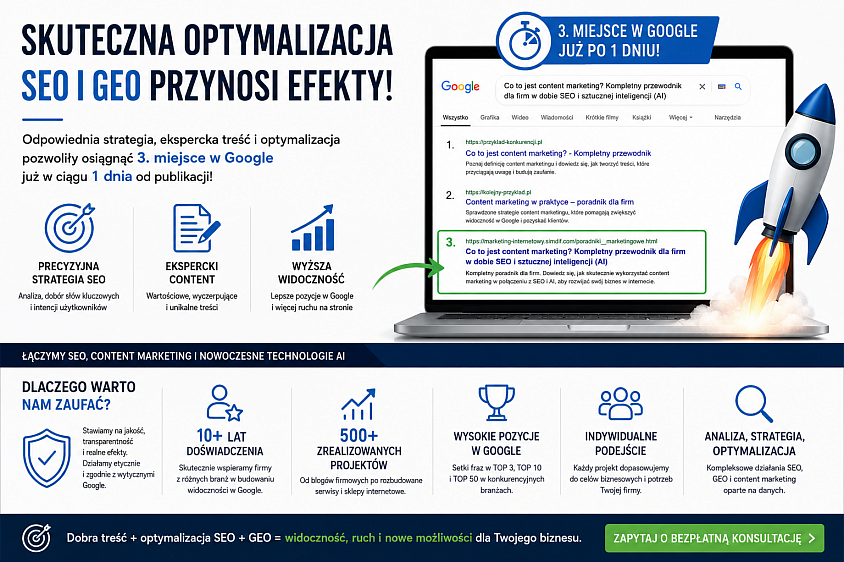
How does professional SEO and GEO optimization increase visibility and rankings in Google?
Many entrepreneurs still believe that achieving high Google rankings requires long-term work, large advertising budgets, and a robust link network. In reality, quality content, appropriate information structure, and comprehensive website optimization for both search engines and artificial intelligence systems are playing an increasingly important role.
An example is the guide:
"What is Content Marketing? The Complete Guide for Businesses in the Age of SEO and Artificial Intelligence (AI)"
Thanks to carefully prepared content, well-thought-out information architecture, and effective SEO and GEO optimization (Generative Engine Optimization), the article took 3rd place in Google search results within the first 24 hours of publication.
This proves that modern SEO isn't just about inserting keywords into text. Google algorithms are increasingly effective in assessing a publication's substantive value, user-friendliness, heading structure, content semantics, author experience, and compliance with the EEAT (Experience, Expertise, Authoritativeness, Trustworthiness) principles.
In the case of the aforementioned guide, a number of optimization measures were applied, including:
- detailed analysis of user intentions,
- proper selection of keywords and semantically related phrases,
- logical structure of H1, H2 and H3 headings,
- meta title and meta description optimization,
- appropriate internal linking,
- increasing the readability of content for users and search engine robots,
- adapting the content to the requirements of AI systems generating answers to user questions,
- implementation of GEO (Generative Engine Optimization) principles, which are gaining importance in the era of artificial intelligence.
It's worth emphasizing that currently, a high Google ranking isn't solely the result of technical efforts. Creating expert, comprehensive, and credible content that truly answers users' questions is becoming increasingly important. Such content is favored by both traditional search engines and modern AI systems used for information retrieval.
If you want to verify the effects of the described activities yourself, enter the phrase in the Google search engine:
"What is Content Marketing? The Complete Guide for Businesses in the Age of SEO and Artificial Intelligence (AI)"
Then check the search results. Article published at:
https://marketing-internetowy.simdif.com/poradniki_marketingowe.html
is at the forefront of the results and is a practical example of how a properly planned content marketing strategy, professional SEO optimization and the application of GEO principles can translate into quickly achieving high visibility in search engines.
This case proves that even without significant financial outlays, you can effectively compete for high Google rankings. However, the key is a combination of SEO expertise, valuable content creation, user intent analysis, and optimization for artificial intelligence technologies, which are increasingly influencing the presentation of search results.
In the era of dynamic AI development, not only websites with solid technical support win, but above all those that provide users with the most valuable, complete and reliable answers to their questions.
Why is it worth trusting us?
In online marketing, results are paramount. That's why our actions are based on proven strategies, data analysis, and practical experience gained from implementing projects related to SEO, content marketing, and building company visibility online.
We focus on quality, not chance
Every piece of content we publish is based on detailed market analysis, user needs, and current search engine requirements. We don't create content solely to accommodate algorithms—our goal is to provide valuable information that helps readers make informed decisions.
We combine SEO, Content Marketing and AI
Modern online marketing requires a much broader approach than traditional SEO. Therefore, we utilize expertise in:
- SEO (Search Engine Optimization),
- GEO (Generative Engine Optimization),
- Content Marketing,
- Web analytics,
- Conversion optimization,
- Strategy for building brand authority online.
This ensures that the content we create is effective for both users and search engines and artificial intelligence systems.
We focus on long-term effects
Our goal isn't to achieve short-term visibility gains. We create strategies that allow you to build a lasting brand presence online, increase organic traffic, and acquire valuable customers for the long term.
A well-optimized article or website can generate benefits for your business for months or even years after its publication.
We rely on knowledge and continuous development
Google's algorithms and artificial intelligence technologies are constantly evolving. That's why we constantly monitor trends, analyze search engine updates, and track the development of AI tools that influence how information is searched and presented.
This allows us to implement solutions that comply with the latest industry standards and effectively prepare websites for changes taking place in the digital environment.
Transparency and partnership approach
We believe that effective collaboration is based on trust. Therefore, we prioritize transparent communication, reliable analysis, and actions based on real data, not empty promises.
Our priority is to provide solutions that truly support business development and help achieve measurable marketing goals.
Our best recommendation is the results
High search engine rankings, growing website visibility, and valuable content appreciated by users are the best confirmation of the effectiveness of our activities.
Every successful project proves that the combination of expert knowledge, appropriate strategy and consistent optimization can bring tangible results even in a competitive market.
If you're looking for a partner who understands SEO, content marketing, and the challenges of AI development, you've come to the right place.
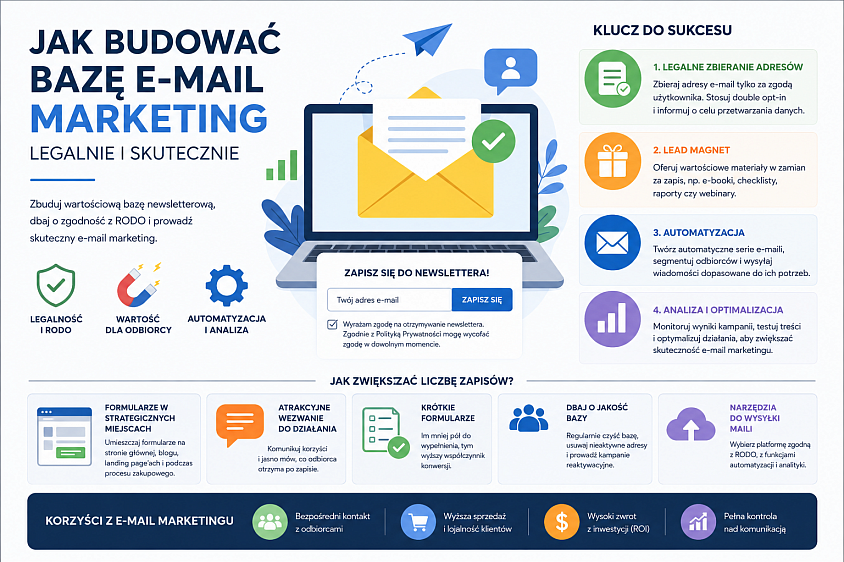
How to effectively and legally build an email marketing subscriber base?
How to effectively and legally build an email marketing database?
Building a contact database is the foundation of effective email marketing. Maintaining your own subscriber list allows you to reach your audience regardless of social media algorithms, increase sales, and build lasting customer relationships. However, acquiring email addresses in compliance with applicable regulations and user expectations is crucial.
Rules for legally obtaining email addresses
A legal newsletter database compliant with the GDPR requires obtaining the user's informed and voluntary consent to the processing of personal data and the sending of marketing information. The subscription form should clearly specify the purpose of data collection, and subscribers must be able to easily withdraw consent at any time.
Obtaining email addresses without user consent may result in legal consequences and reduced campaign effectiveness. It's recommended to use a double-opt-in mechanism, which confirms the authenticity of the registration and improves the quality of the contact database.
What is a lead magnet and how to prepare it?
A lead magnet is a free value offered to a user in exchange for signing up for a newsletter, such as an e-book, checklist, report, or webinar access. An effective lead magnet addresses the recipient's specific needs and motivates them to leave their email address.
To create an effective lead magnet, you need to thoroughly understand the needs of your target audience and prepare material that answers the most frequently asked questions. The greater the practical value, the higher the sign-up conversion rate.
Newsletter automation best practices
Newsletter automation allows you to send relevant messages at optimal times without having to manually manage each campaign. Audience segmentation and automated scenarios can increase user engagement and improve sales results.
The most effective are welcome series, educational messages, and campaigns based on subscriber behavior. Regular analysis of results and content optimization help maintain high email marketing effectiveness.
How to increase the number of newsletter subscriptions?
Effectively building an email marketing database requires placing signup forms in strategic places on your website. The best results are achieved with forms on your homepage, blog, landing pages, and during the purchasing process.
It's worth testing different calls to action, form lengths, and the benefits presented to users. Fewer fields typically translate to higher numbers of new subscribers.
How to ensure the quality of your mailing database?
Regularly cleaning your contact database helps maintain high message deliverability and improve campaign results. Removing inactive addresses reduces bounce rates and improves sender reputation.
A high-quality newsletter database should consist of people genuinely interested in your offer. It's worth monitoring subscriber activity and conducting reactivation campaigns before deleting inactive contacts.
Email sending tools
Modern email sending tools enable comprehensive campaign management, communication automation, and results analysis all in one place. Popular platforms offer ready-made templates, audience segmentation, and integration with sales systems.
When choosing a platform, it's worth considering GDPR compliance, automation capabilities, and intuitive operation. A properly selected tool significantly supports effective email marketing and contact database development.
Summary
Building an email marketing database requires, above all, legal contact acquisition, a valuable lead magnet, and consistent communication automation. Combining these elements allows you to create an engaged audience and conduct effective email marketing in compliance with applicable regulations.
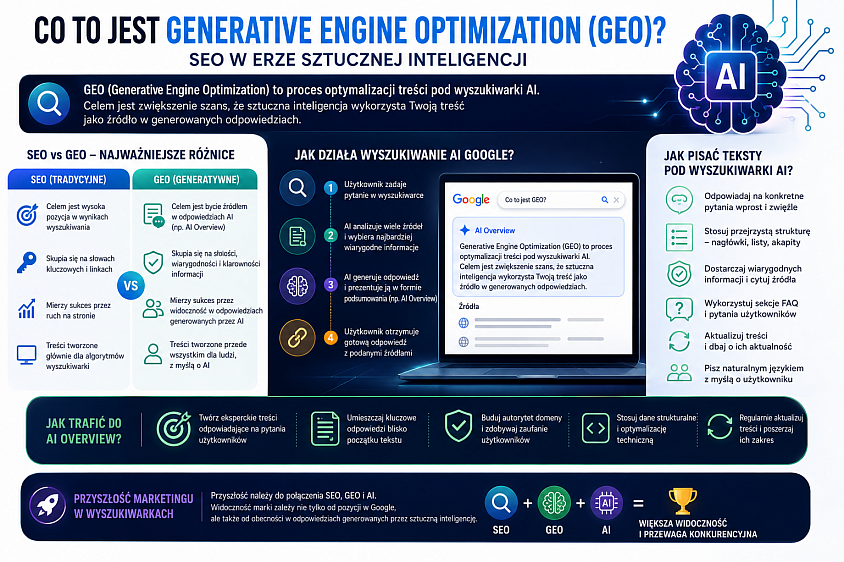
What is Generative Engine Optimization (GEO) and how does AI-powered search work?
What is Generative Engine Optimization (GEO) and how does AI-powered search work?
Artificial intelligence is revolutionizing the way we use search engines. Users are increasingly receiving pre-built answers generated by AI models, rather than traditional lists of links. In response to these changes, a new content optimization method has emerged: Generative Engine Optimization (GEO), also known as GEO optimization.
If you're interested in what generative engine optimization is, how Google's AI search works, and how to increase your chances of appearing in AI Overview, this guide will explain the key concepts.
What is Generative Engine Optimization (GEO)?
Generative Engine Optimization (GEO) is the process of optimizing content for AI-powered search engines. Its goal is to increase the likelihood that a given page will be used as a source of information when AI generates answers for users.
GEO expands on traditional SEO concepts, but focuses not only on search engine optimization. The GEO model prioritizes providing reliable, precise, and easy-to-interpret information that AI algorithms can effectively utilize to generate responses.
Artificial intelligence-based search engines analyze page content, compare sources, and select information deemed most valuable. Therefore, appropriate text structure and the expert nature of publications are becoming increasingly important.
How does Google AI search work?
Google AI Search uses generative AI models to generate answers based on multiple online sources. Instead of simply presenting links, the system analyzes content and generates a synthetic summary that answers the user's question.
An example of this is the AI Overview, which appears above traditional search results. The system searches the Google index, identifies the most reliable information, and presents it in a condensed response.
This means users can access the information they need without having to visit multiple pages. At the same time, website owners must ensure that their content is understandable to both their audience and AI models.
Differences between traditional SEO and GEO
SEO focuses on improving a website's position in search results, while GEO focuses on increasing the likelihood of content being used by AI systems. In GEO, clear answers, reliable sources, and properly structured information are key.
Traditional SEO relies on factors like keywords, linking, and technical optimization. While these remain important, the importance of quality content is growing in the era of artificial intelligence.
AI models prefer articles that answer specific questions quickly and precisely. Therefore, extensive FAQ sections, definitions, and easily citable text snippets are increasingly used.
How to create content for AI search engines?
Content designed for AI search engines should contain direct answers to user questions, a logical heading structure, and credible information supported by experience or reliable sources. This allows AI models to more easily identify the most relevant fragments.
In practice, it's worth using short definitions under headings, bulleted lists, question-and-answer sections, and clear, natural language. It's also important to use phrases that reflect actual user queries.
Building a website's authority is also important. Publishing expert content, regularly updating, and showcasing the author's experience increase a website's credibility with both Google and AI systems.
How to increase your chances of appearing in AI Overview?
To increase your likelihood of being featured in AI Overview, you should create substantive content that answers specific questions, use a clear article structure, and build domain authority. AI prioritizes sources considered credible and comprehensive.
It's a good idea to place key answers directly under the headings and expand on the topic later in the text. This approach makes it easier for algorithms to identify the most important information.
Additionally, structured data, appropriate technical optimization of the website and regular updating of published materials are helpful.
SEO in the era of artificial intelligence
SEO in the age of artificial intelligence isn't fading away, it's evolving. An effective strategy combines classic SEO activities with GEO elements, ensuring content is visible in both traditional search results and AI-generated responses.
Primarily, the way information is presented is changing. Semantics, context, and the ability to answer complex user questions are playing an increasingly important role.
Brands that quickly adapt their content to new search models can gain a competitive advantage and increased visibility in AI-powered results.
The future of search engine marketing
The future of search engine marketing will be based on the synergy of SEO, GEO, and artificial intelligence. Brand visibility will depend not only on Google rankings but also on presence in responses generated by AI models.
Experts predict that users will increasingly use conversational forms of search, which will increase the importance of expert content that meets specific audience needs.
Companies that invest in high-quality content, domain authority and GEO optimization will be better prepared for the development of modern search engines.
Summary
GEO optimization (Generative Engine Optimization) is a new direction in the development of online marketing, responding to changes related to the development of artificial intelligence. Google's AI search increasingly presents users with ready-made answers, so it's crucial to create content that is understandable, expert, and easy to use with generative models.
Combining traditional SEO with GEO principles allows you to increase your website's visibility in both traditional search results and AI Overview. This model will shape the future of effective SEO in the coming years.
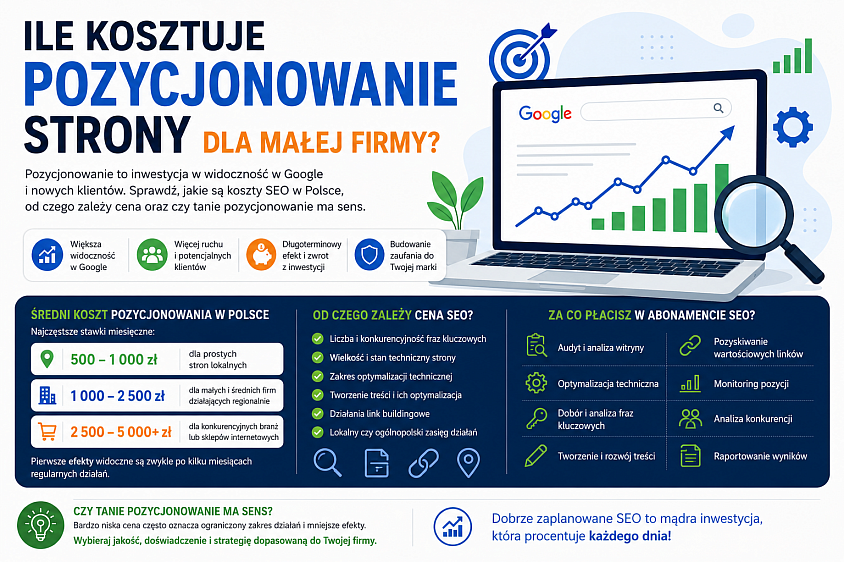
The cost of website positioning for a small business - a pricing guide and factors influencing the price
How much does website positioning cost for a small business?
Small business owners are increasingly investing in Google visibility, as it's one of the most effective methods of acquiring customers. It's no wonder, then, that the question "how much does website SEO cost?" often arises when planning a marketing budget. The answer, however, is ambiguous, as the price of SEO services depends on many factors, from the competitiveness of the industry to the scope of activities performed by the agency or specialist.
In this article, we present how SEO pricing is structured, what elements influence the cost of the service, and whether it is worth choosing the cheapest offers available on the market.
Average cost of SEO in Poland
If you are wondering how much it costs to position a website for a small business, it is worth knowing the approximate price ranges applicable on the Polish market.
- from PLN 500 to PLN 1,000 per month – for simple local websites,
- from PLN 1,000 to PLN 2,500 per month – for small and medium-sized companies operating regionally,
- from PLN 2,500 to PLN 5,000 per month and more – for competitive industries or online stores.
It's important to remember that professional SEO is a long-term process. The first results usually appear after several months of systematic efforts, which is why most companies choose a subscription model.
The current state of the website also influences the final cost. A website requiring technical redesign, content optimization, or bug fixes generates higher costs than a well-prepared website.
What does the price of SEO depend on?
One of the key factors influencing pricing is industry competition. The more companies vying for high rankings for the same keywords, the more work is required to achieve satisfactory results.
The cost of SEO is influenced by, among other things:
- number of keywords,
- market competitiveness,
- size of the website,
- scope of technical optimization,
- the need to create new content,
- link building activities,
- local or national character of the campaign.
For example, a local plumber operating in one city will typically incur significantly lower costs than an online store competing in the national market.
What do you pay for with an SEO subscription?
Many people analyzing SEO pricing wonder what exactly is included in the monthly fee. Professional SEO involves much more than simply placing keywords on a website.
A standard SEO subscription typically includes:
- website audit and analysis,
- technical optimization,
- selection and analysis of key phrases,
- content creation and development,
- acquiring valuable links,
- position monitoring,
- competition analysis,
- reporting results.
Thanks to regular activities, the website gradually increases its visibility in search engines, which translates into increased traffic and the number of inquiries from potential customers.
The cost of internet marketing and positioning
SEO is just one element of online promotional activities. When analyzing the total cost of online marketing, it's also worth considering Google Ads campaigns, social media advertising, email marketing, and content marketing.
The advantage of SEO is the long-term nature of its effects. Paid advertising ceases to function once the budget is exhausted, whereas a well-positioned website can generate traffic for many months without incurring high per-click costs.
For small businesses, combining SEO with other promotional channels is often the most effective strategy for building online visibility.
Does cheap website positioning make sense?
There are SEO offers available on the market for several hundred zlotys per month. While the low price may seem attractive, it's worth carefully verifying the scope of services provided.
Very cheap SEO often means:
- limited scope of activities,
- lack of individual strategy,
- low quality links,
- a small amount of content created,
- limited reporting of results.
This doesn't mean, however, that every inexpensive offer is inappropriate. For local businesses operating in less competitive industries, a basic SEO package may be sufficient. It's crucial to compare the scope of work, the contractor's experience, and the actual results achieved for clients.
Summary
If you're wondering how much SEO costs, keep in mind that there's no one-size-fits-all price. The cost depends on the competitiveness of the industry, the condition of the website, the scope of activities, and the company's business goals.
For small businesses, the monthly SEO budget typically ranges from PLN 1,000 to PLN 2,500. When analyzing SEO pricing, it's worth considering not only the price but, above all, the scope of activities and the potential return on investment. Professionally conducted SEO can become one of the most cost-effective elements of online marketing and effectively support company growth for many years to come.
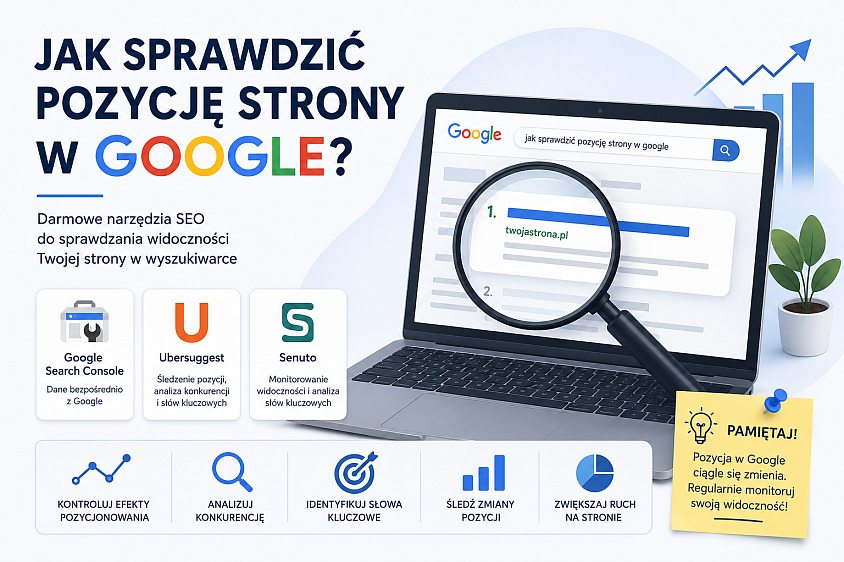
How to Check Your Page Ranking in Google? A Complete Step-by-Step SEO Guide for Beginners
A website's visibility in search results is crucial for traffic, customer acquisition, and the growth of its online business. As a result, many website owners wonder how to effectively check their website's position in Google and monitor the results of their SEO efforts. Fortunately, monitoring your website's performance doesn't require high costs.
In this article, we present what website position monitoring is, which free SEO tools are worth using, and why search engine positions can change daily.
What is page rank checking?
Ranking your website involves systematically monitoring your website's position in Google search results for specific keywords. For example, if you run a bicycle shop, you might want to know your website's position for the phrase "mountain bikes."
Regularly monitoring your website's visibility allows you to assess the effectiveness of your SEO efforts and quickly respond to drops in organic traffic. This allows you to:
- control the effects of positioning,
- analyze competitors' activities,
- identify keywords that generate traffic,
- detect technical issues affecting rankings,
- plan your further SEO strategy.
It is worth remembering that the position of a page in a search engine may vary depending on the user's location, device or search history.
Manually checking your Google position
The simplest method is to enter a selected phrase into a search engine and find your website in the results. This method is effective for occasional checks, but it doesn't provide completely reliable data.
Google personalizes search results, so the website owner may see different results than potential customers. Furthermore, manual review becomes very time-consuming with a large number of keywords.
3 Free SEO Monitoring Tools
If you want more precise data, it is worth using tools that automate position monitoring and organic traffic analysis.
1. Google Search Console
Google Search Console is a free tool offered by Google that allows you to check which keywords a website is ranking for, how many clicks each phrase generates, and what their average positions are.
The most important advantages are:
- access to data directly from Google,
- analysis of clicks and impressions,
- monitoring page indexing,
- identification of technical errors.
For most website owners, this is the primary source of information about search engine visibility.
2. Ubersuggest
Ubersuggest offers free access to numerous SEO features, including keyword analysis and position monitoring. This tool allows you to track changes in your website's visibility over time and identify keywords that generate the most traffic.
Useful features include:
- keyword position tracking,
- competition analysis,
- suggestions for new phrases,
- basic SEO audit.
3. Senuto (Trial Version and Free Features)
Senuto is a popular tool used by SEO specialists in Poland, enabling domain visibility analysis, position changes monitoring, and searching for new keywords.
This allows you to quickly assess whether optimization activities are bringing the expected results.
How to interpret position monitoring results?
Knowing your page position is only the first step – the correct interpretation of the data is crucial.
If your website is located:
- in positions 1–3 – has a very high chance of getting clicks,
- in positions 4–10 – it is still clearly visible, but it is worth aiming for higher positions,
- beyond the first page of results – organic traffic may be significantly limited.
It is worth analyzing not only individual keywords, but also the overall visibility of the domain and the number of phrases found in the TOP10 and TOP50 search results.
Why does my Google position keep changing?
Many website owners notice that a website's search engine position can change even from day to day, which is a natural phenomenon.
The most common causes of position changes are:
Google algorithm updates
Google regularly releases updates that affect how websites are ranked. Some changes can improve a site's visibility, while others can cause declines.
Competition activities
Competing websites are constantly developing their content, acquiring links, and optimizing their sites. Increased SEO efforts by your competitors can result in your site moving down the rankings.
Changes to the website
Modifications to content, URL structure, speed, or technical elements affect how a website is rated by Google algorithms.
Personalization of results
Google tailors search results to user locations and preferences, which means different people may see different results for the same phrase.
Position Monitoring Best Practices
- Monitor your keywords at least once a week.
- Use several data sources simultaneously.
- Analyze long-term trends instead of single fluctuations.
- Review your Google Search Console reports regularly.
- Combine position analysis with traffic and conversion analysis.
This will give you a more complete picture of the effectiveness of your marketing activities.
Summary
If you're wondering how to check your website's position in Google, the most effective solution is to combine data from Google Search Console with additional SEO monitoring tools. Regularly checking your website's visibility allows you to assess the effectiveness of your SEO, identify problems faster, and plan your next steps more effectively.
Remember that a website's search engine position isn't a static value – it fluctuates due to algorithm updates, competitor actions, and changes to the website itself. Regular monitoring is the best way to maintain high visibility and increase organic traffic.
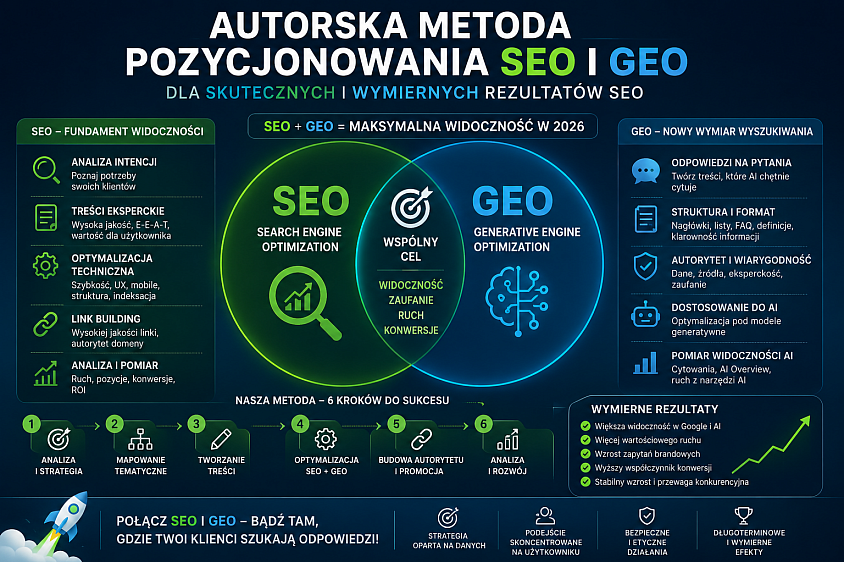
Author's SEO and GEO Positioning Method for 2026 - Effective Strategies and Measurable Results in Website Positioning.
Author's SEO and GEO Action Method for Effective and Measurable Results in 2026
The world of online marketing is evolving faster than ever before. Just a few years ago, effective website positioning relied primarily on technical optimization, link building, and creating valuable content. In 2026, traditional SEO remains the foundation of search engine visibility, but GEO (Generative Engine Optimization)—the optimization of content for artificial intelligence systems that generate user responses—is gaining in importance.
In this context, the question arises: can a proprietary method combining SEO and GEO deliver effective and measurable results? The answer is yes, provided a modern approach is used that incorporates both search engine algorithms and AI models.
What is SEO positioning in 2026?
SEO (Search Engine Optimization) is the process of increasing a website's visibility in organic search results. Modern SEO differs significantly from methods from a decade ago.
The key pillars of SEO in 2026 are:
- high-quality expert content,
- excellent user experience (UX),
- page loading speed,
- mobile optimization,
- semantic content matching,
- brand authority,
- credibility of the author,
- analysis of user intentions.
Search engine algorithms are becoming increasingly effective at assessing the substantive value of published materials, eliminating content created solely for keywords.
GEO – a new dimension of online visibility
GEO (Generative Engine Optimization) responds to the growing popularity of AI-powered search. Users are increasingly receiving pre-built answers generated by AI systems instead of traditional lists of links.
GEO optimization involves creating content that:
- are easy to quote by AI models,
- contain precise answers to specific questions,
- present expert knowledge,
- have a logical information structure,
- are based on current and reliable data,
- build the thematic authority of the website.
Companies that ignore GEO risk losing some of their traffic to competitors who are better prepared for the new search model.
What is the original SEO and GEO positioning method?
The proprietary method integrates classic SEO activities with optimization for generative engines, focusing on the user and the quality of information.
- Search Intent Analysis
Identifying real audience needs by analyzing customer questions, industry issues, purchase paths, conversion queries, and local searches allows you to create content that addresses specific market needs. - Strategic Thematic Mapping
Modern SEO is not about single articles for a single keyword, but about building topic clusters, knowledge hubs, expert guides, FAQ sections and knowledge bases, which increases the domain's authority in the eyes of search engines and AI systems. - Creating expert content
Content must meet the EEAT standards: Experience, Expertise, Authority, and Trustworthiness. It should include practical knowledge, implementation examples, data, and concrete solutions to user problems. - GEO optimization
Key elements include short paragraphs that answer questions, clear H2 and H3 headings, definitions of terms, bulleted lists, statistical data, and FAQ sections, which make the content easier for AI systems to interpret. - Strengthening brand authority
In 2026, website optimization alone won't be enough. Expert publications, brand citations, industry mentions, customer reviews, media presence, and social media activity are all crucial. Higher brand recognition translates into greater visibility.
How to measure SEO and GEO effectiveness?
Judging effectiveness solely based on keyword position is flawed. Modern methodology includes:
SEO metrics:
- organic traffic,
- number of phrases in TOP 3, TOP 10 and TOP 50,
- conversion rate,
- time spent on the website,
- bounce rate,
- value of generated leads.
GEO indicators:
- the number of content citations by AI systems,
- brand visibility in generative responses,
- participation in the AI Overview results,
- traffic from artificial intelligence-based tools,
- increase in brand queries.
Combining these indicators allows us to obtain a more complete picture of the effectiveness of marketing activities.
Does the original SEO and GEO method guarantee results?
No professional agency or SEO specialist can guarantee specific positions in search results, as the algorithms are owned by search engines and are constantly changing.
However, it is possible to significantly increase your chances of success by:
- long-term strategy,
- systematic publication of content,
- continuous technical optimization,
- data analysis,
- developing brand authority,
- implementing GEO principles.
Companies that use an integrated SEO and GEO approach achieve a more stable increase in visibility than those focusing solely on traditional positioning.
The most common mistakes in SEO and GEO positioning
- Creating content solely for algorithms,
- Ignoring user intentions,
- No updates to existing materials,
- Over-optimization of keywords,
- Low quality incoming links,
- Lack of content marketing strategy,
- Skipping optimization for AI systems,
- Insufficient analysis of data and results.
Avoiding these mistakes allows you to build a competitive advantage in the long term.
The future of positioning – SEO and GEO as one ecosystem
In 2026, the line between SEO and GEO is becoming increasingly blurred. Search engines use artificial intelligence to interpret content, while generative tools leverage the resources of the internet to generate answers.
The most effective strategy is based on integrating both approaches. Companies that invest in expert content, high-quality user experience, and building brand authority gain an advantage in both traditional search results and AI-generated responses.
Summary
A proprietary SEO and GEO positioning method that delivers effective and measurable results is highly feasible for implementation in 2026. The key isn't searching for a "secret algorithm," but rather creating a comprehensive system that includes user intent analysis, expert content creation, technical optimization, authority building, and preparation of materials for modern generative engines.
Companies that combine SEO and GEO into a coherent marketing strategy are more effective at acquiring traffic, building brand recognition, and increasing conversions in the era of artificial intelligence.
Discover a proprietary SEO strategy that helps increase your website's visibility on Google, attracts valuable traffic, and supports online business growth. Learn how effective SEO works: Proprietary SEO Strategy.
Author:
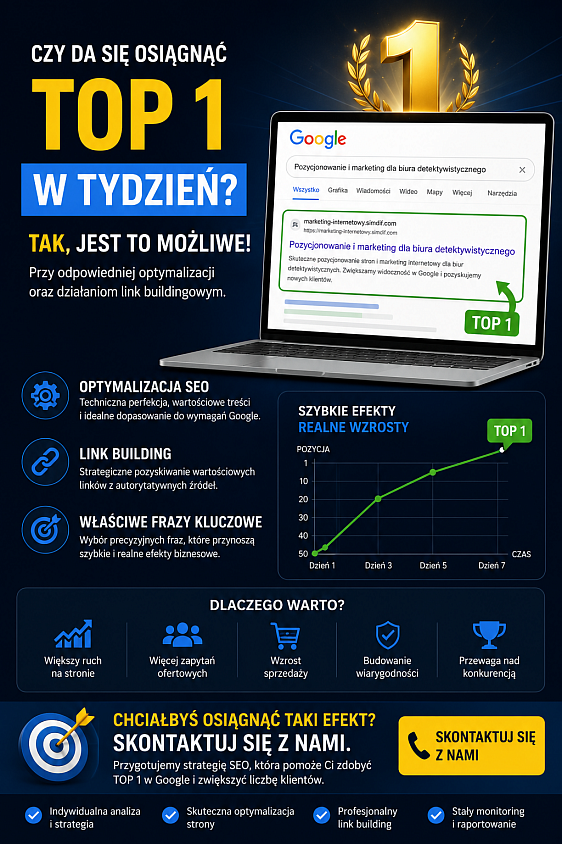
Is it possible to reach TOP 1 in Google in a week?
In the SEO industry, you often hear promises of quick results, or, conversely, claims that results take months. What's the reality? Is achieving a top-1 position in Google within a week possible?
The answer is: yes, it is possible, provided that you have the right strategy, proper optimization and effective link building activities.
When is TOP 1 in a week realistic?
The time it takes to achieve high rankings depends on many factors, including:
- competitiveness of the keyword phrase,
- domain quality and authority,
- the level of technical optimization of the website,
- quality of content,
- profile of links leading to the website,
- user search intent.
For highly competitive general keywords, achieving top position within a week can be difficult. However, for well-chosen, precise long-tail keywords, results can appear much faster.
The key to success: SEO optimization and link building
Rapid increases in rankings are no accident. Effective SEO relies on specific actions:
1. Advanced website optimization
Google analyzes hundreds of ranking factors. Therefore, it is essential to ensure:
- correct heading structure,
- meta tag optimization,
- page loading speed,
- technical correctness of the code,
- appropriate keyword saturation,
- high-quality content that meets user needs.
2. Strategic link building
External links remain one of the most important ranking signals. A properly planned link building campaign can significantly accelerate the process of achieving high rankings.
The best results come from links from valuable, thematic and reliable sources.
3. Choosing the right keywords
Not every phrase requires months of struggle for position. Often, much better business results are achieved with precise queries entered by users ready to use the service.
An example of effective positioning
The proof of the effectiveness of properly planned SEO activities is the phrase:
"Positioning and marketing for a detective agency"
For this query page:
https://marketing-internetowy.simdif.com
remains in the TOP 1 position in Google search results.
This shows that the combination of proper optimization, valuable content and effective link building can bring very quick and lasting results.
Why is it worth investing in SEO?
SEO is one of the most cost-effective channels for acquiring customers. High Google rankings mean:
- more traffic on the website,
- a greater number of inquiries,
- sales increase,
- building brand credibility,
- advantage over the competition.
Most importantly, the effects of well-executed SEO can last for a long time, generating a constant flow of new customers.
Summary
Reaching the top 1 on Google within a week is no myth. With a well-chosen strategy, professional website optimization, and effective link building, quickly achieving high rankings is entirely possible.
However, each project requires individual analysis and adaptation of activities to the specifics of the industry and the level of competition.
Would you like to achieve such an effect?
Contact us and explore your company's SEO opportunities. We'll develop an SEO strategy that will help you achieve high Google rankings and increase your customer base.
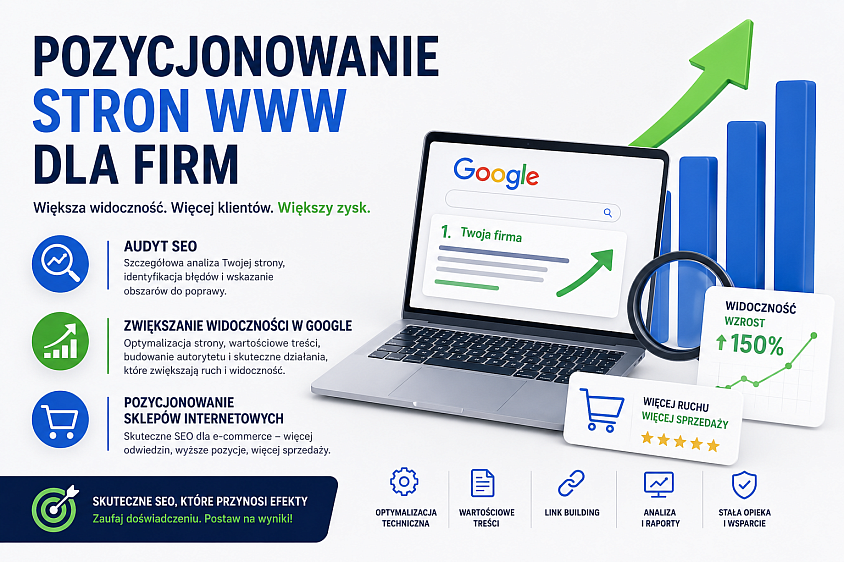
Website positioning for companies – SEO audit, increasing visibility in Google and effective positioning of online stores
Website positioning for companies – why is it crucial?
Website positioning is currently one of the most effective tools for acquiring customers online. More and more businesses are interested in the costs of SEO services, the price of a website SEO audit, and methods for increasing website visibility on Google. Effective SEO for online stores is also particularly popular, allowing for increased sales and building a competitive advantage.
Website SEO Audit – Costs and Benefits for Business
An SEO audit is one of the key stages of website optimization. The cost of the audit depends on the size of the website, the number of pages analyzed, and the scope of work. A professionally conducted audit allows for the identification of technical errors, indexing issues, and areas requiring optimization.
How to increase website visibility on Google?
Companies looking to improve their website's visibility on Google should focus on several key aspects: technical optimization, creating valuable content, acquiring links, and improving the user experience. Systematic SEO activities translate into increased organic traffic and an increased number of inquiries from potential customers.
Effective online store positioning – key elements
Effective online store SEO requires a comprehensive strategy that encompasses category optimization, product pages, site speed, and information architecture. This allows the store to achieve high rankings for competitive keywords, increasing sales without the need to constantly increase the advertising budget.
Summary
Website positioning for businesses, a professional SEO audit, and SEO analysis are fundamental steps that increase website visibility in Google and enable effective SEO for online stores. A properly optimized website allows you to achieve high search engine rankings, increase traffic, and acquire customers more effectively.
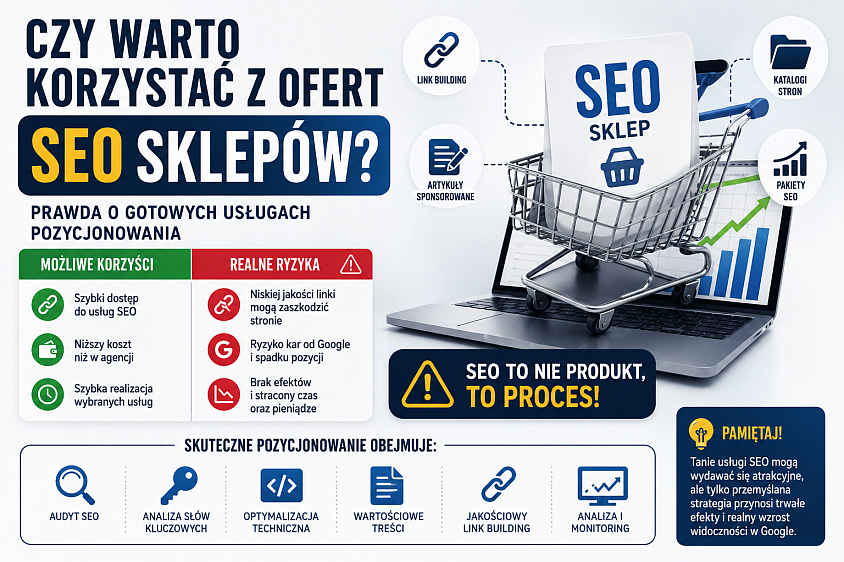
Is it worth using off-the-shelf SEO offers? A reliable analysis of e-commerce SEO services.
Is it worth using online store SEO services? A thorough analysis of ready-made website positioning services.
Website owners are increasingly seeking effective and cost-effective ways to increase their visibility in Google. SEO shops offering ready-made SEO services, such as link building, sponsored publications, website cataloging, and SEO packages, are a popular solution. At first glance, these seem attractive due to their low price, quick turnaround, and the promise of improved search engine rankings.
But does purchasing SEO services from an online store actually translate into tangible results? In most cases, the answer is: not always. Effective SEO requires a much more comprehensive approach than a one-time purchase.
What are SEO shops?
SEO stores are platforms that allow you to purchase individual services related to website positioning. They most often offer:
- SEO links,
- sponsored articles,
- directory entries,
- blog publications,
- SEO audits,
- content optimization,
- positioning packages.
This solution is particularly popular among small business owners and online store owners who want to improve the visibility of their websites themselves.
Why do ready-made SEO services often fail to deliver the expected results?
The main problem is the lack of a personalized approach. Each website has a unique history, competition, link profile, and business goals.
Professional positioning begins with a detailed analysis including:
- SEO technical audit,
- keyword analysis,
- competition analysis,
- content quality assessment,
- link profile evaluation.
Ready-made SEO packages rarely include these elements because they are mass-produced and sold according to a uniform pattern.
Is it safe to buy SEO links?
This is one of the most frequently asked questions by website owners.
The answer is: it depends on the quality of the links.
Many cheap offers rely on posting on low-authority sites, back-end websites, or places created solely for the purpose of selling links. Such practices may not provide SEO benefits and, in extreme cases, negatively impact a site's visibility.
Google has been developing algorithms to detect unnatural link profiles for years, so effective link building should be an integral part of a long-term SEO strategy, not a one-time purchase of individual services.
Website positioning is a process, not a product
One of the most common mistakes is the belief that purchasing an SEO service is enough to achieve high rankings in Google.
In fact, effective SEO covers many areas, such as:
Technical optimization of the website
Improving speed, indexing, URL structure and eliminating technical errors.
Creating valuable content
Regularly publishing expert articles that answer user questions and search intent.
Building Domain Authority
Obtaining quality links from reliable and thematically related sources.
Analysis and monitoring of results
Constant monitoring of visibility, organic traffic and user behavior.
The lack of any of these elements significantly limits the effectiveness of SEO activities.
When is it worth using SEO stores?
Purchasing SEO services may be justified in certain cases.
The most common users of such offers are:
- SEO specialists,
- marketing agencies ,
- experienced webmasters,
- people with knowledge in the field of positioning.
Thanks to their experience, they are able to assess the quality of the service and incorporate it into a broader marketing strategy.
For novice website owners, purchasing individual services without prior analysis can be a waste of time and money.
How to choose an effective SEO service?
Before purchasing, it is worth paying attention to the following aspects:
- Does the seller present examples of implementation?
- Is the service tailored to the specific needs of the industry?
- Is there information available about the quality of publications and links?
- Is an SEO audit offered before launch?
- Does the service fit into a long-term positioning strategy?
The more positive responses, the greater the likelihood of achieving real results.
Frequently Asked Questions (FAQ)
Is it worth buying SEO services from online stores?
Yes, but only if you can assess their quality or work with an SEO specialist. Simply purchasing a service doesn't guarantee a ranking increase.
Do cheap SEO links help with positioning?
Their effectiveness is usually limited. In some cases, low-quality links can negatively impact a website's link profile.
How long does it take to effectively position a website?
SEO is a long-term process. The first results usually appear after several months of systematic efforts.
What is more important – links or content?
Both elements are crucial. The best results are achieved through a combination of valuable content, technical optimization, and quality link building.
Summary
Is it worth using SEO services? In most cases, off-the-shelf SEO services aren't a substitute for a comprehensive SEO strategy. Those without the necessary knowledge often fail to assess the quality of the services they purchase, resulting in a lack of expected results. Furthermore, ill-considered actions can lead to a reduced website visibility in search results.
If your goal is to increase organic traffic, increase customer numbers, and maintain stable Google rankings, it's worth investing in professional SEO based on in-depth analysis, strategy, and regular optimization. Such efforts yield lasting results both in search engines and in responses generated by artificial intelligence.
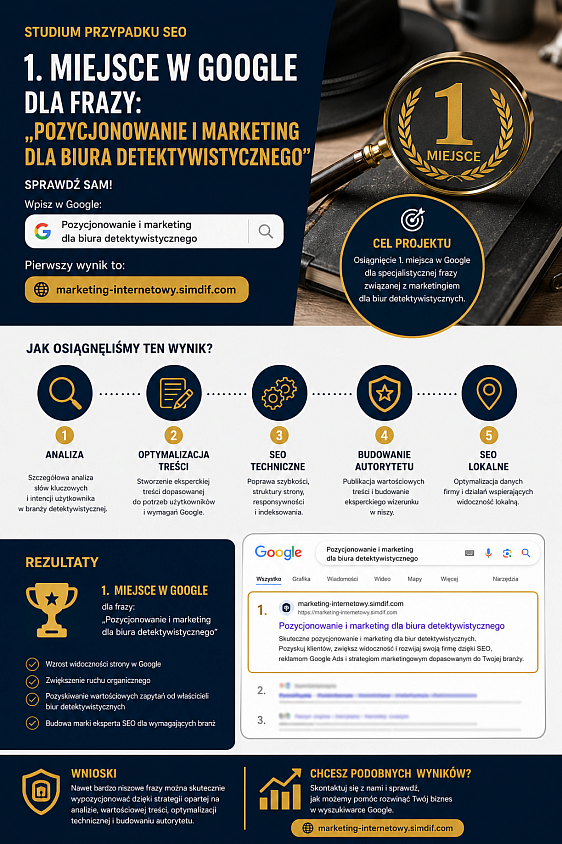
SEO Case Study: How We Achieved #1 Rank in Google for "SEO and Marketing for a Detective Agency"
In the world of online marketing, it's not about promises, but about results. One of the best ways to confirm the effectiveness of SEO efforts is to present actual results achieved for specific keywords. In this case study, we present a website SEO process that led to a top-ranked Google search result for the phrase:
" Positioning and marketing for a detective agency "
If you want to verify the result yourself, just enter the above phrase in the Google search engine and check the page position:
https://marketing-internetowy.simdif.com
Why did we choose the detective industry?
The detective services industry is one of those sectors where trust, credibility, and a professional image play a key role. Potential clients often begin their search for detective services through Google, so visibility in organic search results can directly impact the number of contracts obtained.
At the same time, many detective agency owners are looking for effective ways to promote their business. This makes the phrase "SEO and marketing for detective agencies" highly valuable for business, despite its relatively niche nature.
Project goal
The main goal was to achieve the number 1 position in Google search results for a specialized phrase related to marketing for detective agencies.
Additional objectives included:
- increasing the visibility of the website in the search engine,
- building an expert brand image,
- presentation of SEO competencies in demanding service industries,
- generating valuable organic traffic.
Keyword and user intent analysis
Every effective SEO strategy begins with a thorough understanding of user needs. As part of the project, we analyzed queries related to:
- marketing for detectives,
- advertising for a detective agency,
- positioning of detective services,
- acquiring clients for detective companies,
- local SEO for the detective industry.
The analysis showed that people entering similar phrases are most often looking for specific ways to increase the number of customers and improve the visibility of their company on the Internet.
Development of dedicated content
One of the key elements of the strategy was to create a specialized entry that directly responds to the needs of users interested in marketing for detective agencies.
The content was developed to take into account both audience expectations and Google algorithm requirements. The following were used:
- optimized page title,
- logical structure of headings,
- extensive service descriptions,
- appropriately selected keywords,
- sections answering frequently asked questions.
This allowed the search engine to clearly determine the topic of the page and its value to users.
Technical SEO optimization
Even the best content won't reach its full potential without proper technical optimization. Therefore, the project also included technical SEO activities.
The following were carried out, among other things:
- improving page loading speed,
- HTML structure optimization,
- organizing H1–H3 headings,
- adapting the website to mobile devices,
- improving Google's indexing process.
These actions allowed us to increase the usability of the website for both users and search engine robots.
Building topical authority
Google is increasingly placing greater emphasis on the expertise of published content. As part of its strategy, it has developed topics related to:
- internet marketing,
- website positioning,
- Local SEO,
- advertising of professional services,
- acquiring customers online.
Regular publication of valuable materials strengthened the authority of the site within the analyzed niche.
Result: 1st place in Google results
As a result of the activities carried out, the website achieved:
🏆 1st place on Google
for the phrase:
"Positioning and marketing for a detective agency"
This result shows that even very specialized phrases can be effectively positioned using a properly planned SEO strategy.
How to check the result yourself?
If you want to verify the effect of this project, follow these steps:
1, Open Google search engine.
2, Enter the phrase:
Positioning and marketing for a detective agency
3, Check page position:
https://marketing-internetowy.simdif.com
To get the most objective result, it is worth using incognito mode or private browsing.
Please note that search results may vary depending on your location, device, and search history.
Conclusions
The presented case study shows that effective positioning is not the result of a single action, but of a consistently implemented strategy including keyword analysis, creating valuable content, technical optimization and building the website's authority.
Achieving the first place in Google for the phrase "SEO and marketing for a detective agency" confirms that even in niche market segments it is possible to achieve high visibility and real business benefits.
If you run a detective agency or service company and want to increase your presence in Google search results, a properly planned SEO strategy can be one of the most effective sources of acquiring new customers.
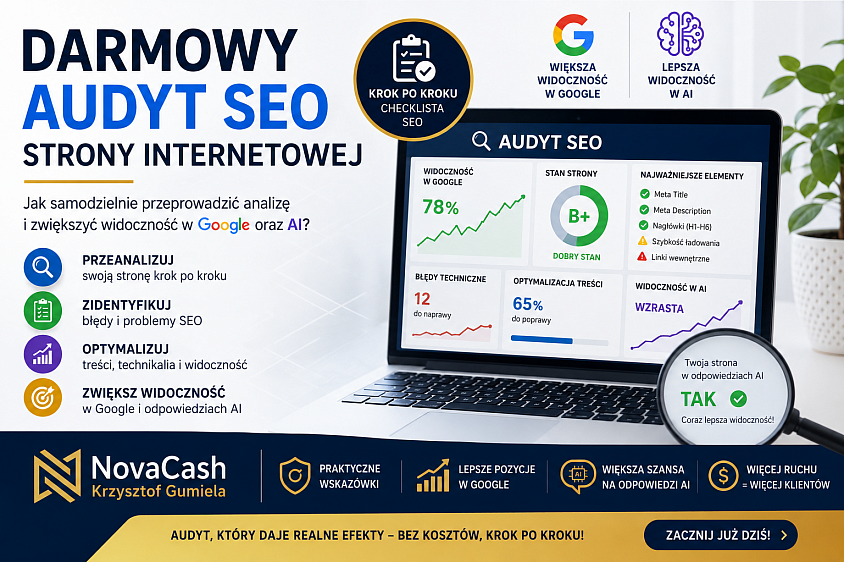
Free SEO audit of your website – independent analysis and optimization of your visibility in Google and AI
Free website SEO audit – how to perform a step-by-step analysis?
Learn how to perform a free SEO audit yourself. Learn the key aspects of technical, content, and GEO analysis that impact your visibility in Google and AI-generated responses.
Does a free SEO audit make sense in 2026?
Many website owners believe that an effective SEO audit requires advanced tools and a large budget. However, in reality, most issues affecting Google rankings can be identified independently using free online tools.
Moreover, a modern SEO audit shouldn't be limited to classic optimization aspects. Artificial intelligence systems that generate user-response responses are gaining increasing importance. Therefore, an effective analysis should encompass both search engine optimization and GEO (Generative Engine Optimization), i.e., preparing content for AI citation.
What is an SEO audit?
An SEO audit is a comprehensive analysis of a website that allows you to identify technical errors, content problems, and factors limiting visibility in organic search results.
A modern audit includes, among others:
- page indexing,
- technical structure of the website,
- speed of action,
- content optimization,
- internal linking,
- external link profile,
- user experience,
- the website's readiness to appear in AI-generated responses.
Professional audit tools currently analyze from several dozen to over 200 ranking factors.
Why is it worth performing an SEO audit regularly?
Google is constantly updating its algorithms, and the importance of content quality, user experience, and expert signals is growing.
A regular audit allows you to:
- faster detection of technical errors,
- improving conversion rates,
- increasing organic traffic,
- limiting the risk of position declines,
- adapting the website to the new requirements of search engines and AI systems.
Even minor technical errors can block the indexing of key subpages and limit the potential of the entire website.
How to perform a free SEO audit step by step?
- Check if Google is indexing your website
The simplest way is to use the operator:
site:yourdomain.pl
If the number of indexed pages differs significantly from the actual number of URLs, this may indicate indexation problems.
It is also worth analyzing the “Pages” report in Google Search Console, paying attention to:- pages excluded from the index,
- redirection errors,
- problems with canonical tags,
- pages blocked by robots.txt.
- Verify your robots.txt and sitemap.xml files
Google robots use these files to navigate the site efficiently.
During the analysis, you should check:- sitemap.xml up-to-date,
- presence of all relevant sites in the map,
- whether robots.txt is not accidentally blocking important sections of the website.
This is one of the most common mistakes on small and medium-sized websites.
- Analyze Core Web Vitals
Website speed affects not only SEO, but also user behavior.
Key indicators are:- Largest Contentful Paint (LCP),
- Interaction to Next Paint (INP),
- Cumulative Layout Shift (CLS).
Problems most often result from:
- too large images,
- suboptimal scripts,
- free hosting,
- excess external plugs.
- Check website security
Every website should use an SSL certificate and run under the HTTPS protocol.
It is worth verifying:- correctness of the certificate,
- the occurrence of mixed content,
- HTTP security headers,
- correctness of redirects.
Security remains one of the key elements in assessing the quality of a website.
- Evaluate the structure of your headings
Proper content structure makes navigation easier for both users and search engine robots.
Good practice includes:- one H1 heading per page,
- logical use of H2 and H3 headings,
- clear hierarchy of information,
- natural incorporation of keywords.
- Verify meta title and meta description
Meta data affects your CTR in search results.
Each subpage should have:- unique title,
- unique description,
- appropriate length,
- incentive to click.
- Check internal linking
Internal linking helps Google understand the structure of a website and transfer authority between subpages.
During the audit, it is worth identifying:- orphaned pages,
- too deeply hidden content,
- missing contextual links,
- incorrect links.
- Look for 404 errors
Deleted subpages without redirects can lead to loss of traffic and SEO value.
You should check:- 404 errors,
- redirection chains,
- temporary 302 redirects,
- incorrect URLs.
- Detect duplicate content
Duplicates make it difficult for Google to choose the correct page to display.
They most often occur in:- online stores,
- category pages,
- filter versions,
- duplicate blog articles.
- Assess EEAT compliance
Google is increasingly promoting content created by experts.
It is worth verifying:- whether the author is clearly presented,
- whether publications contain sources,
- whether the content is updated regularly,
- whether the website builds brand credibility.
Expert content has a greater chance of achieving high rankings and citations.
- Conduct a GEO audit
This is an element that distinguishes a modern audit from the analyses of a few years ago.
Generative Engine Optimization is about increasing the chances of your brand appearing in AI responses.
The content most frequently cited by language models is characterized by:- specific numerical data,
- clear definitions,
- expert comments,
- current statistics,
- clear question and answer structure.
What tools should I use for a free SEO audit?
The most useful tools are:
- Google Search Console,
- Google Analytics 4,
- PageSpeed Insights,
- Screaming Frog SEO Spider,
- Ahrefs Webmaster Tools,
- free online SEO analyzers.
Modern solutions enable the assessment of page speed, indexation, technical structure, content quality and readiness for citation by AI.
The most common errors detected during SEO audits
The most common problems include:
- indexing errors,
- slow page loading,
- duplicate content,
- incorrect redirects,
- lack of structured data,
- poor internal linking,
- insufficient EEAT level.
Eliminating these problems often brings faster results than publishing new content.
Summary
A free SEO audit provides comprehensive information about your website's health and helps identify key issues affecting your visibility in Google. In 2026, effective analysis should extend beyond traditional SEO to include GEO, or optimization for artificial intelligence systems.
The combination of technical analysis, content quality, user experience, and AI citation readiness enables you to build a competitive advantage in both traditional search results and the new generative search ecosystem.
Author of the article:
Krzysztof Gumiela - Expert in website positioning and internet marketing.

US blocks Fable 5 and Mythos 5: consequences of Washington's decision for the artificial intelligence market
The US government restricts access to Anthropic's latest AI models.
In June 2026, the US government made an unprecedented decision regarding the artificial intelligence market. Anthropic was ordered to immediately suspend access to its latest AI models – Claude Fable 5 and Claude Mythos 5. This decision caused a significant stir in the technology industry, as it was the first time such advanced generative AI models had been subject to export restrictions on such a broad scale.
This case transcends a single company. Experts suggest it could set a new direction for AI regulation and impact the development of the entire AI sector globally.
Why did the US block Fable 5 and Mythos 5?
According to official information, the US administration has deemed the Fable 5 and Mythos 5 models to pose a threat to national security. The primary reason for this was reports of a jailbreak, which could potentially enable the use of AI to identify software vulnerabilities and support advanced cybersecurity operations.
A directive issued by the U.S. Department of Commerce prohibited the distribution of models to non-US citizens, both within and outside the United States. The restrictions also extended to Anthropic's own foreign employees.
In the absence of a solution to instantly verify the citizenship of all users, it was decided to completely disable the models for all customers worldwide.
Anthropic's Position: "It's a Misunderstanding"
Anthropic disagrees with the US authorities' arguments. The company emphasizes that the vulnerabilities identified by the administration are limited in nature and do not constitute a universal method for bypassing the model's security measures.
Company representatives point out that similar code analysis, error detection, and cybersecurity support capabilities are also available in other advanced AI models on the market. According to Anthropic, applying such rigorous standards to a single vendor could hinder the implementation of subsequent generations of AI across the entire industry.
What are Claude Fable 5 and Claude Mythos 5?
Fable 5 and Mythos 5 were presented as the most advanced models in Anthropic's history. Fable 5 was intended to be the first widely available next-generation system intended for commercial users, while Mythos 5 remained an even more advanced solution, primarily dedicated to select partners and specialized applications.
The models stood out:
- advanced multi-step reasoning,
- high efficiency in code analysis and generation,
- extensive cybersecurity functions,
- improved AI security mechanisms,
- the ability to implement complex business and technical tasks.
It is these possibilities that have attracted the attention of American regulators.
The first such serious precedent in the history of AI
The decision against Anthropic is seen as a watershed moment for the global artificial intelligence market. Until now, US export restrictions have primarily targeted semiconductors, advanced AI processors, and computing infrastructure.
This time, the software itself and the capabilities of the language model were subject to regulation. Experts note that this marks a new phase in US technology policy, where control extends not only to hardware but also to advanced AI algorithms.
Impact on companies, developers and businesses
The sudden shutdown of Fable 5 and Mythos 5 highlights the high business risks associated with relying on a single AI vendor for company processes.
For companies using advanced models, this means the need to:
- diversification of AI tools used,
- developing contingency plans in the event of regulatory changes,
- monitoring US export policy,
- increased focus on compliance with AI regulations.
This situation could also accelerate the development of local AI models in Europe, Asia and other regions of the world, which will be less susceptible to the decisions of US regulators.
Will Fable 5 and Mythos 5 return?
Talks are currently underway between Anthropic and US government officials. The company has declared its willingness to cooperate and clarify any concerns regarding the safety of its models. The government has not ruled out further negotiations and the possibility of easing restrictions once certain safety requirements are met.
There is currently no official date for restoring access to the models.
Summary
The US administration's ban on Claude Fable 5 and Claude Mythos 5 represents one of the most significant events in the history of the artificial intelligence market. This decision demonstrates that advanced AI models are now being treated not only as business tools but also as a technology of strategic importance to national security.
Regardless of Anthropic's fate, this event could impact the way artificial intelligence is regulated, export policies, and the development of the global AI market for years to come. For companies using modern generative models, this is a clear signal that regulatory issues are becoming as important as the technological capabilities themselves.
Author of the article:
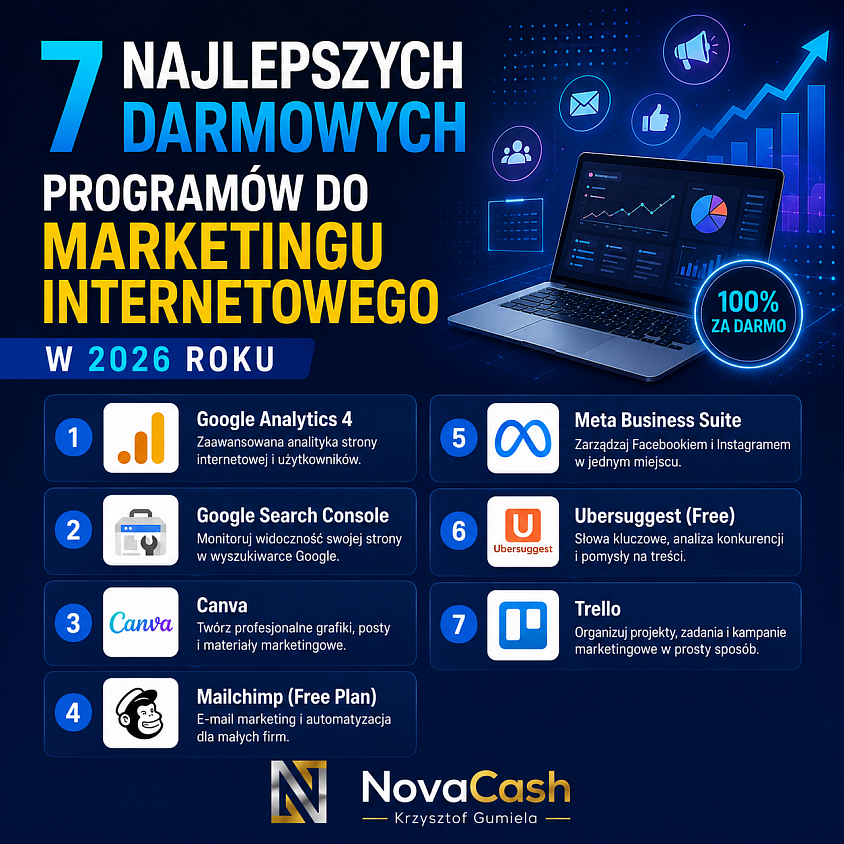
The 7 Best Free Internet Marketing Tools of 2026.
Free marketing tools to support your online business development
We present the seven best free internet marketing software, including SEO, social media, email marketing, and AI tools that will be crucial for online business growth in 2026.
Modern online marketing no longer requires large financial outlays. Thanks to technological advancements, many professional tools offer free versions that enable effective SEO, content marketing, social media management, and analytics. Beginning entrepreneurs, freelancers, and online store owners can leverage these tools to increase brand visibility on Google and AI systems like ChatGPT, Gemini, and Perplexity.
In this article, we present the seven most important free marketing programs worth implementing in 2026.
1. Google Analytics 4 – website traffic analysis
Google Analytics 4 (GA4) is an essential tool for every marketer, enabling them to monitor website traffic, analyze user behavior, and evaluate the effectiveness of advertising campaigns.
Key Features:
- analysis of traffic sources,
- conversion tracking,
- user reports,
- integration with Google Ads and Search Console.
Recipients:
Owners of websites, e-commerce stores and service companies.
SEO and GEO benefits: GA4 data allows you to identify the content that generates the most engagement, which translates into better visibility in search engines and in AI-generated responses.
2. Google Search Console – Free SEO Support
Search Console allows you to monitor your website's visibility in Google search results, identifying keywords and technical errors that require correction.
Key Features:
- keyword analysis,
- page indexing,
- position monitoring,
- detection of technical errors.
Recipients:
SEO specialists, business owners and content creators.
SEO and GEO benefits: allows you to optimize your content for user queries and increases your chances of being cited by AI models.
3. Canva – creating marketing graphics
Canva is one of the most popular free marketing materials design tools.
Key Features:
- ready-made social media post templates,
- designing advertising banners,
- creating presentations,
- photo editing.
Recipients:
Companies wishing to create professional graphics themselves without the need to know advanced graphics programs.
SEO and GEO benefits: attractive graphics increase user engagement and extend the time spent on the website.
4. MailerLite – Free Email Marketing
Email marketing remains one of the most effective promotional channels. MailerLite offers a free plan for building mailing lists and automating communications.
Key Features:
- newsletters,
- automatic email campaigns,
- registration forms,
- audience segmentation.
Recipients:
Online stores, bloggers and service companies.
SEO and GEO benefits: regular communication increases return traffic, which helps build brand authority online.
5. Ubersuggest – Keyword Research
Ubersuggest is a popular SEO tool by Neil Patel. The free version allows you to analyze keywords and competitors.
Key Features:
- keyword search,
- competition analysis,
- position monitoring,
- ideas for blog content.
Recipients:
Copywriters, marketers and website owners.
SEO and GEO benefits: supports the creation of content that answers specific user questions, which is readily used by AI systems.
6. Buffer – Social Media Management
Buffer allows you to schedule and automatically publish posts to social media.
Key Features:
- publication schedule,
- multi-platform support,
- post results analysis,
- team cooperation.
Recipients:
Small businesses, marketing agencies and freelancers.
SEO and GEO benefits: regular activity on social media strengthens brand recognition and increases the number of signals supporting online visibility.
7. ChatGPT – content marketing and GEO support
Artificial intelligence is revolutionizing the content creation process. ChatGPT supports the generation of articles, product descriptions, video scripts, newsletters, and marketing strategies.
Key Features:
- content generation,
- data analysis,
- creating marketing strategies,
- SEO and GEO support.
Recipients:
Marketers, copywriters and entrepreneurs.
SEO and GEO benefits: allows you to create content that matches user intent and increases the chances of your brand appearing in AI-generated responses.
How to choose the best free internet marketing tool?
Choosing the right tool should depend on your business goals:
- SEO and data analysis – Google Search Console and Google Analytics 4,
- content creation – ChatGPT and Canva,
- e-mail marketing – MailerLite,
- social media – Buffer,
- keyword analysis – Ubersuggest.
The best results are achieved by integrating several tools into a coherent marketing ecosystem.
Summary
Free marketing tools enable effective online business development without high costs. Google Analytics 4, Search Console, Canva, MailerLite, Ubersuggest, Buffer, and ChatGPT are currently the most important solutions for companies seeking to increase their visibility on Google and artificial intelligence systems.
In 2026, effective marketing means not only search engine optimization (SEO) but also generative AI systems (GEO). Companies that invest in valuable content and modern marketing tools today gain a competitive advantage in the digital market.
Author of the article:
