
An effective SEO and online marketing strategy for your business

Professional website link building services for better SEO
Professional website linking strategy (SEO Off-Site and Internal Linking) Tailor-made internet marketing !
SERVICE OFFER - OUR REAL ACTIVITIES Comprehensive link building and SEO authority growth services
We focus on building a lasting SEO advantage through professional link building, developing topical authority, and strategic content marketing.
We do not use bulk or spam link acquisition.
We build long-term domain authority based on:
- high-quality publications,
- natural link profile,
- expert content,
- digital PR,
- strategic outreach,
- professional internal linking.
Scope of our activities:
- Full SEO and link profile audit
We analyze the current backlink profile, the quality of linking domains, anchors, toxic links, gaps in competitive rankings, and SEO growth potential. The result is a roadmap and prioritization. - Competitor analysis and link source identification
We investigate where your competitors are getting their links, which content generates the most traffic, which industry portals link to market leaders, and where the biggest SEO gaps lie. Based on this, we develop a strategy to gain an advantage. - Building a topical authority strategy
We design a content architecture that includes pillar pages, cluster content, topic silos, and an internal linking map to increase the topic authority of a domain. - Acquiring quality external links
We offer premium guest posting, sponsored publications, editorial links, digital PR, expert outreach, broken link building, and link reclamation. Each domain is thoroughly assessed for quality and SEO value. - Creating content designed to gain links
We produce industry reports, expert guides, rankings, case studies, data analyses, evergreen content, and link bait materials that are optimized for both SEO and natural citations. - Professional outreach
We conduct portal research, contact publishers, communicate with editorial offices, conduct follow-ups, negotiate publications, and develop industry relationships. Outreach is implemented manually and with full personalization. - Internal linking optimization
We implement logical linking structures, topic silos, strengthen money pages, improve indexation, and distribute link equity. We treat internal linking as a key element of SEO growth. - Monitoring effects and scaling activities
We regularly analyze visibility growth, new and lost backlinks, phrase positions, organic traffic, publication effectiveness, and the ROI of SEO activities, based on which we continuously develop our strategy. - Website positioning in accordance with current SEO guidelines is an effective way to increase your company's online visibility. We use proven strategies that help you achieve better results, attract valuable customers, and build a lasting search engine ranking.
Cooperation model
Stage 1 - Audit and Strategy
SEO analysis , competition analysis, action roadmap, content plan and link building plan.
Stage 2 - Implementation
Publications, outreach, link acquisition, content marketing and internal linking.
Stage 3 - Scaling
Digital PR, development of topical authority, expansion of content hubs and strengthening of the most profitable subpages.
What distinguishes our activities
- We focus on quality, not quantity—we don't use spammy linking systems, automated SWL, low-quality directories, or aggressive exact match SEO. We build stable and secure growth.
- We focus on real business impact – our goal is to increase organic traffic, leads, sales, build brand authority, and dominate topical authority.
- We combine SEO, content marketing, and digital PR — modern SEO requires the integration of quality content, expert outreach, brand authority, and strategic link building, allowing you to build an advantage that is difficult to replicate.
The purpose of a linking strategy
Professional link building isn't about mass link acquisition, but rather building domain authority, increasing search engine visibility, and supporting business conversions. The strategy should simultaneously achieve goals such as:
- increasing domain authority,
- improving positioning for key phrases,
- increase in organic traffic,
- strengthening topical authority,
- improvement of indexation,
- distribution of SEO power between subpages,
- generating reference traffic,
- sales support and lead generation.
PART I - PRE-IMPLEMENTATION ANALYSIS
Link Profile Audit
Before we begin, we conduct a comprehensive audit of your current link profile, including:
- number of linking domains,
- domain quality,
- trust flow / domain authority,
- domain themes,
- anchor texts,
- share of follow/nofollow links,
- link growth dynamics,
- toxic links,
- sitewide links,
- PBN and spam links.
We use tools such as Ahrefs, Semrush, Majestic, Google Search Console, Screaming Frog and LinkResearchTools.
The result of the audit is a list of links to keep, a list of links to remove or disavow, identification of gaps in comparison to competitors, and a map of priority URLs to strengthen.
Competition analysis
We reverse engineer the competition by analyzing:
- sources of link acquisition,
- content types that generate backlinks,
- dominant anchors,
- the strongest subpages,
- media and industry portals linking to competitors,
- rate of acquiring links.
Key elements include gap analysis, intersect links, broken competitor backlinks and link velocity.
PART II - LINK BUILDING STRATEGY
The foundations of professional link building
Modern link building is based on quality instead of quantity, thematic relevance, natural profile, diversification of sources, long-term growth and integration with content marketing.
Link profile structure
The profile should be diversified, with an approximate share of anchor types:
- Brand anchors: 40–60%
- URL anchors: 15–25%
- Generic anchors: 10–20%
- Partial match: 10–15%
- Exact match: 0–5%
Link sources include industry portals, media, expert blogs, quality forums, premium directories, business partners, sponsored publications, podcasts, universities, industry organizations, company profiles, and social signals.
Priority link types
- Editorial links – of the highest value, characterized by natural context, embedded in the content, high relevance, organic domain traffic, Google indexation and real users.
- Digital PR – building relationships with media and portals through industry reports, statistical data, expert commentary, case studies, research, newsjacking and expert publications.
- Premium guest posting – expert publications on quality portals, requiring unique content, no link farms, real traffic, high editorial quality and thematic consistency.
- Link bait content – content designed to gain natural links, such as reports, benchmarks, rankings, tools, calculators, checklists, interactive materials, infographics, and industry data.
PART III - ANCHOR TEXT STRATEGY
Professional anchor distribution
Over-optimizing anchors poses a significant risk to algorithmic filters. The recommended model is:
- Brand anchors — e.g. company name, brand + phrase,
- URL anchors - e.g. domain.pl, https://domena.pl,
- Generic anchors - e.g. check here for more information,
- Partial match — natural weaving of the phrase,
- Exact match - use very limited.
Mapping Anchors to Intentions
- Transactional phrases – moderate exact match, higher share of partial match,
- Information phrases – natural anchors, branded anchors, semantic variations,
- Category pages – strengthening commercial intent,
- Content evergreen — educational anchors.
PART IV - INTERNAL LINKING
Internal linking strategy
Internal linking is an often underestimated SEO element. Its goals include distributing crawl budget, transferring link equity, strengthening topical clusters, improving indexation, and increasing user session time.
Topical authority architecture
The recommended model is Pillar Page with Cluster Content:
- Pillar: a central, broadly themed page,
- Clusters: supporting content,
- Linking scheme: cluster → pillar, pillar → cluster, cluster ↔ cluster.
The result is increased topical authority, better understanding of semantics by Google, and improved long tail positioning.
Professional rules of internal linking
- Contextual linking – top priority,
- Hierarchy: homepage, categories, subcategories, landing pages, articles,
- Links embedded high in the content, natural anchors,
- Limited orphan pages, no cannibalization,
- Logical topic silos, linking to money pages.
PART V - ADVANCED TACTICS
Broken Link Building
The process involves identifying dead links, creating better content, outreach, and replacing the link. The method is highly effective for quality outreach.
Link Reclamation
Recovering dead links, unlinked mentions, bad redirects and lost backlinks by contacting website owners.
Outreach SEO
Professional outreach should be personalized, value-based, scalable, and segmented. Key elements include contact research, domain owner analysis, content customization, follow-up sequencing, and an outreach CRM.
Parasite SEO
In selected industries, you can use platforms such as Medium, LinkedIn Articles, industry-specific marketplaces, or publishing platforms, but be careful and avoid spam strategies.
PART VI - LINK QUALITY
Evaluation of the link's value
The most important factors are:
- thematic relevance — very high,
- organic domain traffic - very high,
- content quality - high,
- domain positions - high,
- indexation - critical,
- SEO visibility - high,
- link placement - high,
- number of outgoing links - average,
- domain history - high.
Signs of toxic links
Risky sources include link farms, automated directories, spam comments, generated PBNs, dead sites, spammy domains, hacked websites, and massive sitewide content. Symptoms include rapid link growth, identical anchors, low-quality domains, and an unnatural profile.
PART VII - OPERATIONAL PLAN
Monthly activity model
- Month 1: SEO audit, competition analysis, topical map architecture, content plan, anchor analysis.
- Months 2–3: building internal linking, first publications, outreach, link reclamation, acquiring foundational links.
- Months 4–6: digital PR, premium guest posts, content assets, outreach scaling, effectiveness analysis.
- Month 6+: process automation, topical authority development, money page strengthening, ROI analysis.
PART VIII – KPIs and Analytics
Professional link building KPIs
SEO KPIs include increasing the number of linking domains, organic traffic, visibility index, the number of keywords in the top 3/top 10, improving crawl frequency, and increasing topical authority. Business KPIs include leads, sales, CAC, ROI, conversion rate, and organic revenue.
Monitoring and reporting
We monitor new and lost links, indexation, and anchor text weekly. We analyze SEO visibility, ranking growth, competition, and outreach effectiveness monthly. We conduct a full profile audit, link quality analysis, and strategy review quarterly.
PART IX - AUTOMATION AND AI
Link building automation
Automation areas include prospecting, domain analysis, quality scoring, outreach sequences, link monitoring, anchor analysis, and broken link detection. We utilize tools such as Pitchbox, BuzzStream, Hunter, Clay, Apollo, Ahrefs API, and Semrush API.
Using AI
AI supports competitive analysis, content topic generation, outreach personalization, topical gap analysis, potential domain scoring, and research automation. However, it does not replace quality editorial, business relationships, expert content, or strategic domain selection.
PART X - A MODEL FOR DIFFERENT TYPES OF BUSINESS
- E-commerce: priorities include category linking, SEO content, shopping guides, rankings, and digital PR.
- SaaS: priorities include data studies, product-led content, comparison pages, integrations and partner pages.
- Local SEO: priorities include citations, local portals, company profiles, regional partnerships and local media.
- B2B: priorities include expert content, whitepapers, LinkedIn outreach, industry conferences and expert publications.
PART XI - WHAT TO AVOID
The most common mistakes
Critical mistakes include bulk link purchasing, exact match spam, automatic linking systems, low content quality, lack of anchor strategy, lack of topical relevance and lack of monitoring.
High-risk strategies
High risk comes from aggressive PBNs, link cloaking, SWL, automated spam, black hat redirects and hacked backlinks.
PART XII - SPECIFIC OPERATIONAL PLAN
Executive model of operational activities
Daily link building activities
You should conduct daily domain prospecting, sourcing potential link sources from industry portals, expert blogs, local media, partner websites, quality directories, podcasts, and expert forums. A minimum target is 20–50 new domains to analyze daily.
Domain eligibility criteria include real organic traffic, Google indexation, updated content, topical relevance, no signs of spam, and SEO visibility.
Competitive analysis should include daily monitoring of new competitor links, publications, partnerships, PR activity, and content trends using tools such as Ahrefs Alerts, Google Alerts, Semrush Backlink Gap, and Brand24.
Daily outreach includes sending publication proposals, collaborations, outreach broken link building, link reclamation, and follow-ups. Minimum KPIs are 20–100 new contacts per day, 10–30 follow-ups, 20–50 domain analyses, and 1–3 new publications.
What to post to get links
The most effective formats are:
- Industry reports – e.g. market analysis, price benchmark, SEO report, trend report, generating natural citations,
- Rankings – e.g. TOP tools, service ranking, company ranking, technology ranking,
- Case studies – especially effective for B2B and SaaS, containing figures, growth, process, charts and before/after results,
- Evergreen content – constantly up-to-date guides, tutorials, definitions, checklists and guides,
- Link bait assets - calculators, PDF checklists, free tools, templates and interactive solutions.
How to get links step by step
Method 1 - Guest posting premium
The process includes finding a quality portal, analyzing traffic and domain quality, contacting the editorial team, proposing a topic, creating an expert article with a natural link placement, and promoting the publication. It's crucial that the publication has value, the link doesn't appear artificial, and the content responds to the user's real intent.
Method 2 - Broken Link Building
The operational process involves searching for dead links on industry portals, analyzing previous content, creating a better version of the content, contacting the website owner, and proposing a link replacement. Effectiveness is enhanced by personalized messaging, quick response, and the real value of replacement content.
Method 3 - Link Reclamation
You should monitor unlinked brand mentions, invalid URLs, lost backlinks, and deleted posts, and then contact the site owners to get the link back.
Method 4 - Digital PR
We create reports, statistical data, expert commentary, industry news, and proprietary analyses, which we then distribute to the media, conduct outreach to journalists, publish on social media, and syndicate content.
How to build professional internal linking
Each new article should link to a pillar page, 3–10 related articles, and receive links from existing content. Weekly, you should analyze orphan pages, add new internal links, update older content, and strengthen money pages.
The best model is a silo structure, e.g. SEO → Link Building → Anchor Text → Outreach → Internal Linking, where each element is logically related.
How to evaluate domains before acquiring a link
You should not buy a link without analysis, which should include:
- organic traffic - does the domain have real traffic,
- domain history - whether it has been spammed,
- indexation – whether pages are indexed,
- the subject matter - is it consistent,
- outgoing links - whether the portal sells links en masse,
- content - is it quality,
- SEO visibility - is the domain growing?
Red flags include a sudden drop in traffic, a huge number of outbound links, spammy articles, lack of topical relevance, AI-generated spam, and a lack of organic traffic.
What does professional outreach look like?
The structure of the message should include:
- Personalization – reference to a specific publication,
- Value – showing the benefits for the recipient,
- Concrete – one clear proposal,
- CTA - a short request for a response.
Avoid bulk templates, generic messages, aggressive selling, and automated spam.
Action scaling model
Stage 1 - Foundation
Audit, internal linking, foundational links, content strategy.
Stage 2 - Growth
Outreach, guest posting, digital PR, topical authority.
Stage 3 - Scaling
Prospecting automation, follow-up automation, AI research, content hub expansion.
Stage 4 – Dominance of topical authority
Building a content ecosystem, industry partnerships, expert publications, data-driven content.
What gives the best results in 2026
- Contextual links with real traffic - the greatest SEO value,
- Topical authority – Google rewards complete topic coverage,
- Digital PR – strong signals of authority,
- Data-driven content – reports and analyses generate natural backlinks,
- Updating existing content - very high ROI,
- Internal linking – one of the most underrated SEO levers.
SUMMARY
A modern linking strategy should be based on domain quality, topical relevance, strong content marketing, topical authority, digital PR, quality internal linking, a secure anchor structure, continuous data analysis and long-term growth.
The greatest competitive advantage is provided by the combination of expert content, strategic outreach, topical authority, data-driven SEO, and quality industry relationships.
Professional link building is an ongoing process, not a one-time campaign. A well-designed strategy can build an SEO advantage for years to come.
We also offer other services, including email marketing , to support brand promotion, customer communication and sales growth.
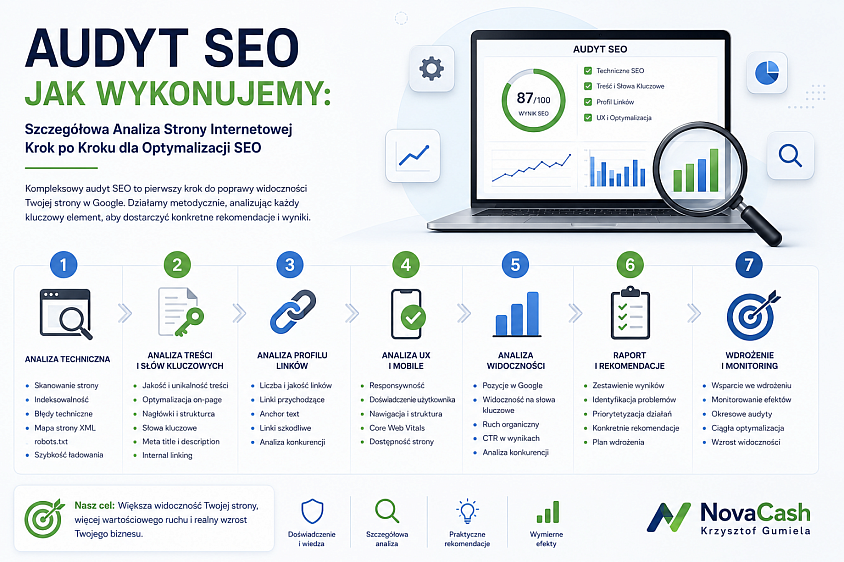
SEO Audit - How We Do It: Detailed Step-by-Step Website Analysis for SEO Optimization
Search engine visibility isn't a matter of chance. Effective SEO begins with a precise diagnosis of problems and identification of a website's potential. Therefore, a professional SEO audit isn't a "short report," but a comprehensive technical, content, and business analysis that precisely pinpoints areas for improvement to increase organic traffic, visibility, and conversions.
What is an SEO audit?
An SEO audit is a detailed assessment of a website's compliance with search engine guidelines and its effectiveness in attracting traffic from Google. We analyze technical aspects, content quality, website structure, link profile, and competitor activity.
Our goal is not to create a document full of incomprehensible graphs, but to prepare a practical optimization plan that indicates:
- factors limiting the visibility of the website,
- errors affecting positioning,
- areas with the greatest growth potential,
- activities that bring the fastest SEO results.
What is the SEO audit process step by step?
- Technical analysis of the website
First, we verify the technical foundations of the website. Even the highest-quality content won't achieve high rankings if the page is slow or poorly indexed.
As part of technical analysis, we check, among other things:
- page loading speed,
- Core Web Vitals,
- indexing and crawl budget,
- URL structure,
- redirects,
- 404 errors and server problems,
- XML maps and robots.txt file,
- mobile versions,
- HTTPS security,
- technical duplication.
Thanks to this, we identify problems that are often invisible to the website owner, but at the same time significantly limit visibility in Google.
- Information structure and architecture audit
We analyze the website structure to assess whether users and search engine robots can navigate the site freely.
We check:
- logical arrangement of categories and subpages,
- internal linking structure,
- click depth,
- heading hierarchy,
- arrangement of content and CTA elements,
- usability on mobile devices.
An optimally designed website architecture increases indexation, improves user experience and supports increased positioning for competitive phrases.
- Keyword and visibility analysis
SEO without a keyword strategy is a haphazard endeavor. That's why we investigate:
- current domain visibility,
- phrases that generate traffic,
- keyword potential,
- user intentions,
- content gaps,
- seasonality of inquiries,
- competition positions.
On this basis, we identify areas requiring expansion and content with the greatest business potential.
- Content audit and content optimization
Content is a key ranking factor. We analyze not only its length but also, above all, its quality, structure, and relevance to search intent.
We verify:
- unique content,
- meta title and description optimization,
- H1–H6 headings,
- keyword saturation,
- substantive value,
- content cannibalization,
- duplicate content,
- graphics optimization,
- semantic structure of texts.
We also show you which content is worth creating, expanding, or rebuilding to increase organic traffic and improve your conversion rate.
- Linking and Domain Authority Analysis
Link profile remains a key element of SEO. During an audit, we assess:
- quality of incoming links,
- anchor texts,
- toxic links,
- link growth dynamics,
- internal linking,
- competitive advantage in terms of backlinks.
This allows us to determine whether the domain requires cleaning up its link profile or intensifying off-site activities.
- SEO Competition Analysis
We investigate why competitive websites rank higher and what activities are responsible for their visibility.
The analysis includes:
- competition's content strategy,
- structure of services,
- link profile,
- visibility for keywords,
- technical advantages,
- vulnerabilities that can be exploited.
This allows you to develop a strategy based on data, not assumptions.
- SEO Report and Implementation Plan
The final stage is the preparation of a detailed SEO report, which includes:
- list of detected problems,
- priorities for action,
- optimization recommendations,
- analysis of the impact of errors on visibility,
- specific implementation tips,
- strategy for further SEO development.
The report is prepared in a way that is understandable both to the company owner and the technical or marketing team.
Why is a professional SEO audit crucial?
Many websites lose potential customers due to errors that are invisible at first glance. Technical issues, ineffective structure, inappropriate content, or poor linking can significantly limit organic traffic growth.
A professional SEO audit allows you to:
- increasing visibility on Google,
- improving website efficiency,
- increasing the number of inquiries and sales,
- elimination of critical errors,
- building an effective positioning strategy,
- optimal use of the marketing budget.
An SEO audit based on data, not guesswork
We analyze each website individually. We don't rely on automated, uninterpreted reports. We combine data analysis, SEO experience, and the client's real business goals.
The result is a precise action map that allows you to effectively develop your website's visibility and increase your competitive advantage in the Google search engine.
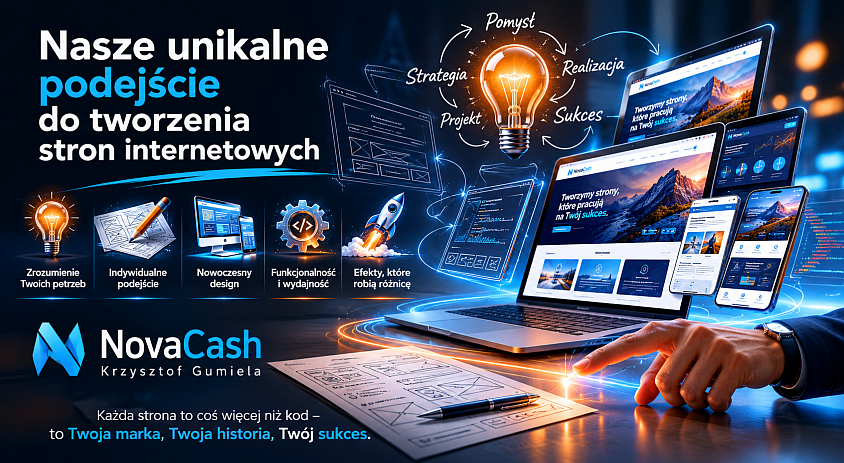
Our unique approach to website development
We create websites that not only stand out aesthetically but, above all, achieve specific business goals. For us, website design is a harmonious blend of strategy, technology, and user experience, ensuring that each website effectively attracts customers, builds trust, and supports sales.
We start with a thorough understanding of your business
We don't use pre-made templates. We begin each project with an analysis of the industry, target audience, and company goals. This allows us to create websites perfectly tailored to the real needs of users and the specifics of the market.
Before preparing the first graphic design, we answer key questions:
- Who are your customers?
- How do they make purchasing decisions?
- What sets your company apart from the competition?
- How will the website support business development?
- We design websites that sell
Modern design is just the beginning. We create intuitive and thoughtful user experiences (UX/UI) that lead visitors to take specific actions—contact, purchase, or submit an inquiry.
We pay special attention to:
- clear website structure,
- clear messages,
- fast charging,
- full responsiveness on mobile devices,
- effective calls to action (CTA).
- Each element of the website performs a specific function and supports the achievement of business goals.
- We combine aesthetics with modern technology
We utilize advanced technologies and proven solutions that guarantee fast, stable, and secure website performance. We optimize website code and structure for SEO, which increases search engine visibility and facilitates customer acquisition.
Our websites are characterized by:
- speed and efficiency,
- optimization for Google,
- intuitive operation,
- readiness for further development,
- security and compliance with current standards.
- We focus on communication and partnership cooperation
We believe that the best projects emerge from close collaboration. We stay in touch at every stage, consult on solutions, and transparently report on progress. We avoid incomprehensible technical language, focusing on clear communication and concrete actions.
We create websites that support the development of companies
Our goal isn't just to create a "pretty website." We design tools that help build brands, increase recognition, and generate real business results.
If you are looking for a modern, effective website tailored to your business, you have come to the right place.
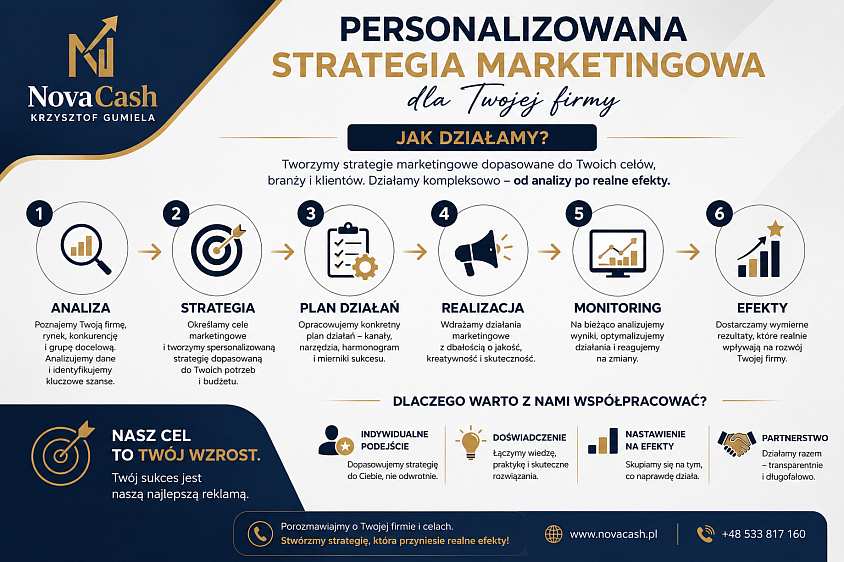
A personalized online marketing strategy for your business – our approach
Every company operates in a unique environment, serves a diverse clientele, and pursues distinct business goals. Therefore, we don't use pre-packaged templates. We develop customized online marketing strategies that effectively support sales, build brand recognition, and enable the acquisition of valuable customers.
How does our cooperation work?
- Company and market analysis
We begin with a detailed understanding of your business. We analyze your industry, competition, target audience, and existing marketing activities. This allows us to select the most effective channels and solutions.
- Developing a strategy tailored to your goals
We create a personalized marketing plan based on your priorities—increasing sales, generating leads, building your brand, or developing your online store. The strategy includes selecting the right tools, budget, and timeline.
- Implementation of effective marketing activities
We implement comprehensive online campaigns using, among others:
- Google Ads ads,
- social media campaigns,
- SEO and positioning,
- content marketing,
- email marketing,
- remarketing,
- website and conversion optimization.
- marketing automation
Each action is aimed at a specific goal and is subject to measurement of effectiveness.
- Constant optimization and development
Online marketing requires continuous improvement. We monitor campaign results, analyze data, and regularly optimize activities to increase effectiveness and maximize return on investment.
- Transparent communication
We prioritize partnership and transparent principles. We provide regular reports, specific recommendations, and comprehensive information on the results of our activities.
Why is it worth trusting us?
- individual approach to each client,
- strategies based on data and analysis,
- focus on business results,
- comprehensive marketing services,
- experience in various industries.
We create marketing that not only looks professional, but above all, brings measurable results and supports the development of your company.
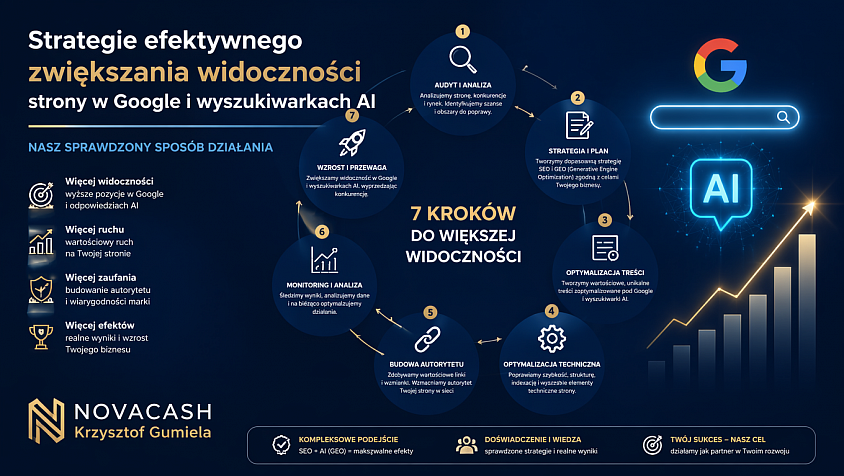
Strategies for effectively increasing your website's visibility in Google and AI search engines - our proven method of operation
How we work – our proven process
Online visibility has undergone a permanent transformation. Nowadays, simply being on Google isn't enough. Companies need to be visible both in traditional search results and in responses generated by AI systems like ChatGPT, Gemini, and Perplexity.
That's why our activities integrate modern SEO, AI search engine optimization, and a content strategy based on reliable data and user intentions.
We don't use formulaic solutions. We create a process that effectively increases traffic, visibility, and customer inquiries.
What does our work process look like?
- Business and market analysis
We start with a thorough understanding of your business.
We analyze:
- industry and competition,
- current level of page visibility,
- traffic sources,
- potential of sales phrases,
- user behavior,
- brand presence in AI results.
We don't focus solely on search engine rankings. Our goal is to have a real impact on sales, lead generation, and brand recognition.
Effect:
- we identify the greatest growth opportunities,
- we detect technical and content barriers,
- We develop an action plan tailored to the specifics of your business.
- SEO + AI Search Optimization Strategy
We are developing a strategy based on two pillars:
SEO for Google
We optimize the website for classic search results, taking into account:
- website structure,
- keywords,
- content organization,
- internal linking,
- page loading speed,
- Core Web Vitals,
- indexation and technical aspects.
AI Search Engine Visibility
More and more users are abandoning traditional results in favor of asking AI questions that generate ready-made answers.
Therefore, we prepare the content and structure of the website so that:
- AI could easily interpret the offer,
- the brand was cited in generative responses,
- the content answered specific user questions,
- increase domain authority and information credibility.
We combine classic SEO with modern GEO (Generative Engine Optimization).
- Technical audit and website optimization
Even the best content will not be effective if the website has technical problems.
We conduct a comprehensive audit covering, among others:
- indexation,
- technical errors,
- URL structure,
- page performance,
- responsiveness,
- structured data,
- crawl budget,
- security,
- mobile optimization.
We implement recommendations or collaborate with your IT department/developers.
Our goal is to make the website fast, algorithmically readable, and user-friendly.
- Content strategy based on user intent
We do not create random articles for "phrases".
We build content that:
- answer real customer questions,
- increase visibility at various stages of the purchasing process,
- build brand expertise,
- support sales,
- increase the chances of appearing in AI responses.
We create:
- expert articles,
- service pages,
- landing page,
- FAQs,
- guide content,
- thematic clusters,
- EEAT supporting materials.
Each material is created based on the analysis of data, competition and user behavior.
- Building brand authority and visibility
Google and AI systems are increasingly assessing brand credibility.
Therefore, our activities also include:
- link profile development,
- external publications,
- digital PR,
- amplifying signals of expertise,
- brand presence in various sources,
- online reputation optimization.
Higher domain and brand authority translates into:
- better positions in search results,
- more frequent citations by AI,
- greater user confidence,
- higher conversion rate.
- Monitoring, analysis and continuous optimization
SEO and visibility in AI is an ongoing process.
Algorithms are constantly changing, so we regularly monitor:
- phrase positions,
- domain visibility,
- organic traffic,
- user behavior,
- content effectiveness,
- brand presence in AI responses,
- competitor activities and market trends.
Based on the collected data, we constantly develop our strategy and optimize our activities.
We do not act blindly – every decision is based on analysis and real results.
What do you gain?
- Greater visibility
Your brand appears where users actually search for products and services – both on Google and in AI tools. - Better quality movement
We attract users with specific purchasing intentions, eliminating accidental entries. - More inquiries and sales
An effective SEO and AI Search Optimization strategy translates into a real increase in the number of customers. - Long-term effect
We build stable brand visibility and authority that deliver long-term benefits.
Why is our approach effective?
We do not rely on outdated patterns.
We connect:
- modern SEO,
- data analysis,
- content marketing,
- optimization for AI,
- business strategy,
- UX experience and technical aspects.
Thanks to this, we create a system for increasing visibility that works not only today, but also in the future of search.
Do you want to increase the visibility of your website?
We'll show you where you're missing out and how to effectively increase your traffic, visibility, and customer base with Google and AI search engines.
Contact us to receive an individual strategy tailored to the specifics of your business.
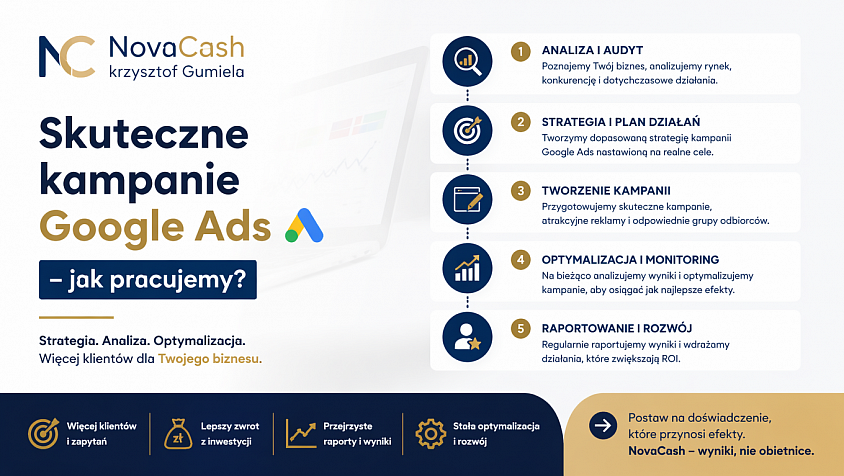
Effective Google Ads campaigns – our proven methodology
Running a Google Ads campaign requires much more than a one-time ad setup. Systematic data analysis, hypothesis testing, and continuous optimization are key. Our approach is based on a structured process that maximizes return on investment (ROAS) and minimizes customer acquisition cost (CPA).
1. Business and Goal Analysis
Every campaign begins with a thorough understanding of:
- business model,
- margin and true customer value (LTV),
- sales or lead goals,
- seasonality and purchasing cycle.
At this stage, we define what “effectiveness” means for you – not in theory, but in concrete numbers.
2. Market audit and verification
We analyze:
- competition in advertising auctions,
- cost-per-click (CPC) level,
- keyword potential,
- structure of existing campaigns (if already active).
Thanks to this, we avoid inefficient budget spending at the start-up stage.
3. Campaign Strategy and Account Architecture
We create a logical campaign structure, including:
- division into campaigns by goals (sales, leads, remarketing),
- ad group segmentation,
- precise keyword matching,
- A/B testing plan.
This allows the Google Ads system to function as an orderly customer acquisition mechanism rather than a chaotic collection of advertisements.
4. Advertising creations and communication
- We design advertisements based on:
- user intent (search intent),
- real customer needs,
- competitive advantages of the offer,
- clear CTA (call to action).
- We test different headline and description variations to maximize CTR and conversion.
5. Optimization and scaling
Once the campaign is launched, we move on to working with the data, including:
- elimination of ineffective keywords,
- rate optimization,
- improving the Quality Score,
- development of the best converting segments.
- We scale solely based on actual results, not assumptions.
6. Reporting and strategic decisions
We regularly analyze:
- conversion cost,
- conversion rate,
- ROAS,
- quality of movement.
Based on this data, we make decisions regarding the further development of the campaign.
The final effect
Instead of a random move you get:
- predictable customer acquisition system,
- full control over the advertising budget,
- scalable sales channel,
- data supporting business decision-making.
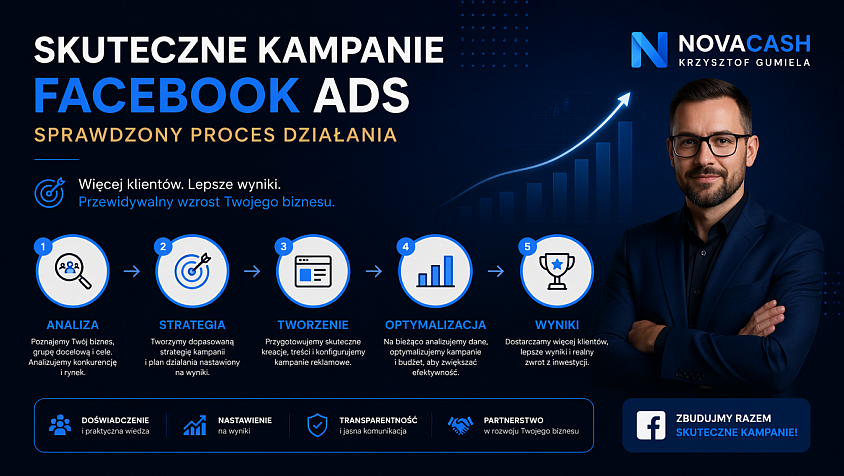
Effective Facebook Ads campaigns – proven methodology and optimization process
Successful Facebook Ads campaigns aren't the result of a "good idea" or a haphazard budget. They're a systematic process based on data analysis, hypothesis testing, and iterative optimization, aimed at predictably generating leads or sales at a controlled cost per customer acquisition.
Our approach is based on a methodical process in which each stage plays a clearly defined role in the advertising ecosystem.
Initially, it's crucial to precisely define the business objective and conversion structure. Campaigns are designed differently depending on the objective: lead generation, e-commerce, or demand building. Based on this, we create a campaign architecture in which audience segmentation, user intent, and product awareness determine the advertising communication strategy.
We then conduct creative hypothesis tests by running different message variants in parallel: various hooks, sales angles, and advertising formats. We don't assume the existence of a "single perfect ad"—instead, we build a validation system that allows us to quickly eliminate ineffective variants and scale those that actually deliver results.
The structure of the advertising funnel is also crucial. Users rarely convert on first contact, so we divide campaigns into stages: cold traffic, remarketing, and retention. Each stage corresponds to a different level of awareness and requires a dedicated message, tailored to the recipient's decision-making phase.
Campaign optimization is based not on intuitive "disabling weak ads," but on the analysis of statistical metrics: CTR, CPC, CPM, conversion rate, and cost per lead or purchase. Based on this, we make decisions regarding budget allocation among ad sets, creatives, and audiences.
In the next phase, scaling is key. We utilize both horizontal scaling (expanding the number of ad sets and segments) and vertical scaling (increasing budgets within proven campaigns). Each change is carefully monitored to prevent performance degradation resulting from algorithm overheating.
The entire process is based on a continuous loop: test → analysis → optimization → scaling. This ensures that campaigns aren't a one-time event, but a system that learns from the market and continuously improves results.
The result of this approach are campaigns that not only generate traffic, but above all, deliver stable conversions at a predictable customer acquisition cost – regardless of the budget size.
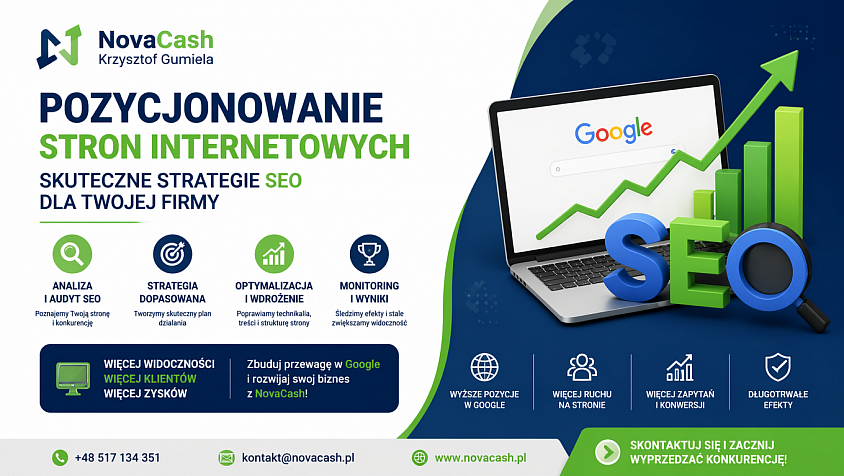
Website positioning – effective SEO strategies for your company
Visibility in Google search isn't a matter of chance, but rather the result of carefully planned and systematically implemented SEO activities that translate into real website traffic, inquiries, and increased sales. Effective website positioning is based on several key pillars that, together, build a sustainable competitive advantage.
SEO audit and competition analysis
Every effective strategy begins with a detailed diagnosis. An SEO audit allows you to identify technical errors, indexing issues, low-quality content, and incorrect website structure. At the same time, a competitive analysis allows you to determine which keywords are generating traffic in your industry and what actions market leaders are taking. This is the foundation for developing a precise action plan.
Keyword selection and content strategy
The foundation of visibility on Google is the accurate selection of keywords—both general and long-tail. A content strategy involves creating content that meets real user needs: service descriptions, expert articles, guides, and sales materials. Each of these is optimized for search intent, increasing effectiveness in generating organic traffic.
Technical website optimization (on-site SEO)
Even the highest-quality content won't deliver the desired results without a solid technical foundation. Optimization includes improving page load speed, adapting to mobile devices, implementing proper heading structure, structured data, and optimizing meta tags. Ensuring an appropriate information architecture is also crucial, helping Google crawlers efficiently index the site.
Link building and domain authority development
SEO also involves building credibility in the eyes of search engines. Link building involves acquiring valuable links from external, thematically related websites. A high-quality link profile increases a domain's authority, which directly impacts its position in search results.
Constant analysis and optimization of activities
SEO is a continuous process. Position monitoring, organic traffic analysis, and testing various content variants allow us to continuously optimize our strategy. This allows us to adapt our activities to changes in Google algorithms and user behavior.
Effect?
Greater visibility on Google, a stable influx of customers, and long-term sales growth without the need to constantly increase your advertising budget.
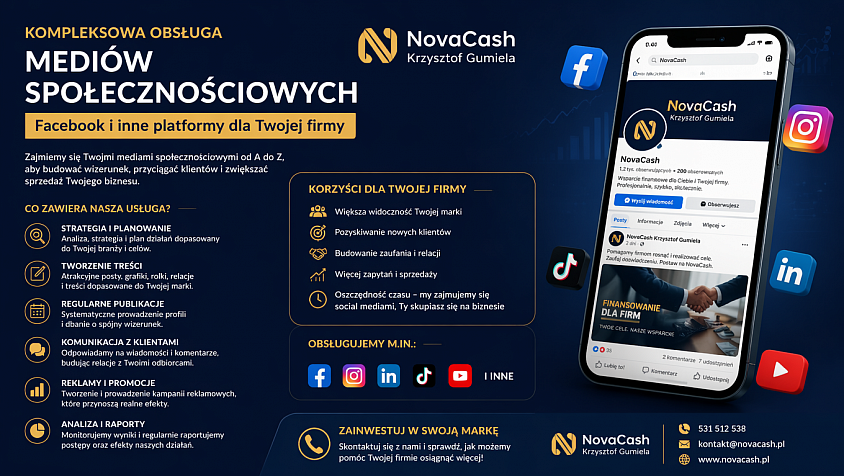
Comprehensive social media management (Facebook and other platforms) for your business
Comprehensive social media management provides strategic support for your company in building visibility, engagement, and real sales across digital channels. We take full responsibility for your brand's presence on platforms such as Facebook, Instagram, TikTok, LinkedIn, and others tailored to your industry and target audience.
Our activities go beyond just publishing posts – it is a coherent, carefully planned process that includes analysis, strategy development, content creation, and optimization of results.
What does comprehensive service include?
We create and implement a communications strategy precisely tailored to the nature of your business, market, and customer expectations. We define the tone of your communication, thematic directions, and marketing goals, which we translate into specific actions.
We provide comprehensive content production—from copywriting, through graphics and advertising creation, to video content. Each element is designed to strengthen brand recognition and increase conversions.
We publish regularly and actively moderate – we respond to comments and messages, nurturing relationships with our audiences and building an engaged community around your company.
We optimize social media advertising campaigns using precise targeting, A/B testing, and real-time results analysis to maximize return on investment.
Why does it work?
An effective social media presence isn't based on random activity, but on a consistent, data-driven strategy. We combine creativity with analytics, so your brand not only gains visibility but also generates real sales results.
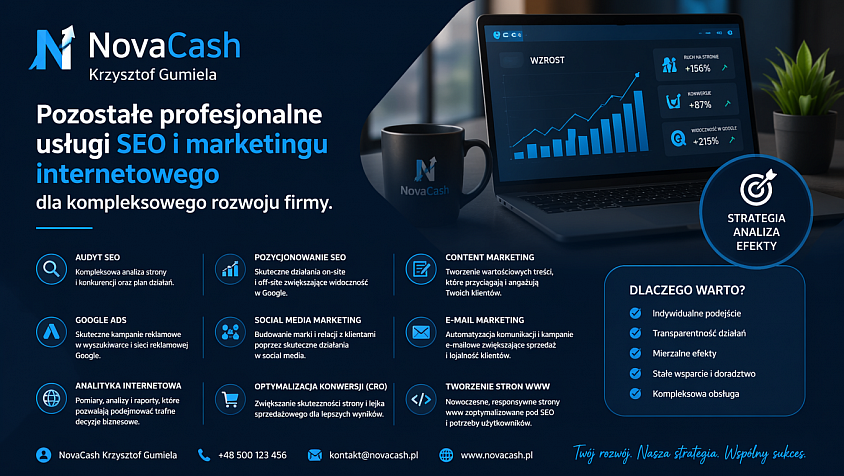
Other professional SEO and internet marketing services for comprehensive company development
We provide comprehensive SEO and online marketing support, focused on truly increasing brand visibility, increasing website traffic, and maximizing conversions. Our efforts are based on detailed data analysis, a strategy tailored to the specific industry, and continuous optimization of results.
The services we offer include, among others:
- comprehensive SEO audit (technical, content, linking),
- on-site and off-site optimization,
- keyword strategy based on competition analysis and user intentions,
- content marketing (creation and optimization of sales and blog content),
- construction and development of a link profile (link building),
- UX and conversion rate optimization (CRO),
- local SEO for service and e-commerce companies,
- running Google Ads and remarketing campaigns,
- web analytics and results reporting.
Each implementation is preceded by a detailed business and market analysis, which allows us to select activities closely aligned with the client's goals—regardless of whether the goal is to increase sales, generate leads, or build brand recognition.
We focus on measurable results: increased search engine visibility, increased organic traffic, and improved conversion rates. We work long-term, focusing on the sustainable development of your business in the online environment.
Online marketing is an effective way to reach new customers and build brand recognition. Professionally conducted marketing campaigns help increase sales, engage audiences, and strengthen a company's market position. With carefully selected activities, such as online marketing, it's possible to increase a company's visibility in search engines, social media, and other digital channels.
Want to better understand online marketing and effective SEO? Take advantage of our SEO course , which will help you learn the most important principles of website optimization and positioning. Also, visit our case studies , where you'll find implementation examples and information on the results achieved through the use of proven SEO strategies.
