
Marketing Guides – Blog about SEO, internet marketing, social media and brand building with practical tips.
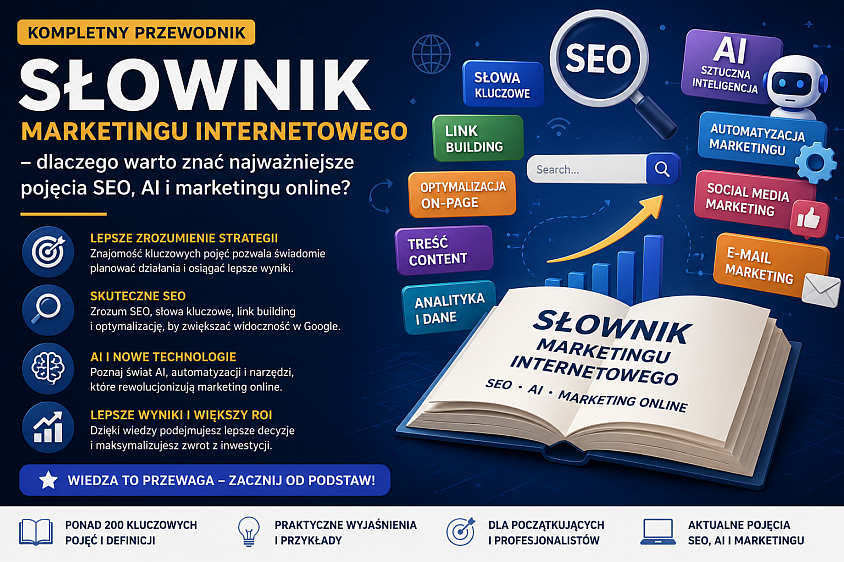
The Complete Guide: Internet Marketing Dictionary – Why is it important to know the most important terms of SEO, AI and online marketing?
Online marketing is evolving faster than ever. Just a few years ago, basic knowledge of SEO, Google Ads, and social media was enough. Today, effective promotion also requires an understanding of advanced concepts such as AI Search, GEO (Generative Engine Optimization), topical authority, structured data, Core Web Vitals, and semantic content optimization.
In response to these needs, the Internet Marketing Dictionary was created – a practical knowledge base containing definitions of key terms used by SEO specialists, marketers, entrepreneurs, and those just starting out in online marketing. The website provides a structured collection of terms related to SEO, online advertising, content marketing, analytics, search engine optimization, and artificial intelligence systems. ( NovaCash - Internet Marketing )
What is an internet marketing dictionary?
The Digital Marketing Dictionary is a comprehensive compendium explaining specialized terms used in digital marketing. It allows you to understand both basic definitions and the more advanced concepts necessary to effectively build website visibility.
A good dictionary is not limited to short definitions, but also presents:
- practical application of a given concept,
- impact on website positioning,
- importance to users,
- role in marketing strategy,
- relationships between individual elements of SEO and marketing.
This approach makes the dictionary not only a source of information, but also a practical guide for entrepreneurs and specialists.
Why use an internet marketing dictionary?
Online marketing now encompasses many specializations. Knowing the terminology makes it easier to:
- maintaining effective communication with the SEO agency,
- interpretation of reports from Google Search Console,
- analysis of data from Google Analytics,
- planning advertising campaigns,
- implementing content marketing activities,
- improving the visibility of the website,
- website optimization for AI search engines.
The better you understand the terminology used, the easier it will be to make good business decisions.
What terms are included in the internet marketing dictionary?
The modern internet marketing dictionary contains definitions from many areas of digital marketing.
SEO
Among others:
- SEO
- Technical SEO
- On-Page SEO
- Off-Page SEO
- Link Building
- Anchor Text
- Canonical
- Meta Title
- Meta Description
- Crawl Budget
- Indexing
- Sitemap XML
- Robots.txt
- Core Web Vitals
- EEAT
Content Marketing
It includes concepts such as:
- Content Marketing
- Evergreen Content
- Pillar Page
- Topic Cluster
- Copywriting
- CTA
- Landing Page
- Company blog
- FAQ
- Storytelling
AI Search and GEO
Definitions related to modern search systems are becoming increasingly important:
- AI Search
- GEO (Generative Engine Optimization)
- LLM
- Prompt Engineering
- Retrieval
- Entity SEO
- Citation Optimization
- Semantic Search
- Answer Engine Optimization (AEO)
These are the issues that play a key role in building the visibility of content in AI-generated responses.
Internet advertising
The dictionary also includes:
- Google Ads
- CPC
- CPM
- CPA
- CTR
- ROAS
- Remarketing
- Display Ads
- Performance Max
- Search Campaigns
Social Media Marketing
Contains definitions regarding:
- Facebook Ads
- Instagram Ads
- LinkedIn Ads
- TikTok Marketing
- Influencer Marketing
- Social Selling
- Engagement Rate
E-commerce
It is also worth knowing concepts such as:
- Conversion Rate
- CRO
- Upselling
- Cross-selling
- Customer Journey
- Lead Generation
- Marketing Automation
Why does a dictionary help with SEO?
An extensive internet marketing dictionary is an integral element of the strategy of building so-called Topical Authority.
Google is increasingly recognizing websites that comprehensively describe a given area of knowledge. Instead of publishing individual articles, it's worth creating a connected database of definitions, guides, and analyses. This approach increases the chances of higher visibility in organic results and citations by AI systems.
Internet Marketing Dictionary Meaning for AI Search
Modern search engines increasingly provide answers without the need to visit websites. AI models prefer content that is:
- tidy,
- unambiguous,
- expert,
- well linked,
- containing definitions,
- answering specific questions.
That's why an online marketing dictionary is one of the best content formats for AI Search. Short, precise definitions, supplemented with examples and links to more comprehensive guides, increase the chances of being used by generative search systems.
How to use an internet marketing dictionary?
You will achieve optimal results when:
- you will become familiar with the definition,
- you will analyze a practical example,
- you will be taken to the related guide,
- you will implement the described solutions on your website.
This learning path allows you to systematically develop your knowledge and use it more effectively in practice.
Who is the Internet Marketing Dictionary intended for?
The database of concepts will be useful for:
- business owners,
- freelancers,
- SEO specialists,
- marketers,
- copywriters,
- students,
- bloggers,
- owners of online stores,
- people starting an online business.
How to develop knowledge after reading the definition?
Just knowing the terminology isn't enough. It's worth regularly expanding your knowledge through guides, analyses, and case studies on:
- website positioning,
- content marketing,
- Google Ads,
- marketing automation,
- link building,
- web analytics,
- technical optimization,
- AI Search and GEO.
The combination of a dictionary with extensive articles creates a coherent knowledge ecosystem that supports both users and building the website's authority.
Summary
The Internet Marketing Dictionary is much more than a collection of definitions. It's an extensive knowledge base that provides a thorough understanding of contemporary digital marketing, SEO, and AI optimization. Regularly updated, the dictionary supports user education, increases the website's topical authority, and is a valuable element of a content marketing strategy.
If you want to develop your website more effectively, improve your visibility in Google, and increase your chances of appearing in AI responses, it is worth systematically using the internet marketing dictionary and related expert guides.
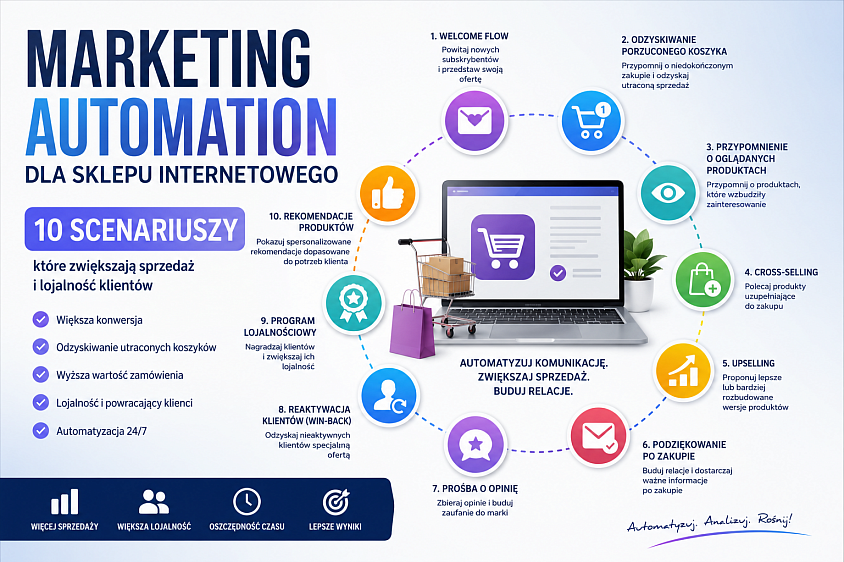
Marketing Automation for an Online Store – 10 Scenarios That Increase Sales and Customer Loyalty
Discover the 10 most effective marketing automation scenarios for online stores. Learn how to increase conversions, recover abandoned carts, and build lasting customer loyalty.
Marketing Automation for an Online Store – A Comprehensive Guide
Marketing automation is now a key element of effective online store management. In the face of growing competition, it's not enough to simply acquire traffic through SEO, Google Ads, or social media. Maximizing the potential of each visitor through intelligent communication automation is equally crucial.
Modern marketing automation systems analyze user behavior and initiate appropriate actions at optimal times, significantly increasing the chances of sales growth. This allows the online store to operate continuously, without the need for manual oversight of each process.
What is Marketing Automation?
Marketing automation is a set of technologies that enable the automation of marketing activities based on user behavior.
The system can, among other things:
- analyze customer behavior,
- segment your audience,
- send personalized messages,
- remind you about unfinished purchases,
- recommend products,
- build relationships after the sale,
- recover inactive customers.
The biggest advantage is the ability to personalize communication without having to manually manage each contact.
Why does Marketing Automation increase sales?
Customers expect communication tailored to their individual needs.
Automation allows you to:
- increasing conversion rate,
- recovery of lost transactions,
- increasing the value of the basket,
- increasing the frequency of purchases,
- building customer loyalty,
- optimization of marketing costs.
Carefully designed automation scenarios run 24 hours a day, responding to specific user behavior, significantly increasing the effectiveness of marketing activities.
10 Marketing Automation Scenarios for an Online Store
- Welcome Flow – automatic welcome sequence
The first contact with the customer is crucial.
After subscribing to the newsletter, the user should automatically receive:
- welcome message,
- brand presentation,
- the most important benefits,
- discount code or free delivery,
- overview of the most popular products.
It is the first messages that usually have the highest open and click rates.
- Recovering an abandoned cart
One of the most effective scenarios is a reminder about an unfinished order.
Sample reminder sequence:
- after 1 hour,
- after 24 hours,
- after 48 hours with additional incentive.
Various communication channels can be used, such as:
- e-mail,
- text message,
- web push,
- remarketing.
This solution allows us to recover a significant portion of lost orders.
- Reminder about viewed products
Not every customer adds a product to their cart. Often, users:
- they browse the offer,
- compare prices,
- they postpone the purchasing decision.
Marketing automation can automatically remind you about viewed products and suggest similar solutions.
- Cross-selling
After making a purchase, the system may recommend complementary products such as:
- phone case,
- printer ink,
- sports accessories,
- cosmetics from the same series.
Cross-selling increases average order value.
- Upselling
Automation allows you to offer customers more expensive or more advanced versions of products, for example:
- larger package,
- Premium version,
- subscription,
- extended warranty.
- Thank you after purchase
The relationship with the customer does not end with payment.
An automated email may include:
- thanks,
- instructions for use,
- guide,
- link to track your shipment,
- an invitation to further purchases.
Such actions strengthen trust in the brand.
- Request for opinion
A few days after receiving an order, the customer may automatically receive a request to rate the product.
Benefits include:
- more opinions,
- increased confidence,
- improving SEO,
- higher conversion rate.
- Customer reactivation (Win-back)
Inactive customers don't have to be lost forever.
After a certain period of time, the system may send:
- store reminder,
- information about new products,
- special offer,
- individual discount.
This is an effective method of regaining some customers without having to incur the costs of acquiring new ones.
- Loyalty program
Automation can:
- count points,
- remind you of their use,
- inform about new thresholds,
- send discount coupons.
Loyal customers purchase more often and generate higher Customer Lifetime Value (CLV).
- Product recommendations
Based on previous purchases, the system can present:
- similar products,
- news,
- complementary products,
- bestsellers from your favorite category.
Personalized recommendations increase conversion rates and cart value.
The most common mistakes when implementing Marketing Automation
The most common problems include:
- lack of customer segmentation,
- sending identical messages to all recipients,
- too aggressive selling,
- excessive number of messages,
- no analysis of results,
- no A/B testing,
- suboptimally designed shopping paths.
Automation will not replace a marketing strategy – its effectiveness depends on the quality of scenarios and data.
How to start implementing Marketing Automation?
It is best to implement solutions in stages:
Stage 1
- Welcome Flow
- Recovering an abandoned cart
Stage 2
- Cross-selling
- Upselling
- Customer reviews
Stage 3
- Win-back
- Loyalty program
- Personalized recommendations
This approach enables a quick return on investment and the gradual development of the automation system.
FAQ
Is Marketing Automation only for large stores?
No. Even small online stores can significantly increase sales thanks to basic scenarios such as welcome flow or abandoned cart recovery.
Which scenario should be implemented first?
The highest return on investment is usually provided by:
- welcome sequence,
- recovering an abandoned cart,
- messages after purchase.
Does Marketing Automation Affect SEO?
Indirectly, yes. A better user experience, more returning customers, longer time spent on site, and higher engagement can support the effectiveness of SEO efforts and increase the value of organic traffic.
Summary
Marketing automation is one of the most effective methods for increasing sales in online stores. Automated scenarios enable personalized communication at every stage of the customer journey – from the first visit, through purchase, to building loyalty and repeat purchases.
The greatest benefits come from scenarios like Welcome Flow, abandoned cart recovery, cross-selling, upselling, customer reactivation, and intelligent product recommendations. The gradual implementation of these solutions can increase conversion, cart value, and customer lifetime value while reducing the marketing team's workload.
Author of the article:
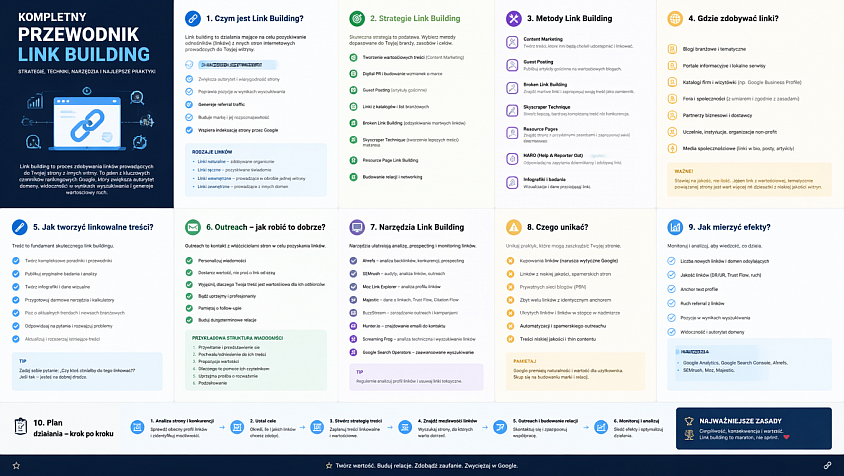
The Complete Link Building Guide 2026 - Effective Link Building for SEO and AI Visibility
What is Link Building and why is it important?
Link building is the process of acquiring links to a website from other websites. For Google, Bing, and modern AI algorithms like ChatGPT, Gemini, Copilot, and Perplexity, high-quality links remain a key signal of a website's authority.
Professionally implemented link building affects:
- improving your position in search results,
- increasing organic traffic,
- building domain authority,
- improving the indexation of new subpages,
- increased brand recognition,
- greater visibility in AI-generated responses.
Modern link building no longer relies on mass acquisition of random links. What's now crucial is the quality, topicality, and naturalness of the link profile.
How do links work in SEO?
Every link to a website can be considered a vote of confidence. When a valuable website links to yours, it transfers some of its authority.
Google analyzes, among other things:
- authority of the linking domain,
- the topic of the source page,
- the quality of the content surrounding the link,
- link location,
- domain history,
- naturalness of the link profile.
The links that have the greatest value are:
- placed in the content of the article,
- coming from thematically related websites,
- surrounded by valuable content,
- generating real user traffic.
Types of links used in positioning
- Dofollow links – they provide SEO power and support website positioning. They form the basis of most link building strategies.
- Nofollow links – do not directly convey full ranking power, but they can generate traffic, build a brand and support the naturalness of the link profile.
- Sponsored links – marked with the rel="sponsored" attribute, mainly used for commercial publications and sponsored articles.
- UGC links – with the rel="ugc" attribute, used on internet forums, blogs and user-generated content.
- Brand links – contain the name of a brand, company or author, especially valued in the context of building EEAT.
The most effective methods of acquiring links
- Sponsored articles – publishing expert materials on industry portals is one of the safest methods of acquiring valuable links.
Benefits:- high quality links,
- increased brand recognition,
- the ability to build topical authority,
- additional traffic from publications.
- SEO support – creating your own thematic pages allows you to have full control over your link profile.
A modern SEO infrastructure should include:- unique content,
- regular updates,
- logical structure,
- own link profile.
- Local linking – in local SEO the following play a key role:
- company catalogs,
- regional portals,
- city pages,
- local blogs,
- news services.
- Digital PR – expert publications, industry reports and media commentary allow you to gain strong links from reputable sources.
- Guest Posting – publishing guest articles on other websites remains an effective method of building authority and gaining natural links.
Link Building and AI SEO and GEO
As artificial intelligence advances, the role of links is also changing. AI systems increasingly analyze:
- brand citations,
- mentions without links,
- the authority of the author,
- sources of information,
- thematic connections.
Therefore, a modern SEO strategy should include:
- Building expert authority – expert publications help algorithms identify the author as a credible source of knowledge.
- Brand mentions – even without an active link, having your company name appear in multiple sources increases its recognition.
- Topical Authority – Google and AI prefer pages that comprehensively describe a given topic, so it is worth creating:
- guides,
- case studies,
- FAQs,
- analysis,
- industry news.
The most common mistakes in link building
- Buying weak links – mass linking from low-quality sites can result in algorithmic filters.
- Over-optimization of anchors – repeating identical keyword phrases looks unnatural.
A secure profile should include:- brand anchors,
- URLs,
- general anchors,
- anchors partially fitted.
- Lack of diversity of sources – it is worth obtaining links from:
- blogs,
- industry portals,
- local media,
- forums,
- quality catalogs,
- social media.
- Ignoring the quality of the content – a link placed in a valuable article is much more effective than a link surrounded by poor content.
How to create an effective link building strategy?
A professional link building strategy should include:
- Link profile audit – analysis of current links allows you to detect weak points and potential threats.
- Competition analysis – worth checking out:
- where your competitors are linking from,
- what anchors do they have,
- which pages generate the most SEO power.
- Publication plan – regular link acquisition looks more natural than sudden spikes in link count.
- Content expansion – the more valuable materials there are on the website, the easier it is to acquire natural links.
- Monitoring the effects – the following should be analyzed regularly:
- phrase positions,
- organic traffic,
- indexation,
- increase in the number of linking domains,
- brand visibility.
FAQ – Frequently Asked Questions about Link Building
Does link building still work?
Yes. Links remain one of the most important ranking factors in Google and support visibility in AI systems.
How many links do you need to achieve high rankings?
There's no universal number. The quality and authority of linking domains are far more important than the sheer number of links.
How quickly can you see the effects?
The first results may appear after a few weeks, but the full effects of professional link building are usually visible after a few months.
Is it worth building your own SEO resources?
Yes, as long as it consists of valuable pages developed over the long term.
Do mentions without links matter?
Yes. Google and AI systems are becoming increasingly effective at analyzing brand citations and authority signals beyond traditional links.
Summary
Link building remains the foundation of effective SEO. In 2026, high-quality thematic links, brand authority, topical authority, and a natural link profile are paramount. An effective strategy should combine sponsored articles, digital PR, local SEO, valuable content, and activities that support visibility in artificial intelligence systems. Companies that consistently invest in quality link building achieve better Google rankings, greater organic traffic, and higher brand recognition in both search engines and AI tools.
Author of the article:
Krzysztof Gumiela – SEO and Internet Marketing Expert
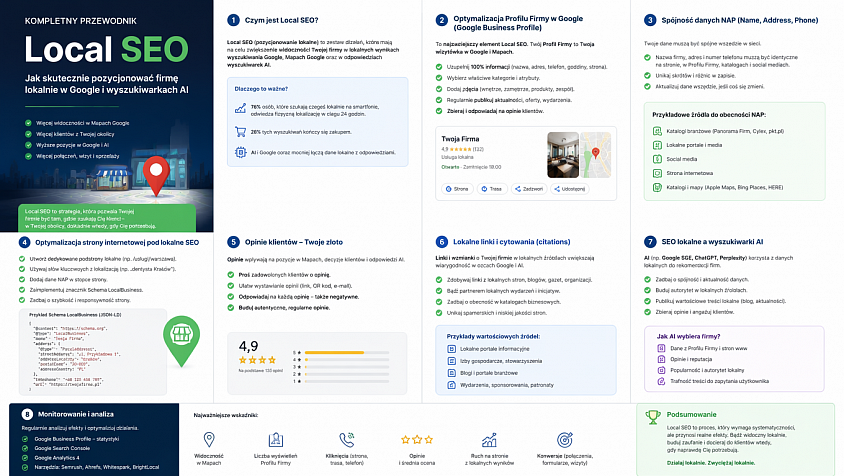
The Complete Local SEO Guide – How to Effectively Position Your Business Locally on Google and AI Search Engines
What is Local SEO and why is it crucial?
Local SEO (local positioning) is a set of optimization activities aimed at increasing a company's visibility in search results for users searching for products or services in a specific geographic area. With an effective local SEO strategy, a company can appear in both organic Google results and Google Maps, as well as in responses generated by AI systems such as ChatGPT, Gemini, Copilot, and Perplexity.
Examples of local queries include:
- website positioning Lublin
- dentist Warsaw
- plumber Krakow
- law firm Poznań
- internet marketing Lublin
- restaurant near me
- the best hairdresser in the area
As artificial intelligence advances, local ranking signals are becoming increasingly important. Algorithms are increasingly able to interpret a user's location context and search intent with greater precision.
How does local SEO work?
Google analyzes hundreds of ranking factors, of which three areas play the most important role in Local SEO:
Relevance
Google evaluates how accurately a company's profile responds to user queries. The more precisely you describe your business, services, and location, the greater your chance of ranking high in the results.
Distance
The search engine takes into account the physical distance between the user and the company, so the location of the company is crucial.
Prominence
Factors such as:
- customer reviews,
- mentions on the internet,
- links leading to the site,
- company activity,
- domain authority,
- presence in local directories.
Google Business Profile – the foundation of Local SEO
One of the most important elements of local SEO is a company profile on Google Business Profile. It's important to ensure:
Completeness of the profile
Complete:
- company name,
- address,
- phone number,
- website,
- working hours,
- description of the activity,
- business categories.
Photos and multimedia
Regularly add:
- photos of the headquarters,
- provision of services,
- products,
- team photos,
- presentation videos.
News and posts
Posting on your Google profile increases user engagement and provides new ranking signals to the algorithms.
Responses to opinions
Google rewards companies that actively communicate with customers. It's important to respond to both positive and negative reviews.
Customer reviews as a key ranking factor
Reviews are one of the most important elements of local SEO. The benefits of a large number of positive reviews include:
- greater customer confidence,
- higher click rate,
- better visibility in Google Maps,
- a greater number of inquiries,
- stronger signals for AI algorithms.
Best practice is to systematically gather authentic reviews from real customers. Encourage them to post reviews that include:
- name of the service,
- location,
- details of cooperation,
- implementation effects.
Website optimization for Local SEO
Local keywords
Phrases should include:
- name of the city,
- region,
- district,
- area of operation.
Examples:
- SEO Lublin
- website positioning Lublin
- internet marketing Lublin
- SEO audit Lublin
- SEO specialist Lublin
Meta tag optimization
Example:
Title:
Website positioning Lublin | SEO and Internet Marketing
Meta Description:
Effective website positioning in Lublin. SEO audits, optimization, link building, and online marketing for local businesses.
H1-H3 headings
Each subpage should have a logical heading structure that takes into account local keywords.
Contact details
The website should include:
- company address,
- phone number,
- email address,
- Google map,
- contact form.
Local landing pages and city websites
If your company serves multiple locations, it is worth preparing dedicated subpages for each city.
Examples:
- website positioning Warsaw
- website positioning Krakow
- website positioning Lublin
- website positioning Rzeszów
Each subpage should contain:
- unique description,
- local references,
- case studies,
- customer reviews,
- FAQs.
Avoid copying identical content between locations.
Local link building
Local links are of particular value for SEO.
Local link sources include:
Company catalogs
- Business Panorama
- Cylex
- Oferteo
- pkt.pl
- Firmy.net
Local portals
- city portals,
- local media,
- news services,
- regional blogs.
Business organizations
- chambers of commerce,
- entrepreneurs' associations,
- local industry organizations.
The more local a link is, the more value it has for local SEO.
Schema.org and Structured Data
Structured data allows Google and AI systems to better interpret company information.
The most important tags are:
- LocalBusiness
- Organization
- PostalAddress
- GeoCoordinates
- FAQ Page
- Review
- AggregateRating
Correctly implementing schema.org increases your chances of getting enhanced search results.
Local SEO and Artificial Intelligence (AI SEO, GEO and AEO)
Modern search engines increasingly use artificial intelligence models, so local SEO should take into account:
GEO (Generative Engine Optimization)
Optimization for AI-generated responses.
AEO (Answer Engine Optimization)
Creating content that answers users' questions directly.
Building local authority
AI analyzes:
- the company's expertise,
- experience,
- customer reviews,
- brand citations,
- presence in numerous sources.
The stronger a brand's presence in the local online ecosystem, the more often it will be recommended by AI tools.
The Most Common Mistakes in Local SEO
Many companies make similar mistakes, such as:
- unverified Google business card,
- no customer reviews,
- inconsistent NAP data (Name, Address, Phone),
- lack of local keywords,
- lack of structured data,
- poor mobile optimization,
- no local links,
- duplicate local content.
Eliminating these issues can often quickly improve your visibility in search results.
FAQ – frequently asked questions
How long does Local SEO take?
The first effects are visible after a few weeks, while full results usually appear after 3–6 months of systematic use.
Is a Google Business Profile enough?
No. A business card is the foundation, but the best results are achieved through a combination of website optimization, link building, customer reviews, and a content marketing strategy.
Do reviews affect ranking?
Yes. The number, quality, and regularity of reviews are important ranking factors.
Does Local SEO work for mobile services?
Yes. Even businesses providing on-site services can effectively position themselves locally with the right Google Business Profile configuration.
Does Local SEO support AI results?
Yes. AI tools increasingly leverage local ranking signals, reviews, structured data, and brand authority.
Summary
Local SEO is currently one of the most effective channels for acquiring customers. A properly optimized Google Business Profile, local keywords, valuable reviews, local link building, schema.org data, and content prepared for AI SEO, GEO, and AEO significantly increase a company's visibility both on Google and modern AI-based search engines.
Companies that invest in local SEO build a competitive advantage, increase organic traffic, obtain more inquiries, and more effectively reach customers seeking services in their area.
Author of the article:
NovaCash Krzysztof Gumiela – SEO specialist
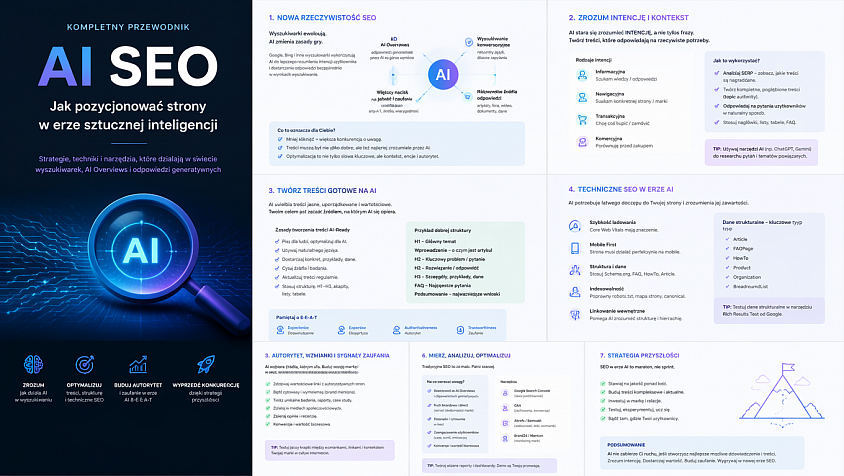
The Complete AI SEO Guide – How to Rank Your Site in the Age of Artificial Intelligence
What is AI SEO and why is it revolutionizing the rules of the game?
AI SEO (Artificial Intelligence SEO) is an advanced approach to website positioning that integrates traditional SEO techniques with content optimization for artificial intelligence systems such as ChatGPT, Gemini, Copilot, Perplexity, and AI Overviews on Google.
Just a few years ago, the primary goal was to achieve high rankings in Google search results. Today, users increasingly receive answers generated by artificial intelligence, without having to visit multiple websites. Therefore, companies must ensure not only search engine visibility but also presence in the answers generated by AI models.
AI SEO involves optimizing content, building expert authority, developing topical authority, and creating materials that AI systems can use as credible sources of information.
How do search engines and AI systems work?
Traditional search engines analyze:
- keywords,
- page structure,
- incoming links,
- qualitative signals,
- user experience.
AI systems go a step further by analyzing:
- content context,
- the importance of information,
- the authority of the author,
- credibility of the source,
- thematic consistency throughout the site.
Therefore, a modern SEO strategy should focus on providing comprehensive answers to user questions, not just on inserting keywords into the content.
The foundations of effective AI SEO
- Creating expert content
Artificial intelligence models prefer valuable and substantive content. Good content should:
- answer specific questions,
- solve user problems,
- contain data and examples,
- be updated regularly,
- present expert knowledge.
Formats such as "Complete Guide", "FAQ", "Step-by-Step Guide" or "Frequently Missed" are currently among the most effective.
- EEAT
Google is increasingly placing greater emphasis on the concepts of Experience, Expertise, Authoritativeness, and Trustworthiness. In practice, this means publishing:
- information about the author,
- case studies,
- customer reviews,
- portfolio of projects,
- company contact details.
AI SEO Keyword Research
Classic phrases still hold significance, but the following are playing an increasingly important role:
- Conversational phrases
Examples:
- How to improve your website's visibility on Google?
- What influences website positioning?
- How does AI SEO work?
- How to optimize your website for ChatGPT?
- Long Tail Keywords
Long-tail keywords typically generate more valuable traffic. Examples:
- professional website positioning for small businesses,
- website optimization for artificial intelligence,
- how to increase organic traffic with AI SEO.
- Semantic phrases
Google and AI systems analyze relationships between concepts. For the phrase "AI SEO," it's also worth using:
- SEO for artificial intelligence,
- optimization for AI,
- GEO,
- AEO,
- AI Search,
- generative search,
- positioning in ChatGPT.
GEO and AEO – the new generation of SEO
Generative Engine Optimization (GEO) involves optimizing content for generative search engines. The goal of GEO is to increase the likelihood that engines such as:
- ChatGPT,
- Gemini,
- Copilot,
- Perplexity,
- AI Overviews
will use your content when generating responses.
AEO (Answer Engine Optimization) focuses on providing ready-made answers to user questions. The best solutions are:
- FAQ sections,
- bulleted lists,
- definitions,
- step-by-step instructions,
- comparison tables.
The importance of content structure
Modern content should be easy to interpret by both users and algorithms. Key elements include:
- Heading hierarchy
H1 – main topic,
H2 – main sections,
H3 – topic developments. - Short paragraphs
AI systems prefer clear content with 2-5 sentences per paragraph. - Lists and bullet points
They facilitate content analysis, indexing, and the use of snippets in AI responses.
Linking in AI SEO strategy
Internal linking supports building topical authority. Sample structure:
Home → SEO → AI SEO → GEO → AEO → Link Building → SEO Audit
External linking remains a key ranking factor. It's worth acquiring links from:
- industry portals,
- expert blogs,
- news services,
- company catalogs,
- sponsored publications.
Schema.org Structured Data
Schema Markup allows search engines to better interpret a page's content. The most important markups are:
- Article,
- FAQPage,
- LocalBusiness,
- Person,
- Organization,
- Service,
- BreadcrumbList.
Thanks to them, the chance of obtaining extended search results and using content by AI systems increases.
The best AI SEO tools
Analytical tools:
- Google Search Console,
- Google Analytics 4,
- Bing Webmaster Tools.
SEO tools:
- Ahrefs,
- Semrush,
- Screaming Frog,
- Surfer SEO.
AI tools:
- ChatGPT,
- Gemini,
- Claude,
- Perplexity,
- Microsoft Copilot.
It is worth using them for keyword analysis, generating content ideas, article optimization and competitor research.
The Most Common Mistakes in AI SEO
The most common problems include:
- publishing superficial AI-generated content without verification,
- lack of authorial authority,
- excessive keyword saturation,
- poor internal linking,
- lack of structured data,
- duplicate content,
- ignoring user experience (UX).
These types of actions can negatively impact both your Google ranking and your visibility in AI-generated responses.
The Future of AI SEO
SEO is currently undergoing its biggest transformation since the founding of Google. In the coming years, the following will be crucial:
- artificial intelligence,
- conversational search,
- personalization of results,
- expert authority,
- topical authority,
- GEO and AEO,
- structured data.
Companies that adapt their websites to the requirements of search engines and AI systems now will gain a competitive advantage and increase their visibility both in organic results and in responses generated by artificial intelligence.
Summary
AI SEO combines traditional website positioning with optimization for generative artificial intelligence systems. An effective strategy requires creating expert content, building authority, implementing structured data, developing topical authority, and optimizing for GEO and AEO. This allows for increased organic traffic, improved visibility on Google, and presence in responses generated by ChatGPT, Gemini, Copilot, and other modern AI systems.
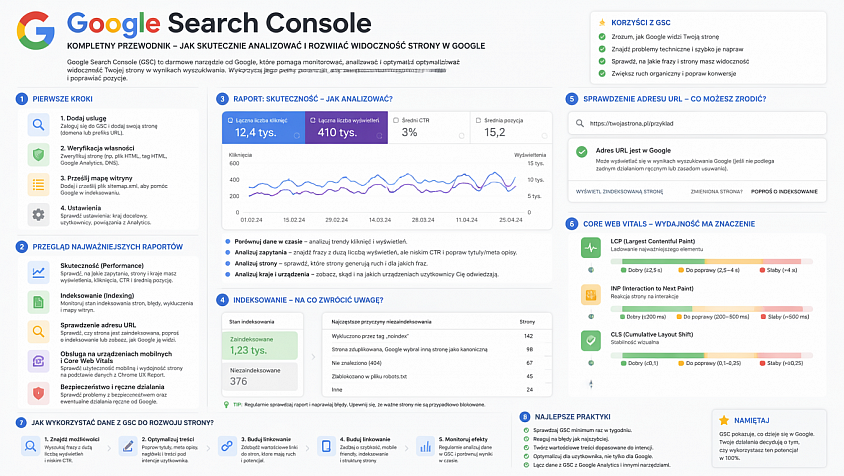
The Complete Google Search Console Guide – How to Effectively Analyze and Develop Your Website's Visibility in Google
Google Search Console – A Comprehensive Guide for Website Owners
Google Search Console (GSC) is one of the most important free tools for website owners, SEO specialists, marketers, and entrepreneurs developing their online presence. It allows you to monitor your website's visibility in Google, analyze organic traffic, identify technical errors, and optimize your website for SEO and artificial intelligence.
In the era of artificial intelligence, semantic search, and advanced algorithms such as Google AI Overview, Google Search Console is a key tool for managing a website's visibility.
What is Google Search Console?
Google Search Console is a free platform created by Google that allows you to monitor indexation, keyword position, number of clicks, views and the technical status of your website.
With GSC you can:
- check your website's visibility on Google,
- monitor keyword positions,
- analyze organic traffic,
- submit XML sitemaps,
- detect indexing errors,
- monitor Core Web Vitals,
- analyze links leading to the website,
- monitor the effectiveness of SEO activities.
Why is Google Search Console crucial for SEO?
Without reliable data, it's difficult to effectively implement SEO strategies. Google Search Console provides information directly from Google, ensuring the highest level of reliability for your website data.
Benefits of using GSC include:
Keyword position monitoring
You can check:
- which queries generate clicks,
- average keyword positions,
- CTR rate.
This is an excellent source of information for developing your content marketing and positioning strategy.
Detecting technical problems
Google Search Console informs about:
- 404 errors,
- indexation problems,
- redirection errors,
- problems with the mobile version,
- structured data errors.
How to add a website to Google Search Console?
The setup process is simple and consists of the following steps:
Step 1 – Login
Go to the Google Search Console website and log in with your Google account.
Step 2 – Adding a service
There are two types of properties available:
- Domain – Includes all subdomains and HTTP and HTTPS protocols. This is the recommended option.
- URL Prefix – Monitors only the specified URL.
Step 3 – Ownership Verification
The most commonly used verification methods are:
- DNS record,
- HTML file,
- Google Analytics,
- Google Tag Manager.
After successful verification, data analysis can begin.
Performance Report – A Key Section of the GSC
The Performance report is the hub of Google Search Console, where you will find data on:
- number of clicks,
- views,
- CTR rate,
- average position in search results.
How to interpret the data?
- High number of views and low CTR – indicates unattractive SEO titles, need to improve meta description or strong competition attracting clicks.
- A large number of clicks with a low position – a signal to expand content and internal linking.
- High positions without traffic – may indicate low search volume for a given phrase.
Page Indexing and the Pages Report
The "Pages" section presents URLs indexed by Google and allows you to:
- checking indexed pages,
- identification of excluded parties,
- detecting indexing errors,
- analysis of redirection problems.
The most common causes of problems are:
- Page detected but not indexed – Google knows the URL but has not visited it yet.
- Page scanned but not indexed – most often caused by poor content quality, duplication or insufficient value for the user.
- Error 404 – deleted or non-existent page; it is recommended to implement a 301 redirect.
Link analysis in Google Search Console
Links remain a key ranking factor. The "Links" report presents:
- external links,
- internal linking,
- most frequently linked pages,
- referring domains.
This allows you to evaluate your link profile, develop your link building strategy and identify the most important subpages.
Core Web Vitals and User Experience
Google is increasingly focusing on user experience. Google Search Console now offers a Core Web Vitals report that covers key metrics:
- LCP (Largest Contentful Paint) – loading time of the main page element,
- INP (Interaction to Next Paint) – website responsiveness,
- CLS (Cumulative Layout Shift) – visual stability of the page.
Improving these parameters has a positive impact on SEO , conversion and user experience.
Google Search Console and Artificial Intelligence
The development of AI is changing the way we search for information. Google is increasingly analyzing:
- user intent,
- query context,
- semantic relationships between topics.
Therefore, when analyzing data in GSC, it is worth paying attention to:
- Long tail queries , e.g. "how Google Search Console works", "how to check the indexing of a website", "how to improve the position of a website in Google",
- Thematic clusters – creating groups of related articles covering a given topic,
- Topical Authority – building expert authority, which increases the chances of your content being displayed both in Google Search and in AI-generated responses.
SEO Best Practices Using Google Search Console
- Monitor your performance report weekly,
- Analyze new keywords regularly,
- Update XML maps,
- Fix indexing errors,
- Optimize titles and meta descriptions,
- Develop content that generates views,
- Analyze internal linking,
- Monitor Core Web Vitals,
- Build topical authority,
- Create content that answers questions from users and AI systems.
Summary
Google Search Console is an essential tool for every SEO specialist, website owner, and digital marketing expert. It allows you to analyze your visibility in Google, monitor organic traffic, control indexing, and identify technical issues affecting your SEO.
Regular use of Google Search Console allows you to make data-driven decisions, increase your website's visibility, improve your position in search results, and effectively prepare your website to operate based on modern Google algorithms and artificial intelligence systems.
Author of the article:
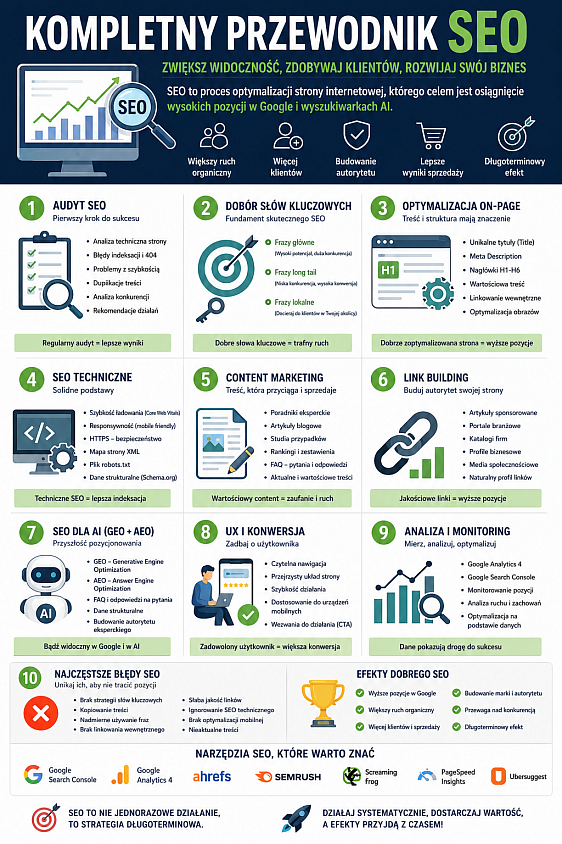
The Complete SEO Guide – How to Effectively Position Your Website in Google and AI Search Engines
What is SEO and why is it crucial?
SEO (Search Engine Optimization) is the process of optimizing a website, aimed at increasing its visibility in Google search results and generating valuable organic traffic. Modern SEO activities go beyond traditional SEO to also include optimization for artificial intelligence systems such as ChatGPT, Gemini, Copilot, and Perplexity.
A professionally developed SEO strategy allows you to:
- increasing organic traffic,
- acquiring new customers,
- building brand recognition,
- improving conversion rates,
- reducing customer acquisition costs,
- strengthening the authority of the website.
SEO is currently one of the most cost-effective online marketing channels.
How do Google algorithms work?
Google uses hundreds of ranking factors to evaluate websites. The search engine's robots analyze factors such as:
- content quality,
- website structure,
- page loading speed,
- backlink profile,
- user experience,
- domain authority,
- EEAT signals (Experience, Expertise, Authoritativeness, Trustworthiness).
The goal of algorithms is to provide users with the most valuable and reliable answers to their queries.
Therefore, effective positioning requires a comprehensive approach, encompassing both technical optimization and content marketing.
SEO audit – the first step to high rankings
Every positioning process should begin with a professional SEO audit, which allows us to identify:
Technical problems
- indexing errors,
- broken links,
- 404 errors,
- problems with redirects,
- duplicate content,
- XML sitemap errors.
Content Issues
- no keywords,
- thin content,
- duplicate content,
- suboptimal headlines.
UX Issues
- slow page loading,
- not adapted to mobile devices,
- illegible structure.
Regularly conducting an SEO audit allows you to maintain the high quality of your website and quickly respond to algorithm changes.
Selection of keywords
Keyword analysis is the foundation of an effective SEO strategy. The most important keyword types are:
Main phrases
Examples:
- website positioning,
- SEO services,
- internet marketing,
- website optimization.
Long tail phrases
Examples:
- how much does website positioning cost,
- effective SEO for a local business,
- how to increase your visibility on Google.
Local phrases
Examples:
- SEO Lublin,
- website positioning Warsaw,
- internet marketing Krakow.
Long tail phrases often convert higher than highly competitive keywords.
On-Page Optimization
On-Page SEO covers all activities performed directly on the website.
SEO Titles
Each subpage should have a unique title containing the main keyword.
Example:
Website Positioning – Effective SEO and Online Marketing
Meta Description
The description should encourage clicking and contain key phrases.
H1-H6 headings
Correct heading structure makes it easier for Google robots to understand the topic of the page.
Content optimization
It is recommended to use:
- synonyms,
- semantically related words,
- user questions,
- statistical data,
- practical examples.
Internal linking
Carefully planned link structure:
- facilitates indexing,
- strengthens important subpages,
- improves user experience.
Technical SEO
Technical SEO is the foundation of effective SEO. Key elements include:
Core Web Vitals
Google rates:
- loading speed,
- visual stability,
- interactivity of the site.
Responsiveness
The website must work properly on:
- smartphones,
- tablets,
- computers.
HTTPS
An SSL certificate is now the standard for ensuring security.
Schema.org
Structured data helps search engines interpret your website content. Popular tags include:
- Organization,
- LocalBusiness,
- Article,
- FAQs,
- Review,
- Person.
XML sitemap
An up-to-date sitemap significantly improves the indexing of new subpages.
Content Marketing and SEO
Content remains one of the most important ranking factors. The most effective forms are:
- expert guides,
- case studies,
- industry analyses,
- reports,
- rankings,
- FAQs.
It's important to create content that answers specific user questions. Google is increasingly understanding search intent, so content should deliver real value.
Link Building – building the authority of the website
Backlinks remain one of the most important ranking factors. The most effective link sources include:
- sponsored articles,
- expert publications,
- industry portals,
- high-quality company catalogs,
- business profiles,
- social media.
It's worth focusing on quality, not just quantity, of links. A natural link profile increases the trust of Google's algorithms.
SEO for AI – the future of positioning
As more and more users use AI-powered search engines, a modern SEO strategy should include:
GEO (Generative Engine Optimization)
Optimization for generative AI search engines.
AEO (Answer Engine Optimization)
Creating content that answers specific user questions.
Building expert authority
AI increasingly cites sources that are:
- reliable,
- current,
- specialized.
Extensive FAQ
Question and answer sections increase your chances of appearing in AI-generated answers.
Structured data
Schema.org supports AI systems in interpreting website content.
The most common SEO mistakes
Many websites lose their potential due to basic mistakes such as:
- lack of keyword strategy,
- copying content,
- excessive use of phrases,
- no internal linking,
- poor quality backlinks,
- ignoring technical SEO,
- no mobile optimization,
- outdated content.
Eliminating these issues often leads to a rapid increase in visibility.
Summary
SEO is a long-term process that requires a carefully planned strategy, regular optimization, and continuous content development. Effective SEO includes an SEO audit, keyword selection, technical optimization, content marketing, link building, and GEO and AEO activities related to the development of artificial intelligence.
Companies investing in professional SEO increase their visibility in Google, acquire valuable organic traffic, build brand authority and gain a competitive advantage both in traditional search results and in responses generated by modern AI systems.
Author of the article:
Krzysztof Gumiela – SEO and Internet Marketing Expert for Businesses
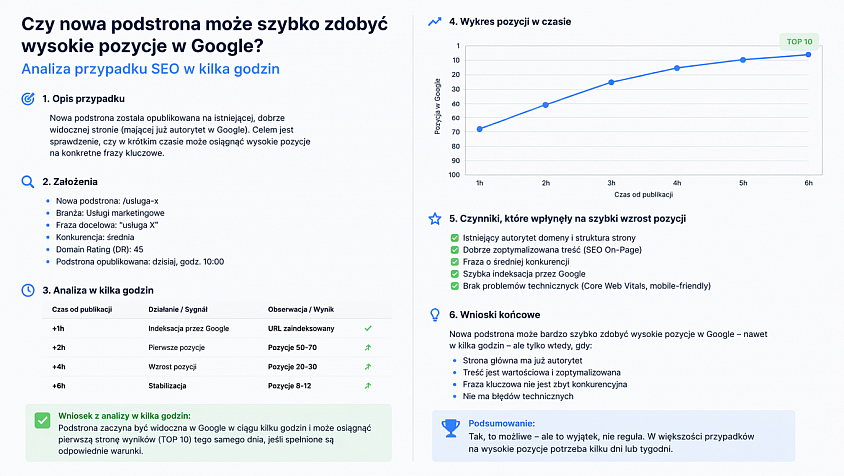
Can a New Page Quickly Rank High in Google? SEO Case Study in Hours
Yes, it's possible. While most SEO efforts take weeks or months to produce results, there are cases where a newly published page reaches high positions in Google search results within just a few hours of publication.
An example is the phrase " SEO and Internet Marketing Expert ," for which a new subpage achieved 4th place in Google within a few hours. Importantly, this result was achieved without the support of a Google Ads campaign or additional external linking. Comprehensive website optimization played a key role.
Is it possible to quickly position a new website?
Yes, but under certain conditions.
Google doesn't just evaluate a website's age. Its algorithms primarily analyze:
- quality and uniqueness of content,
- consistency of content with the user's search intent,
- information structure,
- domain authority,
- technical correctness of the website,
- user experience (UX),
- loading speed and website accessibility.
If a new subpage responds to a specific query better than the competition, it can be indexed quickly and achieve high rankings even in a very short time.
Case Study: "SEO and Internet Marketing Expert"
The goal was to create a subpage that would meet the needs of users looking for a specialist in SEO and online marketing.
Optimization included:
- Precise match to search intent
The content has been prepared for users entering queries such as:
- SEO expert,
- SEO specialist,
- internet marketing expert,
- SEO consultant,
- professional SEO services,
- website SEO audit,
- how to choose an SEO expert.
Thanks to this, Google received a clear signal regarding the topic of the subpage.
- Technical SEO optimization
Applied:
- optimized Title tag,
- unique meta description,
- correct structure of H1-H3 headings,
- internal linking,
- friendly URL,
- appropriate structured data,
- fast page loading.
These elements influence both indexation and the assessment of the page's quality by search engine algorithms.
- Building EEAT signals
Google is placing increasing importance on the author's credibility and practical experience.
Therefore, effective expert websites should include:
- information about the author,
- description of professional experience,
- case studies,
- results of the activities carried out,
- customer references,
- transparent contact details.
In the SEO and internet marketing industry, these factors are particularly important because they require a high level of trust.
Why can optimization alone bring quick results?
Many companies focus primarily on acquiring external links, when the greatest growth potential often lies within the website itself.
Well-optimized subpage:
- is easier for Google robots to understand,
- gets into the index faster,
- better responds to user needs,
- achieves a higher click-through rate (CTR),
- has a greater chance of appearing in AI Overviews.
In practice, this means that properly prepared content can generate visibility almost immediately after publication.
How to increase your chances of appearing in Google's AI Overviews?
AI systems select content that:
- answer users' questions directly,
- contain specific data and examples,
- are written in expert language,
- present practical experience,
- have a clear structure.
It is recommended to use sections such as FAQs, case studies and answers to frequently asked questions.
Frequently asked questions
Can a new website reach the Google TOP 10 in one day?
Yes. For niche or highly targeted phrases, this is possible even within a few hours of publication.
Are links always needed to achieve high rankings?
No. Links remain an important ranking factor, but many pages achieve high rankings thanks to proper technical optimization and high-quality content.
How quickly does Google index new pages?
This process can take anywhere from a few minutes to several days. For regularly updated and well-optimized websites, it's usually very quick.
What has the greatest impact on the visibility of a new website?
The most important are:
- relevance of content,
- quality of SEO optimization,
- domain authority,
- user experience,
- relevance to search intent.
Conclusions
The example of the phrase "SEO and Internet Marketing Expert" proves that achieving high Google rankings doesn't always require months of effort. Under favorable conditions, website optimization alone can result in a new page appearing in top search results within hours of publication.
This doesn't mean, however, that every new website will achieve similar results. Content quality, the author's experience, technical optimization, and the ability to create materials that truly answer users' questions are crucial. These elements form the foundation of effective SEO and increase the chances of visibility in both traditional search results and those generated by artificial intelligence.
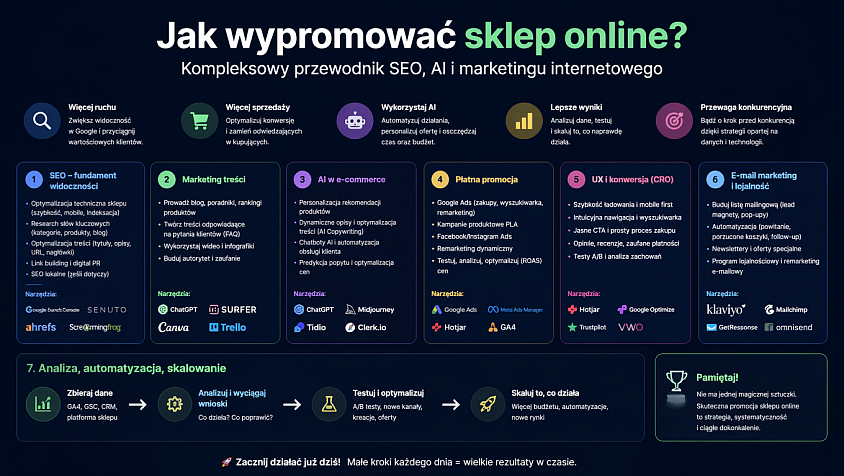
How to Effectively Promote Your Online Store? The Complete Guide to SEO, AI, and Digital Marketing for E-Commerce
Why is promoting an online store more challenging than ever before?
The e-commerce market is growing at an incredibly rapid pace. Thousands of new online stores are launched every year, competing for the attention of the same customers. Simply launching a store doesn't guarantee success—acquiring traffic, building brand recognition, and effectively converting visitors into customers are crucial.
Modern online store promotion requires an integrated approach that combines SEO, content marketing, social media, paid advertising, and AI-based search engine optimization. Companies that strategically leverage all of these channels achieve significantly better sales results.
SEO as the foundation for online store promotion
Online store SEO remains one of the most effective and cost-effective sources of traffic. Users who enter specific shopping phrases already demonstrate interest in the product, which translates into high conversions.
Technical optimization
The basis of effective SEO is:
- fast page loading,
- responsiveness on mobile devices,
- correct URL structure,
- SSL certificate implementation,
- Core Web Vitals optimization,
- correct indexation by search engine robots.
Google is paying more and more attention to user experience (UX), so technical aspects have a direct impact on search results.
Category and product optimization
Each product card should include:
- unique description,
- carefully selected keywords,
- H1, H2 and H3 headings,
- optimized photos,
- Schema.org structured data,
- FAQ section.
Avoid copying manufacturer descriptions as this may limit the store's visibility in search results.
Content marketing to increase traffic and sales
Regularly publishing valuable content allows you to build brand authority and acquire traffic from the long tail of searches.
Example article topics include:
- shopping guides,
- product rankings,
- comparison of solutions,
- instructions for use,
- answers to frequently asked questions.
A professionally run company blog can generate up to several dozen percent of the store's total organic traffic.
How to prepare your store for AI searches?
More and more users are using tools like ChatGPT, Gemini, Perplexity, and Google AI Overviews. This means content needs to be optimized not only for traditional SEO but also for artificial intelligence systems.
Create complete answers
AI models prefer content that:
- exhaust the topic,
- answer specific questions,
- contain data, statistics and examples,
- are logically ordered.
Use FAQ sections
Questions and answers increase the chances of AI systems using your content to generate answers for users.
Example:
How to quickly promote an online store?
Google Ads campaigns and social media ads yield the fastest results. However, SEO combined with content marketing provides the highest long-term return on investment.
Build expert authority
AI algorithms analyze the credibility of sources, so it is worth:
- publish expert content,
- present authors,
- get citations and links,
- update articles regularly.
Google Ads as a way to get instant traffic
Positioning takes time, while Google Ads campaigns allow you to reach customers almost immediately.
The most important types of e-commerce campaigns are:
- Google Shopping product campaigns,
- Performance Max,
- search engine advertising,
- remarketing.
Carefully configured campaigns allow you to quickly increase sales and obtain the data necessary for further SEO optimization.
Social Media and Community Building
A presence on social media supports brand recognition and strengthens customer trust.
Depending on the industry, it is worth using:
- Facebook,
- Instagram,
- TikTok,
- LinkedIn,
- Pinterest,
- YouTube.
The greatest results are achieved by brands that regularly publish educational, guide and inspirational materials.
Email marketing is still effective
Despite the development of new communication channels, email marketing remains one of the most profitable sales tools.
It is worth implementing:
- automation of abandoned carts,
- newsletters with tips,
- promotional campaigns,
- loyalty programs.
Building your own mailing database allows you to become independent from changes in search engine algorithms and social media.
Link building and building domain authority
Acquiring valuable external links remains one of the key ranking factors.
Effective actions include:
- expert publications,
- sponsored articles,
- cooperation with industry portals,
- PR marketing,
- business partnerships.
The most valuable links come from reliable and thematically related websites.
Data analysis and continuous optimization
Effective online store promotion requires systematic monitoring of results.
Key indicators are:
- organic traffic,
- conversion rate,
- average order value,
- customer acquisition cost,
- keyword visibility,
- share of traffic from mobile devices.
The use of analytical tools allows you to quickly identify areas requiring improvement.
Summary
Promoting an online store isn't based on a single activity. The best results are achieved through a comprehensive combination of SEO, content marketing, AI search optimization, advertising campaigns, social media, and email marketing.
Companies that invest in a long-term online visibility strategy build a competitive advantage, increase sales, and more effectively reach new customers. In the era of artificial intelligence, high-quality, expert content that addresses real user needs and is easily interpreted by both search engines and AI systems is particularly important.
About the author
Krzysztof Gumiela is an expert in website positioning and digital marketing. For years, he has been supporting companies in increasing their visibility on Google, acquiring online customers, and developing effective SEO and internet marketing strategies. He specializes in online store positioning, conversion optimization, and adapting websites to the requirements of modern search engines and artificial intelligence systems.
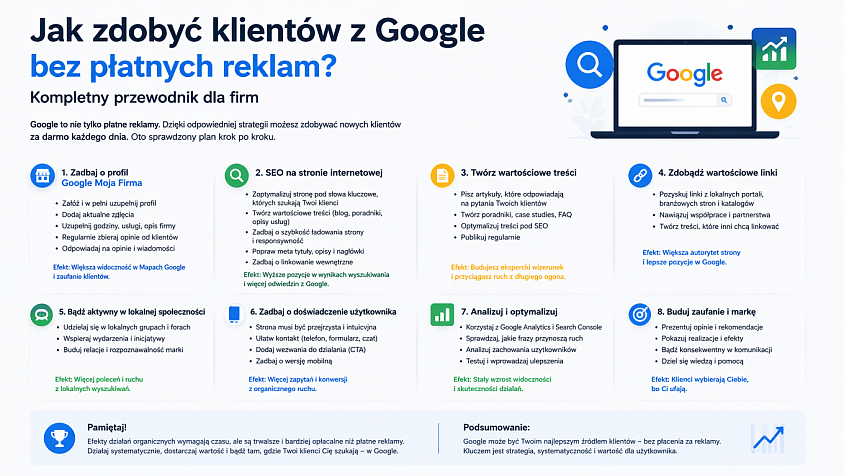
How to acquire customers from Google without paid ads? A complete guide for companies on effective organic SEO.
How to Acquire Customers from Google Without Paid Ads? A Comprehensive Guide for Businesses
Many entrepreneurs believe that effectively acquiring customers through Google requires significant investment in advertising campaigns. However, there are many methods for generating valuable traffic and acquiring customers without using Google Ads. The key elements include a carefully developed SEO strategy, creating relevant content, and building brand recognition in the search engine's organic results.
In this article, we show you how to effectively acquire customers from Google organically, increase website traffic, and build a lasting competitive advantage.
Why is it worth investing in customer acquisition from organic results?
Organic traffic refers to users who arrive at a website through Google's organic search results. Unlike paid advertising, the effects of SEO efforts can last for months or even years.
The most important benefits are:
- no costs per click,
- greater user confidence in organic results,
- a constant flow of potential customers,
- long-term increase in brand visibility,
- higher cost-effectiveness of marketing activities.
Understanding user intent
Modern SEO isn't just about placing keywords on a page. Google is increasingly better at interpreting user intent and rewarding content that provides precise answers to questions.
For example, a user entering:
"how to acquire clients for a construction company"
expects practical tips and solutions, not general marketing information.
Therefore, each subpage should respond to the specific needs of potential customers.
Create content that answers customer questions
One of the most effective ways to increase your visibility on Google is to publish expert content.
It's worth creating:
- guides,
- expert articles,
- case studies,
- answers to frequently asked questions,
- rankings and comparisons.
Example topics include:
- How to choose a renovation company?
- How much does website positioning cost?
- How to increase sales in your online store?
- The most common mistakes in local marketing.
Such content allows you to acquire traffic at various stages of the purchasing process.
Focus on local SEO
In the case of local business, local positioning is crucial.
Basic activities include:
- Google Business Card – complete your company profile with:
- description of the activity,
- photos,
- opening hours,
- contact details,
- services and products.
Regular updates increase your chances of appearing in local results.
Customer reviews
Opinions are one of the most important factors influencing users' purchasing decisions.
Encourage customers to leave reviews and respond to all reviews – both positive and negative.
Local keywords
Create subpages that include locations, e.g.:
- positioning Lublin,
- wedding photographer Warsaw,
- accounting office Krakow.
This will allow you to reach people actively seeking services in a specific region.
Take care of the technical aspects of SEO
Even the best content will not achieve high rankings if the website has technical problems.
You should take care of:
- fast page loading,
- responsiveness on mobile devices,
- correct heading structure,
- SSL certificate,
- correct internal linking,
- XML sitemap,
- Core Web Vitals optimization.
Google prefers sites that provide a high-quality user experience.
Build authority through links
Links leading to a website remain one of the key ranking factors.
It is worth acquiring them through:
- expert publications,
- guest articles,
- industry cooperation,
- reports and studies,
- PR activities.
The greatest value comes from natural links from reliable and thematically related websites.
The development of artificial intelligence is changing the way we search for information. Users are increasingly turning to Google AI Overviews, ChatGPT, Gemini, and Perplexity.
To increase the chances of your content being cited by AI systems:
- Be specific – include concise answers to key questions at the beginning of your articles.
- Use a clear structure – use H2 and H3 headings, bulleted lists, tables and FAQ sections.
- Build credibility – publish information about authors, their experience and data sources, in line with the EEAT (Experience, Expertise, Authoritativeness, Trustworthiness) principles.
- Create comprehensive content – AI prefers content that is comprehensive and answers many related user questions.
Use the FAQ section
The question and answer section increases the visibility of the website in search results.
Is it possible to acquire customers from Google without advertising?
Absolutely. Thanks to SEO, local positioning, and valuable content, you can systematically acquire customers without having to invest in paid campaigns.
How long does it take to see SEO results?
The first results usually appear after a few months, but the full potential of the activities develops in the long term.
What is more important: SEO or Google Ads?
Both channels have their advantages. SEO builds lasting visibility, while advertising allows for rapid traffic generation. The best results are often achieved by combining both strategies.
Can a small company compete with big brands?
Yes, especially in the area of local SEO and by creating specialized content that responds to specific customer needs.
Summary
Acquiring customers from Google without paid advertising is possible and, for many companies, represents the most cost-effective marketing channel. High-quality content, SEO optimization, local visibility, a positive user experience, and building brand authority are key.
Companies that consistently invest in developing their organic visibility can generate a stable inflow of customers regardless of advertising budgets and the rising costs of paid campaigns.
About the author
Krzysztof Gumiela is an internet marketing expert specializing in SEO, local positioning, online customer acquisition strategies, and increasing company visibility in search engines. For years, he has been supporting entrepreneurs in building an effective presence on Google and growing sales through organic activities.
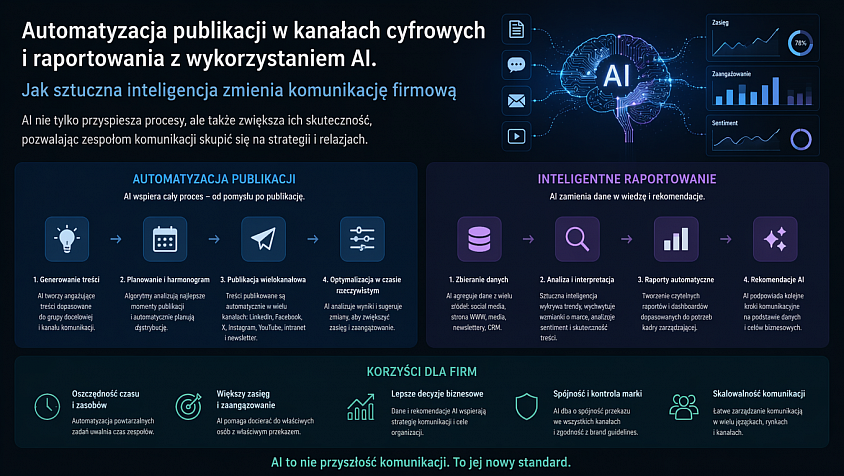
How to Automate Content Publishing and Reporting Using AI? A Practical Guide for Businesses
Introduction: Why automate communication?
Modern companies operating in a digital environment must communicate simultaneously across multiple channels, such as social media, company blogs, newsletters, and business platforms like LinkedIn. Maintaining regular publications, creating valuable content, and analyzing the results, however, requires significant time and commitment from marketing teams.
Automation using artificial intelligence streamlines this process. With a properly designed system, companies can generate content faster, publish it to the right channels, and automatically analyze the results.
This guide provides a step-by-step guide on how to build an effective communication and reporting automation process.
1. Define your communication goals
Before implementing AI tools, it is worth analyzing current working methods and answering key questions:
- What communication channels does the company use?
- How often is content published?
- Which activities take up the most time?
- How are publication effects measured?
- Which processes can be repeatedly automated?
Automation should solve specific business challenges, not merely be the implementation of new technology.
Examples of goals include:
- increasing the frequency of publications,
- shortening the time of preparing materials,
- improving the quality of reporting,
- better personalization of communication,
- increasing audience engagement.
2. Create a central content creation system
The greatest efficiency is achieved by creating a single source of information from which materials adapted to various channels can be prepared.
Sample process:
Base material
→ expert article, press release, event, report or company announcement
AI analysis
→ identification of key information, topics and target groups
Content adaptation
→ preparation of different versions:
- LinkedIn post,
- publication on Facebook,
- description on Instagram,
- blog article,
- newsletter,
- short message for customers.
Thanks to this, one prepared content can be used multiple times, adapted to the specifics of individual channels.
3. Automate your social media posting
Regularity is a key factor in effective communication. However, many companies struggle with a lack of time to prepare and publish materials daily.
Automation allows you to create an organized publishing schedule.
The process may be as follows:
Step 1: Prepare a content calendar
- publication topics,
- communication frequency,
- target groups,
- format of materials.
Step 2: Preparing content using AI
- creating post suggestions,
- shortening longer texts,
- preparing versions in various languages,
- generating ideas for graphics,
- adapting communication style.
Step 3: Automatic publication
Finished materials can be planned and published according to a pre-determined schedule. However, a degree of human oversight is essential, particularly in expert, crisis, or corporate image communications.
4. Use AI to run your company blog
A company blog is one of the most effective tools for building brand expertise. To deliver the desired results, it requires regular publications and the right selection of topics.
AI can support the entire process:
Topic planning
- analysis of audience interests,
- identification of popular customer questions,
- searching for thematic areas requiring development.
Creating articles
- preparing the text structure,
- development of the first version of the article,
- improved readability,
- SEO optimization.
Optimization
- checking whether the text meets the needs of the recipients,
- selecting appropriate keywords,
- developing an attractive title and description.
The best results are achieved by combining AI capabilities with the knowledge of company experts.
5. Automate newsletters and personalize communications
A newsletter shouldn't be limited to mass mailings. Automation allows for the creation of communications tailored to individual recipients.
AI analyzes:
- user interests,
- message opening history,
- clicked content,
- stage of relationship with the company.
On this basis, you can create various communication scenarios.
Examples:
- New customer
→ educational and introductory materials. - Regular customer
→ news, extended services, specialized content. - A recipient interested in a specific topic
→ dedicated materials that meet his needs.
6. Implement automated marketing reporting
Reporting is often one of the most time-consuming tasks for marketing teams because data comes from various sources and requires manual collation.
The automated reporting system may collect information regarding:
- publication results,
- website traffic,
- effectiveness of newsletters,
- recipient activity,
- campaign effectiveness.
AI also interprets data and answers questions:
- Which content performed best?
- What type of communication engages audiences the most?
- Which channels generate the most value?
- What activities are worth increasing?
This makes the report a decision-support tool, not just a summary of past activities.
7. Integrate all elements into one workflow
The most effective automation model is a coherent process that includes:
Stage 1: Strategy
- defining goals,
- channel selection,
- preparing a content calendar.
Stage 2: Production
- creating materials,
- using AI to adapt content,
- preparation of graphics and descriptions.
Step 3: Publication
- automatic planning,
- multi-channel distribution,
- newsletter service.
Step 4: Analysis
- data collection,
- reporting,
- recommendations for next steps.
8. The most common mistakes when implementing AI automation
No strategy
Using AI tools without clearly defined goals and target groups does not guarantee success.
Complete reliance on automated content
AI-generated content requires quality control, especially in expert communication.
No analysis of results
Publishing without monitoring results prevents you from optimizing your activities.
Excessive automation
Not all communication elements should be automated; relationships with audiences also require human involvement.
Summary: Automation as a Competitive Advantage
Automating publishing and reporting with AI allows companies to operate faster, more efficiently, and more consciously. The greatest value lies not in content generation itself, but in creating an intelligent system that integrates data planning, production, distribution, and analysis.
Companies that properly use artificial intelligence can increase the scale of their communications without losing quality and better respond to the needs of their audiences.
AI does not replace the strategy or competences of the team, but supports them by automating repetitive tasks and allowing you to focus on activities that generate real business value.
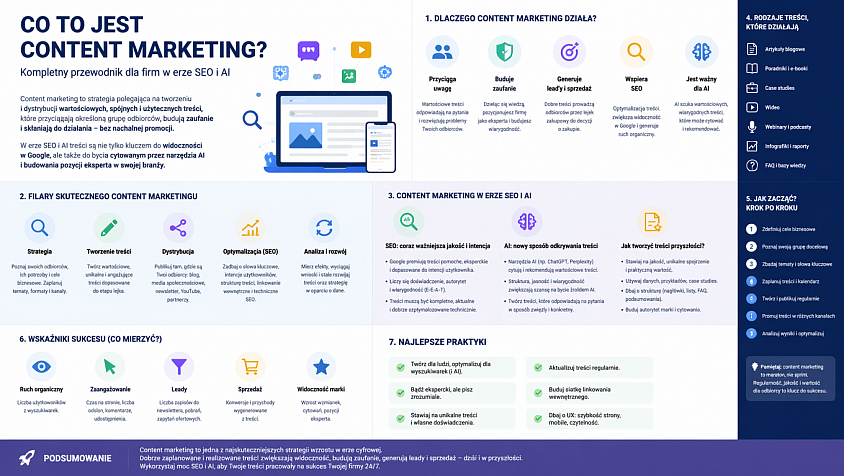
What Is Content Marketing? The Complete Guide for Businesses in the Age of SEO and Artificial Intelligence (AI)
What Is Content Marketing? A Comprehensive Guide for Businesses in the Age of SEO and AI
Content marketing is a marketing strategy that involves creating, publishing and distributing valuable, useful and engaging materials that meet audience needs and support the achievement of a company's business goals.
Unlike traditional advertising, content marketing doesn't focus on directly selling products or services. Its primary goals are building trust, educating customers, increasing brand recognition, and generating valuable traffic and conversions.
A carefully planned content marketing strategy allows a company to position itself as an industry expert and effectively reach potential customers at every stage of the purchasing process.
Why is content marketing important?
The modern consumer independently searches for information before making a purchasing decision, using search engines, social media, industry blogs and artificial intelligence-based tools.
For this reason, high-quality content has become a key element of digital marketing.
The most important benefits of content marketing:
- increasing brand visibility on Google and other search engines,
- building expert authority,
- generating organic traffic,
- acquiring sales leads,
- increased audience engagement,
- improving conversion rates,
- building long-term relationships with customers.
How does content marketing work?
A content marketing strategy is based on providing recipients with answers to their questions, solving problems and meeting their information needs.
This process typically includes:
- target group analysis,
- user intention research,
- keyword research,
- creating valuable content,
- distribution of materials in appropriate channels,
- results analysis and optimization.
The content published by the brand helps users find solutions to specific problems, which translates into building trust and increasing the likelihood of choosing its products or services.
Forms of content marketing
Content marketing encompasses much more than just running a company blog.
The most popular formats include:
- Blog articles – publications answering users’ questions and supporting website positioning,
- Guides and manuals – extensive educational materials that build expert authority,
- Case studies – analyses of actual projects and achieved results,
- E-books – extensive materials used to generate leads,
- Infographics – graphical representation of data and processes,
- Podcasts – audio content aimed at audiences who prefer listening,
- Video marketing – instructional, training, product and expert videos,
- Newsletters – regular communication with the customer and subscriber base.
Content marketing and SEO
SEO (Search Engine Optimization) and content marketing are closely related.
Search engines promote content that:
- respond to user intentions,
- are substantive and up-to-date,
- have an appropriate heading structure,
- contain keywords in a natural way,
- ensure high quality user experience.
Thanks to valuable content, a company can achieve high positions in search results, increase organic traffic and reduce customer acquisition costs.
Key SEO Elements in Content Marketing
- Selection of keywords – analysis of phrases entered by potential customers enables the creation of content that meets the real needs of the market,
- Heading optimization – the H1, H2 and H3 structure makes it easier for both users and search engine robots to understand the content,
- Internal linking – linking related articles improves page indexing and supports user experience,
- EEAT – Google is placing increasing importance on the experience, expertise, authority and credibility of the author and brand.
Content marketing in the era of AI and GEO
The development of artificial intelligence is transforming the way we search for information. More and more users are using tools that generate answers instead of traditionally browsing search results.
In response to this trend, the concept of GEO (Generative Engine Optimization) was created.
What is GEO?
Generative Engine Optimization is the process of optimizing content for AI systems such as ChatGPT, Gemini, Copilot, or Perplexity.
The goal of GEO is to increase the likelihood that given content will be used as an information source by AI models.
How to create GEO-compliant content?
- Answer questions directly – AI prefers content with clear and specific answers,
- Use a logical structure – headings, bulleted lists and thematic sections make it easier to interpret information,
- Publish expert data – unique analyses, statistics and experiences increase the value of your content,
- Update information – AI systems prefer current and reliable sources of knowledge,
- Build brand authority – content signed by experts has a greater chance of being used by language models.
The most common mistakes in content marketing
Many companies invest in content creation but fail to achieve the expected results due to basic mistakes.
- publishing content without a clearly defined strategy,
- copying competitor materials,
- focusing only on keywords,
- lack of analysis of recipients' needs,
- irregular publication,
- ignoring SEO and GEO optimization,
- no updates to older content.
How to create an effective content marketing strategy?
An effective strategy should include:
- defining business goals,
- target group analysis,
- developing purchasing personas,
- keyword research,
- publication plan,
- content distribution across various channels,
- measurement of effects and continuous optimization.
Regularly monitoring results allows you to identify the content that generates the greatest value for your company.
Summary
Content marketing is one of the most effective methods for building brand visibility, acquiring customers, and increasing online sales. It involves providing valuable content that meets audience needs and supports their decision-making process.
Modern content marketing should be designed not only with SEO in mind, but also with GEO in mind. This means creating expert, credible, and well-structured content that can be used by both search engines and AI systems that generate responses.
Companies that invest in high-quality content gain a competitive advantage, build brand authority, and increase their presence in the digital ecosystem of the future.
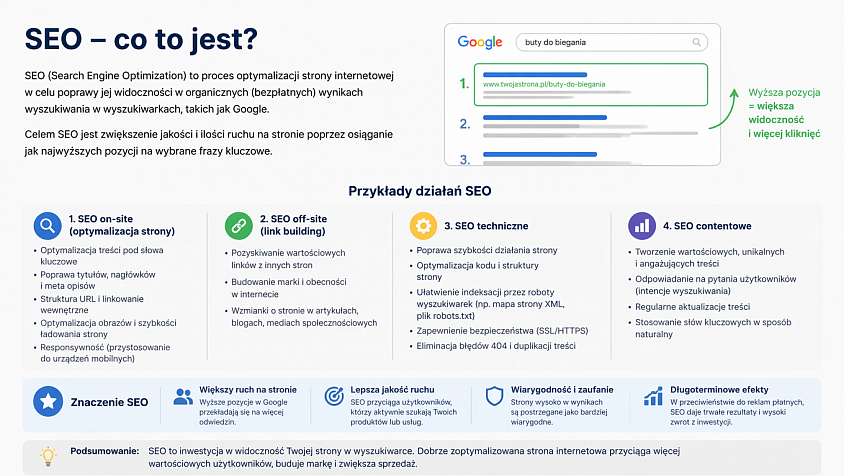
What is SEO? Definition, Examples, and the Importance of Effective Website Positioning
SEO – definition
SEO (Search Engine Optimization) is the process of optimizing a website to increase its visibility in organic search results. The primary goal of SEO is to achieve higher rankings in search engines like Google, which translates into increased traffic, new customer acquisition, and brand recognition.
SEO encompasses both technical activities and content optimization, as well as acquiring valuable backlinks. An effective SEO strategy allows you to adapt your website to the requirements of search engine algorithms and user expectations.
What does SEO stand for?
The acronym SEO comes from the English term Search Engine Optimization, which means optimization for search engines.
This process focuses on improving the website's quality, usability, and compliance with search engine guidelines to increase the chances of high organic rankings.
Why is SEO important?
Most internet users begin their search for products, services, or information by entering a query into a search engine. Websites appearing on the first page of results receive significantly more clicks than sites further down the page.
The benefits of SEO include:
- increasing organic traffic,
- acquiring valuable sales leads,
- increase in sales of products and services,
- building brand credibility,
- improving user experience (UX),
- long-term development of online business.
How does SEO work?
Search engines use advanced algorithms to analyze and evaluate websites. This process can be divided into three main stages:
- Crawling – search engine robots visit websites and collect information about their content.
- Indexing – the acquired data is saved in the search engine index, which is an extensive database of information about websites.
- Ranking – after entering a query, the algorithm selects and orders the results according to relevance, quality and authority.
Key SEO Elements
Technical SEO
Responsible for the proper functioning of the website and its accessibility to search engine robots.
Examples of activities:
- page loading speed optimization,
- SSL certificate implementation,
- Core Web Vitals optimization,
- creating an XML sitemap,
- improving the structure of URLs,
- elimination of indexing errors.
On-page SEO
It concerns the optimization of elements located directly on the page.
Examples:
- title optimization (Title),
- creating effective meta descriptions,
- appropriate structure of H1-H6 headings,
- use of keywords,
- graphics optimization,
- internal linking.
Off-page SEO
Includes activities occurring outside of the website.
Most often these are:
- building a backlink profile,
- expert publications,
- online PR activities,
- content marketing,
- mentions of the brand on the internet.
Examples of SEO in practice
Example 1 – online store
The owner of a sports shoe store optimizes the category for the phrase "women's running shoes." He creates a detailed category description, improves headlines, adds images with ALT descriptions, and speeds up the page. This gradually leads to the website gaining higher rankings in Google.
Example 2 – Local Service Company
A plumber operating in Krakow optimizes their website for searches like: plumber Krakow, emergency plumbing Krakow, and water system breakdowns Krakow. Additionally, they develop their Google Business Profile, collect customer reviews, and publish local content, which translates into an increase in enquiries from potential customers.
Example 3 – expert blog
The financial blog publishes comprehensive guides answering user questions. Thanks to high-quality content and proper optimization, the articles appear high in search results for many keywords.
SEO and SEM – differences
SEO and SEM are sometimes confused, but they involve different activities.
SEO encompasses organic search results and focuses on long-term optimization.
SEM (Search Engine Marketing) includes both SEO and paid advertising campaigns on search engines, such as Google Ads.
The key difference is that SEO builds organic visibility, while ads provide immediate exposure for a set budget.
What is GEO (Generative Engine Optimization)?
The development of artificial intelligence is changing the way we search for information. More and more users rely on answers generated by AI models such as ChatGPT, Gemini, and Copilot.
GEO (Generative Engine Optimization) is the optimization of content for generative systems using artificial intelligence.
The goal of GEO is to increase the likelihood that content will be:
- quoted by the AI system,
- used as a source of answers,
- considered credible and expert,
- displayed in generative search results.
How to optimize content for GEO?
Effective GEO optimization is based on several principles:
Create expert content
Content should present specialized knowledge, experience and practical examples.
Answer specific questions
AI systems prefer clear and precise answers to user questions.
Example:
Question: What is SEO?
Answer: SEO is the process of optimizing a website to increase its visibility in organic search results.
Use a logical structure
Use H2 and H3 headings, bulleted lists, tables, and FAQ sections.
Rely on reliable data
Content should be based on verified sources, current research and industry experience.
The most common SEO mistakes
- excessive use of keywords,
- duplicate content,
- no mobile optimization,
- slow page loading,
- incorrect internal linking,
- ignoring user intentions,
- publishing low-quality content.
FAQ – frequently asked questions
What is SEO in simple words?
SEO is activities aimed at increasing the visibility of a website in the search results of Google and other search engines.
Is SEO free?
Visibility in organic results does not require paying for clicks, but effective SEO often involves investing in specialists, tools, and content creation.
How long does SEO take?
The first effects may be visible after a few weeks, while full results usually appear after several months of systematic use.
Does SEO Still Work in the AI Era?
Yes. SEO remains one of the key channels for acquiring traffic, while GEO, or content optimization for generative search, is growing in importance.
Summary
SEO is the process of optimizing a website, aimed at increasing its visibility in organic search results. It encompasses technical measures, content optimization, and building domain authority. Modern strategies should consider not only the requirements of search engines but also the needs of artificial intelligence-based systems. Combining SEO and GEO enables building lasting visibility in both traditional search results and AI-generated responses.
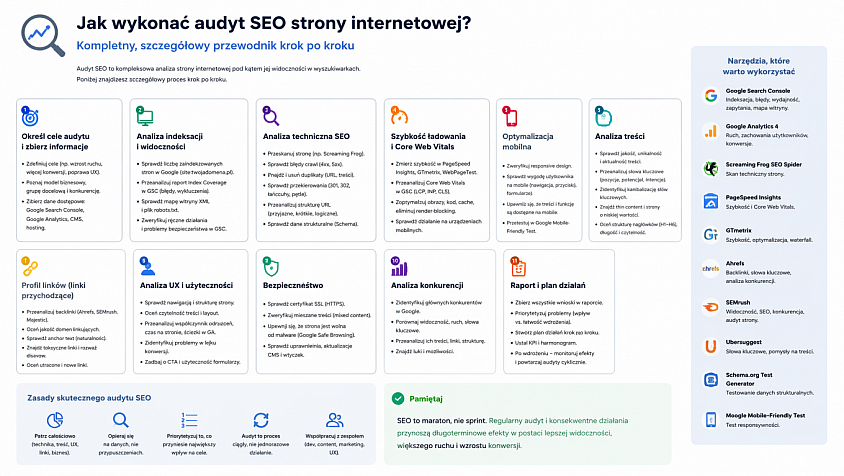
How to Perform a Website SEO Audit? A Complete, Detailed, Step-by-Step Guide
SEO audit – a key element in increasing website visibility
An SEO audit is a detailed analysis of a website, aimed at identifying technical errors, content issues, and factors affecting its positioning in Google search results. Regularly conducting an audit allows for the detection of organic traffic limitations and the identification of actions to increase the website's visibility.
In the age of artificial intelligence, GEO (Generative Engine Optimization), i.e., optimizing content for generative search engines and AI models, is gaining increasing importance. Therefore, a modern audit should consider both traditional SEO and preparing a website for citations by AI-based systems.
What is an SEO audit?
An SEO audit is a comprehensive assessment of all website elements that impact its positioning. It includes technical analysis, content quality assessment, link profile, user experience (UX), and compliance with current Google guidelines.
A professional audit answers the following questions:
- Why doesn't the website achieve high rankings?
- Which subpages generate traffic?
- What technical errors hinder indexing?
- Does the content meet user expectations?
- How to prepare your website for AI search engines?
Step 1. Check the page indexation
The first stage of the audit is to verify that your website is being indexed correctly by Google.
How to check indexation?
In the search engine, enter:
site:yourdomain.pl
This will give you a list of indexed subpages.
- pages excluded from indexing,
- duplicate URLs,
- indexing technical pages,
- 404 errors,
- outdated subpages.
It is also worth analyzing the "Indexing" report in Google Search Console.
Step 2. Verify technical SEO aspects
Technical SEO is the foundation of effective positioning.
Items requiring inspection:
- Page loading speed
Google considers website performance as a ranking factor. Consider:
- Largest Contentful Paint (LCP),
- Interaction to Next Paint (INP),
- Cumulative Layout Shift (CLS).
- Responsiveness
A website should function properly on smartphones, tablets, and computers. Google uses mobile-first indexing, so a mobile-friendly version is crucial. - SSL certificate
The website address should use the HTTPS protocol. The lack of a certificate reduces the site's credibility. - Robots.txt file
Make sure it does not block important resources and subpages. - XML Site Map
A sitemap makes it easier for search engine robots to find new content.
Step 3. Analyze the page structure
A properly designed information architecture impacts both SEO and user experience.
What to pay attention to?
- logical arrangement of categories,
- a maximum of 3–4 clicks to the most important subpages,
- correct internal linking,
- readable URLs,
- the presence of a menu and navigation breadcrumbs.
Example of a valid address:
yourdomain.pl/seo-audit-pages
Example of an invalid address:
yourdomain.pl/index.php?id=5837&cat=19
Step 4. Assess the quality of your content
Content remains one of the most important ranking factors.
During a content audit, you should verify:
- Uniqueness
Content should be original and bring value to the recipient. - Topicality
Outdated information may reduce the credibility of the site. - Keywords saturation
Keywords should occur naturally and match the users' intentions. - Heading structure
Correct hierarchy: H1, H2, H3, H4. - Answers to user questions
Content should solve specific problems and answer frequently asked questions.
Step 5. Conduct keyword analysis
An SEO audit requires verification of keyword strategy.
Worth checking out:
- phrases that generate traffic,
- keywords with growth potential,
- long-tail queries,
- competitor keywords,
- users' search intent.
Example phrases related to the topic:
- website SEO audit,
- how to do an SEO audit,
- website SEO analysis,
- technical SEO,
- website optimization,
- SEO audit checklist.
Step 6. Examine your link profile
Inbound links remain one of the key ranking signals.
When analyzing backlinks, you should evaluate:
- number of linking domains,
- link quality,
- spam links,
- the rate of link acquisition,
- share of dofollow and nofollow links.
Low-quality links can cause visibility drops and domain trust issues.
Step 7. Evaluate the user experience (UX)
Google increasingly rewards websites that provide positive user experiences.
Areas to be analyzed:
- intuitive navigation,
- readability of content,
- speed of action,
- number of pop-up windows,
- bounce rate,
- time spent on the site.
A well-designed UX supports both conversion and positioning.
Step 8. Include GEO (Generative Engine Optimization)
More and more users use search engines based on artificial intelligence, so a modern audit should also include GEO.
How to assess a website's readiness for AI?
- Create expert content
AI systems prefer sources that present specialized knowledge and practical experience. - Build brand authority
It is worth publishing reports, research, case studies and industry analyses. - Answer specific questions
Content should include FAQ sections and clear answers. - Use structured data
Schema.org helps search engines and AI models better interpret page content. - Amplify EEAT signals
Google pays attention to Experience, Expertise, Authoritativeness and Trustworthiness.
Tools useful during an SEO audit
It is worth conducting a professional audit using proven tools.
The most popular solutions are:
- Google Search Console,
- Google Analytics 4,
- Screaming Frog SEO Spider,
- Ahrefs,
- Semrush,
- Surfer SEO,
- Sitebulb,
- PageSpeed Insights,
- Google Lighthouse.
Each of them provides unique data and allows you to look at the website from different perspectives.
The most common errors detected during an SEO audit
The most common problems include:
- lack of meta title and meta description optimization,
- duplicate content,
- slow page loading,
- 404 errors,
- inappropriate redirects,
- no internal linking,
- suboptimal images,
- poor mobile version,
- content not adapted to the user's intentions,
- lack of GEO strategy.
Summary
An SEO audit is an ongoing process, not a one-time activity, that helps maintain and increase a website's visibility in search results. A comprehensive analysis encompasses technical aspects, content, link building, user experience, and the increasingly important GEO optimization for search engines using artificial intelligence.
Companies that systematically conduct SEO audits identify problems faster, use the potential of organic traffic more effectively, and increase their competitive advantage both in Google and in the environment of generative AI systems.
