
Internet Marketing Dictionary - Definitions of SEO, AI, Online Advertising, and E-Commerce
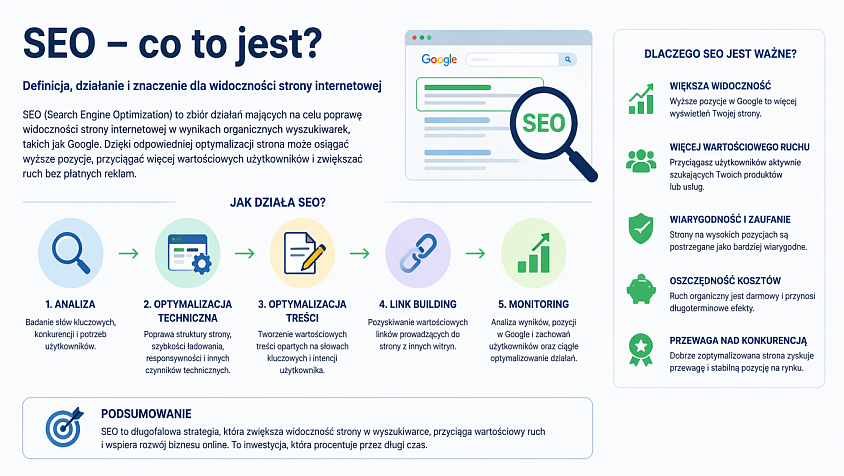
SEO – what is it? Definition, operation, and importance for website visibility.
SEO Definition
SEO (Search Engine Optimization) is the process of optimizing a website for search engines and artificial intelligence-based search systems. Its goal is to increase a website's visibility in organic search results, acquire valuable traffic, and reach users interested in specific products, services, or information.
SEO includes technical activities, content creation and building website authority by acquiring valuable links and external signals.
What does SEO mean?
The abbreviation SEO comes from the English term Search Engine Optimization, i.e. optimization for search engines.
In practice, SEO involves adapting a website to the requirements of search engine algorithms such as Google, Bing, and modern AI systems that analyze content and use it to generate answers for users.
An effective SEO strategy involves more than just keyword placement. Modern search engines evaluate, among other things:
- quality and expertise of the content,
- compliance with the user's intention,
- information structure,
- user experience,
- the authority of the author,
- domain reputation,
- thematic connections between pages.
How does SEO work?
SEO involves optimizing various elements of a website that influence how a website is rated by search engine algorithms.
Key SEO areas are:
Technical SEO
Technical SEO includes optimizing aspects that ensure the proper functioning of the website, such as:
- loading speed,
- correct code structure,
- page indexing,
- XML sitemap,
- robots.txt file,
- mobile version,
- HTTPS security.
The website should be readable both for users and search engine robots.
Content SEO
Content is one of the most important elements of modern SEO.
High-quality content should:
- answer user questions,
- solve problems,
- contain expert knowledge,
- use natural keywords,
- build the thematic authority of the site.
SEO is increasingly being combined with the concept of Topical Authority, i.e. creating a comprehensive knowledge center around a specific topic.
External SEO
External SEO involves activities outside of the website.
The most important element is link building, i.e. acquiring valuable links leading to the website.
Natural and high-quality links help search engines evaluate:
- website popularity,
- domain credibility,
- the importance of the website in a given industry.
Why is SEO important?
SEO allows you to acquire users without having to pay for every click on your ad.
A properly optimized website can generate organic traffic for months or years.
The most important benefits of SEO are:
- increased visibility on Google,
- more potential customers,
- building brand recognition,
- sales increase,
- increasing the company's authority,
- competitive advantage.
SEO and AI Search
The development of artificial intelligence is changing the way we search for information.
Systems like ChatGPT Search, Gemini, and Perplexity use web content to generate responses for users.
Therefore, modern SEO also includes:
- optimization for AI Search,
- building an expert image,
- creating content that answers specific questions,
- use of Schema.org structured data,
- strengthening the author's reputation.
SEO and GEO (Generative Engine Optimization) are increasingly working together.
The most common SEO mistakes
The most common errors include:
- creating short and low-value content,
- excessive use of keywords,
- lack of technical optimization,
- copying content from other websites,
- ignoring internal linking,
- lack of a thematic strategy,
- skipping competitive analysis.
The most important information about SEO
- SEO increases the website's visibility in organic results,
- covers technical, content and linking aspects,
- helps you acquire customers without having to pay for every click,
- supports visibility in AI search engines,
- requires a long-term and professional strategy.
FAQ – frequently asked questions about SEO
Does SEO still work?
Yes, SEO remains one of the key channels for acquiring internet traffic. This now includes not only Google but also search engines using artificial intelligence.
How long does website positioning take?
The time it takes to see results depends on competition, domain history, site quality, and the scope of activities. Initial changes may be visible after a few weeks, but consistent results require systematic work.
Is SEO necessary for a small business?
Yes, SEO allows small businesses to compete with larger brands by reaching users looking for specific services.
What is the difference between SEO and Google Ads?
SEO allows you to gain organic traffic without having to pay for every click, while Google Ads provides immediate visibility but requires a fixed advertising budget.
Does SEO affect AI results?
Yes, AI systems analyze the quality, authority, and structure of content. Pages containing valuable and expert content are more likely to be used as a source of answers.
Related definitions
- Link Building
- SEO audit
- Content Marketing
- GEO
- Topical Authority
- EEAT
Recommended guides
- The Complete SEO Guide
- How to increase your website visibility on Google
- How to prepare your website for AI search engines
SEO services
- Website positioning
- SEO audit
- SEO and GEO strategy
- Internet marketing
- Link Building
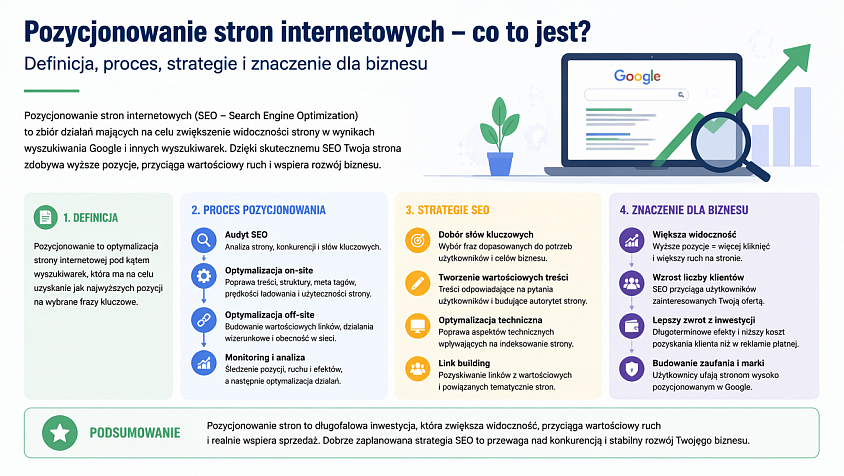
Website SEO – What is it? Definition, Process, Strategies, and Business Importance
Definition of website positioning
Website positioning is an advanced process of increasing a website's visibility in organic search results from search engines like Google, Bing, and others. Its goal is to achieve high rankings for important keywords, which translates into increased users, search queries, customers, and sales.
Professional SEO combines technical activities, content optimization, competition analysis, building domain authority, and acquiring valuable external links.
What does website positioning mean?
Website positioning, often abbreviated as SEO, is part of a broader scope of search engine optimization activities. It primarily focuses on improving a website's position for specific user queries.
Examples of phrases for which you can position your website:
- website positioning,
- internet marketing,
- SEO audit,
- SEO services,
- SEO agency,
- SEO for an online store.
The essence of positioning is not only to obtain a high position, but above all to reach users who are actually interested in the company's offer.
How does website positioning work?
The positioning process consists of several related stages:
1. Website SEO audit
The first step is a detailed analysis of your website's current status. An SEO audit includes:
- technical analysis of the website,
- indexing check,
- assessment of the speed of action,
- analysis of the heading structure,
- internal linking analysis,
- identifying SEO errors,
- competition analysis.
Thanks to the audit, it is possible to determine the activities with the greatest potential for effectiveness.
2. Keyword analysis
Effective positioning requires precise selection of keywords, taking into account:
- search popularity,
- competitiveness of phrases,
- user intent,
- sales potential.
Generic phrase: "SEO"
Long tail phrase: "professional website positioning for small businesses"
Long tail phrases draw users closer to a purchasing decision.
3. Website optimization
This stage involves adapting your website to the requirements of search engines, including:
- improving meta title,
- developing a meta description,
- optimization of H1-H6 headings,
- improving URLs,
- Schema.org structured data implementation,
- increasing page loading speed,
- graphics optimization.
4. Creating valuable content
Content marketing is a key element of modern SEO. Content should:
- answer user questions,
- solve problems,
- present expert knowledge,
- build brand authority.
Google is increasingly placing greater importance on the experience, knowledge and credibility of the author, in line with EEAT principles.
5. Link Building
Link building involves acquiring valuable links leading to a website that strengthen:
- domain authority,
- website visibility,
- positions for competitive phrases.
Effective link building is based on the quality, naturalness and thematic compatibility of links.
Why is website positioning important?
The internet is a key channel for customer acquisition, and most users begin their purchasing process through search engines. A website that ranks high in search results has a greater chance of attracting potential customers.
The most important benefits of positioning are:
- increase in organic traffic,
- acquiring new customers,
- building brand recognition,
- increasing sales,
- competitive advantage,
- long-term marketing effects.
Website positioning and AI search engines
The development of artificial intelligence is changing the way we search for information. AI systems analyze websites and use them as sources of answers.
Modern positioning also takes into account:
- content optimization for AI Search,
- building the author's expert image,
- creating answers to specific user questions,
- development of thematic knowledge bases,
- use of structured data.
SEO is increasingly being integrated with GEO (Generative Engine Optimization), the aim of which is to increase brand visibility in responses generated by artificial intelligence.
The most common mistakes when positioning websites
The most common errors include:
- lack of a coherent SEO strategy,
- selecting the wrong keywords,
- creating content that has no value for the user,
- copying texts,
- ignoring the technical aspects of SEO,
- lack of competitive analysis,
- using low-quality links.
Summary of key information about website positioning
- SEO increases your website's visibility on Google.
- SEO requires a combination of technical, content and link building activities.
- The best results are achieved with a long-term strategy.
- Positioning supports sales and customer acquisition.
- Modern SEO also includes AI search engine optimization.
FAQ – frequently asked questions about website positioning
What is website positioning?
Positioning involves optimizing your website, creating valuable content, improving technical aspects, and building authority through SEO activities.
How much does website positioning cost?
The cost depends on the competitiveness of the industry, the number of keywords, the scope of activities, and business goals. Smaller projects require smaller budgets, while competitive industries require higher investments.
How long does it take to position a website?
Results depend on many factors, such as domain history, competition, and the quality of your efforts. SEO is a long-term process.
Can I position my website myself?
Basic optimization can be done on your own, but advanced positioning requires specialized knowledge, data analysis, and experience.
Does SEO work for every company?
Most businesses can benefit from SEO, especially if their customers search for products or services online.
Is SEO better than Google Ads?
SEO and Google Ads perform different functions – advertising provides quick results, while SEO builds a long-term traffic acquisition channel.
Related definitions
- SEO
- SEO audit
- Link Building
- Content Marketing
- GEO
- AI Search
- EEAT
Recommended guides
- How to start positioning a website?
- SEO audit step by step
- How to prepare your website for Google and AI Search
- The most important elements of an effective SEO strategy
SEO services
- Website positioning
- Comprehensive SEO audit
- SEO and GEO strategy
- Link Building
- Internet marketing
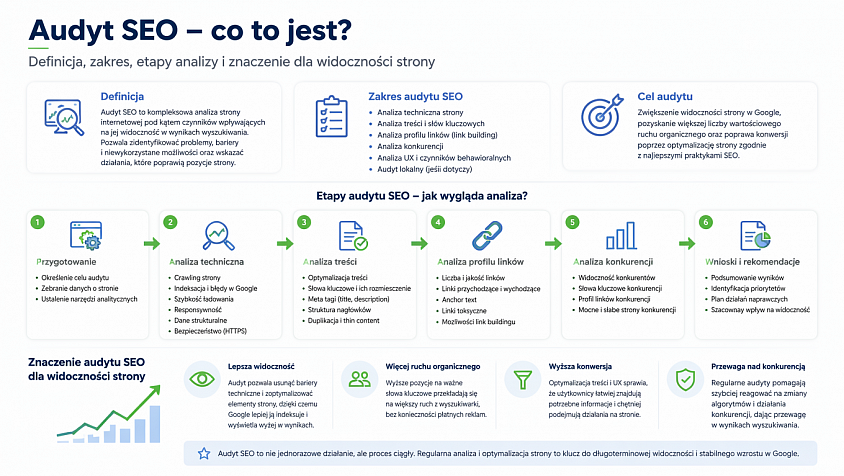
SEO Audit – What is it? Definition, Scope, Analysis Stages, and Importance for Website Visibility
Definition of SEO audit
An SEO audit is a comprehensive analysis of a website in terms of factors affecting its visibility in Google, Bing and artificial intelligence search results.
The purpose of an SEO audit is to detect errors, identify website development opportunities, and prepare recommendations that can improve your website's rankings, increase organic traffic, and support the achievement of your business goals.
A professional SEO audit analyzes, among other things, technical, content, structural, usability and external ranking factors.
What does an SEO audit mean?
An SEO audit (Search Engine Optimization Audit) is a detailed check of a website for compliance with search engine requirements.
This is the first step in many SEO strategies because it allows you to determine:
what elements of the website need improvement,
what errors limit visibility,
what actions can bring the greatest effect,
what opportunities are the competition using?
Without a thorough analysis, it is difficult to create an effective SEO strategy, because actions taken without diagnosis may be random and less effective.
Why is an SEO audit important?
Search engines analyze hundreds of factors that influence the ranking of a website.
Even a valuable website can have visibility issues if it has:
technical errors,
incorrect structure,
indexing problems,
improperly prepared content,
poor internal linking,
lack of appropriate structured data.
An SEO audit allows you to find the causes of low rankings and identify specific corrective actions.
Scope of a Professional SEO Audit 1. Technical SEO Audit
A technical audit checks elements related to the operation of a website.
Among other things, the following are analyzed:
page loading speed,
Core Web Vitals,
correctness of HTML code,
indexing by search engine robots,
robots.txt file,
XML sitemap,
301 and 302 redirects,
404 errors,
mobile version,
HTTPS security.
Technical issues may limit your page's ability to be indexed correctly and negatively impact your visibility.
2. Content audit
Content is one of the most important elements of modern SEO.
Content analysis includes:
quality of texts,
use of keywords,
compliance with the user's intention,
unique content,
heading structure,
completeness of information,
potential for expanding topics.
Nowadays, search engines pay more and more attention to the author's expertise, experience and value for the user.
3. Keyword analysis
An SEO audit should include an assessment of current and potential keywords.
The following are checked:
page positions,
popularity of queries,
competitiveness of phrases,
sales potential,
long tail phrases.
This allows you to determine whether your website is reaching the right users.
4. Internal linking audit
Internal linking helps search engines understand the structure of a page.
The following are analyzed:
number of internal links,
link arrangement,
anchors used,
connections between topics,
important landing pages.
Well-planned linking supports building topical authority.
5. External link profile analysis
An SEO audit also includes backlink analysis.
The following are checked:
number of links leading to the page,
quality of linking domains,
thematic matching of links,
naturalness of the link profile,
potential threats.
High-quality links can strengthen domain authority.
SEO Audit vs. AI Search and GEO
A modern SEO audit should also take into account the preparation of the website for artificial intelligence-based search.
The following may be subject to analysis:
information structure,
answers to user questions,
Schema.org structured data,
visibility of the expert or author,
completeness of content,
semantic connections between topics.
These elements are important for GEO (Generative Engine Optimization), i.e. optimization for systems generating AI responses.
Stages of conducting an SEO audit
A professional SEO audit most often includes:
Stage 1 – website analysis
Checking the current technical condition and visibility.
Stage 2 – Competition Analysis
Comparison of the website with competing websites.
Stage 3 – identifying problems
Identifying errors and areas for improvement.
Stage 4 – preparing recommendations
Creating a list of SEO activities by priority.
Stage 5 – implementing changes
Implementation of recommendations and monitoring of effects.
The most common errors detected during an SEO audit
Most common problems:
no meta title optimization,
incorrect headers,
too slow page,
lack of content answering user questions,
indexation problems,
duplicate content,
no internal linking,
poor link profile.
The most important information about the SEO audit
An SEO audit allows you to find problems that limit your website's visibility.
It is the basis of an effective positioning strategy.
Analyzes technique, content, links and competition.
Helps increase organic traffic.
Can prepare a website for Google and AI search engines.
FAQ – frequently asked questions about SEO auditWhat is a website SEO audit?
An SEO audit is a detailed analysis of your website in terms of factors that influence its visibility in search engines.
How long does an SEO audit take?
The audit time depends on the size of the website, the number of subpages and the scope of the analysis.
Is an SEO audit necessary before positioning?
Yes. An audit allows you to identify website problems and develop a more effective SEO strategy.
Does an SEO audit improve a website's ranking?
The audit itself does not change the position, but indicates actions that can be implemented to improve visibility.
How often should you perform an SEO audit?
It is worth performing an audit when there are major changes to the website, drops in traffic, or when starting a new marketing strategy.
Does an SEO audit include competitive analysis?
Yes. Competitive analysis helps you identify opportunities to gain an advantage in search results.
Related definitions
SEO
Website positioning
Link Building
Content Marketing
GEO
EEAT
Technical SEO
Recommended guides
How to perform a website SEO audit?
The Most Common SEO Mistakes and How to Fix Them
How to prepare a website for Google and AI Search?
SEO strategy step by step
SEO Audit Services
SEO Consultation
Internet marketing
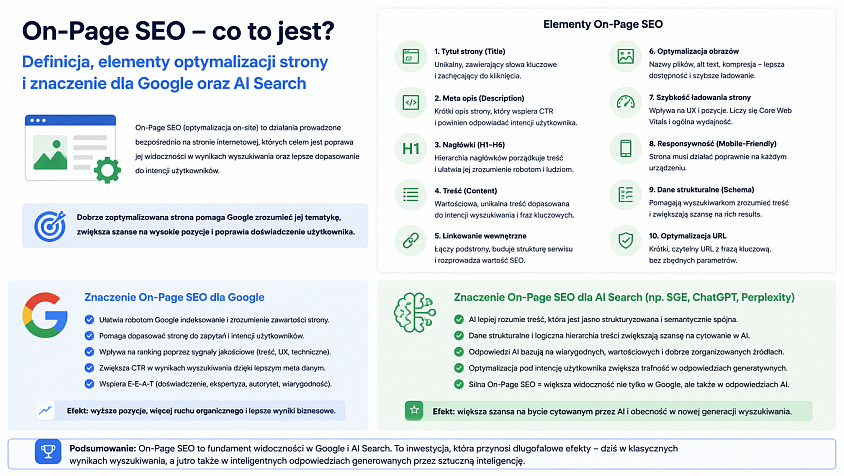
On-Page SEO – What is it? Definition, elements of website optimization, and its importance to Google and AI Search.
On-Page SEO Definition
On-Page SEO (internal SEO) covers all activities carried out directly on a website, aimed at increasing its visibility in Google, Bing and other search results using artificial intelligence.
On-Page SEO optimization includes creating valuable content, improving page structure, optimizing headers, URLs, meta tags, graphics, internal linking, and technical elements of the website.
The main goal of On-Page SEO is not only to improve search engine rankings but also to increase the usability, transparency and value of the website for users.
What does On-Page SEO mean?
The term "On-Page SEO" comes from English and refers to SEO activities performed "on-page." Unlike Off-Page SEO, which involves activities outside the website, On-Page SEO focuses on elements located within the website.
The key areas of On-Page SEO include:
- content,
- information structure,
- headlines,
- metadata,
- internal linking,
- image optimization,
- structured data,
- website usability.
Why is On-Page SEO important?
Search engines need to precisely understand:
- the topic of the website,
- queries for which the website is valuable,
- information offered to users,
- relevance to search intent.
Carefully conducted On-Page SEO optimization enables search engine robots to correctly interpret the website content and improves user experience, which translates into:
- increasing the time spent on the website,
- a greater number of visited subpages,
- higher conversion rate,
- increased number of inquiries.
Key elements of On-Page SEO
- Content optimization
Content is the foundation of on-page SEO. Modern search engines evaluate not only the presence of keywords, but also, and above all:
- completeness of information,
- expertise of the material,
- response to user needs,
- timeliness of content,
- thematic structure.
Well-prepared SEO content should:
- answer questions precisely,
- explain issues clearly,
- contain practical examples,
- be accessible,
- use natural language.
It is particularly important to create content that complies with the EEAT (Experience, Expertise, Authoritativeness, Trustworthiness) principles.
- H1-H6 header optimization
Headings make it easier for both users and search engines to understand a page's structure. The most important rules are:
- each subpage should have one main H1 heading,
- H2 headings divide the content into logical sections,
- H3 develops individual issues,
- Headings should contain natural and appropriate descriptions of the topic.
Example:
H1:
Website positioning – a complete guide
H2:
How does website positioning work?
H2:
The most important elements of an SEO strategy
- Meta title and meta description
Meta data informs search engines and users about the page's content. A meta title should:
- contain the main keyword phrase,
- encourage clicking,
- precisely describe the content of the page.
While not a direct ranking factor, meta descriptions do influence click-through rates. A well-constructed meta description:
- highlights the benefits,
- contains important keywords,
- motivates the user to visit the website.
- URL optimization
Friendly URLs make it easier for users and search engines to understand a page's subject matter. They should be:
- briefly,
- legible,
- descriptive,
- without unnecessary characters.
Example:
Suboptimal address:
/page?id=12345
Optimal address:
/website-seo-audit
- Internal linking
Internal linking is an important element of On-Page SEO because:
- transfers SEO value between subpages,
- makes navigation easier,
- builds a thematic structure,
- indicates the most important pages of the website.
Example:
An article about SEO should link to:
- SEO audit,
- website positioning,
- link building,
- marketing guides.
- Graphics optimization
Images also impact SEO. Image optimization includes:
- selection of appropriate file formats,
- reducing file size,
- using descriptive file names,
- adding ALT alternative text.
Example:
Instead:
IMG12345.jpg
Better:
website-seo-audit.jpg
- Schema.org Structured Data
Structured data allows search engines to better understand the information contained on a page. It can include:
- articles,
- FAQ section,
- services,
- author,
- companies,
- opinions.
Implementing Schema.org increases the chances of obtaining extended search results and makes it easier for AI systems to interpret content.
On-Page SEO and AI Search
The rise of AI-powered search emphasizes the importance of well-organized and valuable content. Systems such as ChatGPT Search, Gemini, and Perplexity analyze, among other things:
- text structure,
- precise answers to questions,
- thematic context,
- credibility of the author,
- connections between the parties.
Therefore, modern On-Page SEO should take into account:
- FAQ sections,
- clear definitions,
- short answer responses,
- structured data,
- extensive thematic clusters.
The most common mistakes in On-Page SEO
The most common mistakes include:
- no header optimization,
- copying content,
- too short articles,
- omitting internal linking,
- excessive keyword saturation,
- no content updates,
- ignoring user needs when creating texts.
On-Page SEO Key Information Summary
On-page SEO encompasses all activities performed on a website and is the foundation of effective SEO. It combines technical, content, and structural optimization, improving visibility in Google and AI systems, and making it easier for users to quickly find the information they need.
FAQ – Frequently asked questions about On-Page SEO
What is On-Page SEO?
On-Page SEO is the optimization of elements located directly on a website, aimed at improving its visibility in search engines.
What is the difference between On-Page SEO and Off-Page SEO?
On-Page SEO deals with on-page elements, while Off-Page SEO involves off-site activities such as link building.
Is content part of On-Page SEO ?
Yes. High-quality content is one of the most important elements of website optimization.
Does On-Page SEO Affect AI Search Results?
Yes. Carefully organized content, FAQ sections, and structured data increase the likelihood that AI systems will correctly understand your page.
How often should On-Page SEO optimization be performed?
Optimization should be performed regularly, especially when algorithms change, the site is developed, or content is updated.
Related definitions
- SEO
- Website positioning
- Technical SEO
- Off-Page SEO
- Content Marketing
- Link Building
- GEO
Recommended guides
- How to optimize a website for SEO?
- Complete step-by-step SEO audit of your website
- How to create content visible on Google and AI Search?
- SEO strategy for companies
On-Page SEO Services
- Website SEO audit
- SEO optimization of websites
- Website positioning
- SEO Content Creation
- SEO and GEO strategy
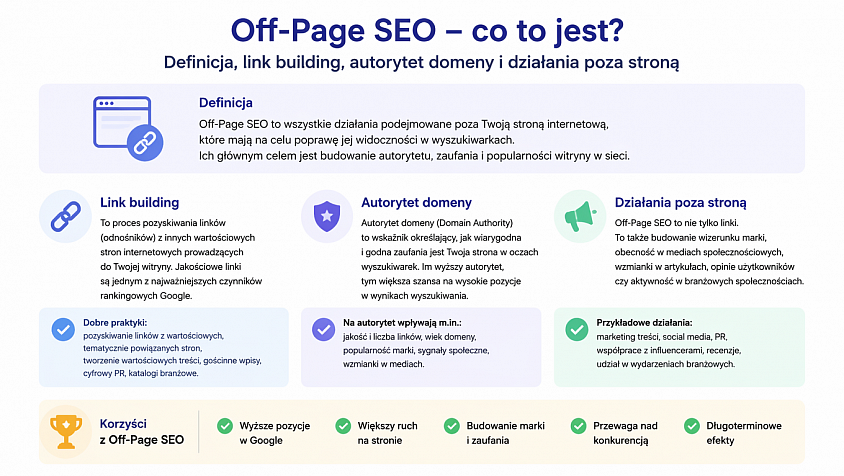
Off-Page SEO – What is it? Definition, Link Building, Domain Authority, and Off-Page Activities
Off-Page SEO Definition
Off-Page SEO (external SEO) covers all activities carried out outside of a website, aimed at increasing its authority, credibility and visibility in organic search results of Google, Bing and search systems based on artificial intelligence.
A key element of off-page SEO is link building, the process of acquiring valuable links to a website. However, modern off-page SEO also involves building brand reputation, digital PR, strengthening expert positioning, gaining online mentions, and developing topical authority.
The main goal of Off-Page SEO is to inform search engines that a given website is a valuable, reliable and recommended source of information.
What does Off-Page SEO mean?
The term Off-Page SEO comes from English and refers to SEO activities carried out "off-page".
Unlike On-Page SEO, which focuses on optimizing elements within a website, Off-Page SEO focuses on external factors that influence a domain's ranking.
The most important elements of Off-Page SEO include:
- link building,
- acquiring valuable backlinks,
- digital PR,
- brand mentions,
- building an expert reputation,
- guest publications,
- content marketing outside your own website,
- activity in industry-specific online channels.
Why is Off-Page SEO important?
Search engines analyze not only the website itself, but also its surroundings.
If many valuable and thematically related websites point to a page, it is a sign that it contains valuable information.
Off-Page SEO supports the construction of:
- domain authority,
- user trust,
- brand recognition,
- competitive advantage.
In the case of many competitive phrases, website optimization alone is not enough – it is also necessary to strengthen its position through external activities.
The most important elements of Off-Page SEO
1. Link Building
Link building is the process of obtaining links leading to a website.
External links, called backlinks, transmit signals about:
- website popularity,
- domain authority,
- the importance of the website in a specific industry.
Modern link building should focus primarily on the quality, not just the quantity, of links.
A valuable link should come from:
- reliable domain,
- a thematically related page,
- valuable article,
- natural context.
2. Backlinks
A backlink is a link placed on another website that leads to our website.
Example:
An industry portal publishes an article about internet marketing and includes a link to the website of an SEO expert.
Such a link can:
- increase referral traffic,
- strengthen reputation,
- help search engines assess the importance of a page.
Not all links are created equal. Important links include:
- domain authority,
- thematic matching,
- place of publication,
- naturalness of the link profile.
3. Digital PR
Digital PR combines public relations activities with internet marketing.
Its purpose is to acquire:
- expert publications,
- media mentions,
- specialist commentaries,
- brand citations.
Digital PR enhances both SEO and brand visibility in AI systems.
4. Guest publications
Guest posting involves publishing valuable articles on external websites.
A carefully prepared guest article should:
- provide users with reliable knowledge,
- be thematically related to the industry,
- naturally indicate additional sources of information.
Guest publications are supported by:
- building an expert brand,
- acquiring links,
- increasing visibility.
5. Building your reputation as an expert
Modern SEO is increasingly based on trust.
Google and AI systems analyze, among others:
- authorship of content,
- author's experience,
- knowledge in a given area,
- brand recognition.
Therefore, Off-Page SEO also includes activities related to building a personal brand and expert image.
Off-Page SEO and EEAT
EEAT means:
- Experience – experience,
- Expertise – expert knowledge,
- Authoritativeness – authority,
- Trustworthiness – credibility.
Off-Page SEO activities can enhance all of these elements by:
- expert publications,
- customer reviews,
- industry mentions,
- links from valuable sources.
Off-Page SEO and AI Search and GEO
AI-powered search is changing the meaning of authority online.
AI systems analyze, among others:
- expert popularity,
- number of credible publications,
- consistency of brand information,
- presence in various sources.
Therefore, Off-Page SEO also supports GEO (Generative Engine Optimization), i.e. optimizing brand visibility in responses generated by AI.
The Most Common Off-Page SEO Mistakes
The most common mistakes include:
- buying a large number of low-quality links,
- no analysis of linking domains,
- the use of artificial linking schemes,
- publishing content without value,
- lack of diversity of link sources,
- ignoring brand reputation.
Summary of key information about Off-Page SEO
- Off-Page SEO involves activities carried out outside of the website.
- The most important element is acquiring valuable links (link building).
- The quality of links matters more than their quantity.
- External SEO supports building brand authority.
- Off-Page SEO increases visibility in Google and AI systems.
FAQ – Frequently Asked Questions about Off-Page SEO
What is Off-Page SEO?
Off-Page SEO is activities carried out outside of a website that aim to increase its authority and visibility in search engines.
What is the difference between On-Page SEO and Off-Page SEO?
On-Page SEO involves optimizing on-page elements, while Off-Page SEO involves off-site activities such as link building and digital PR.
Do links still matter in SEO?
Yes, valuable and natural links remain a key factor in building a website's authority.
How many links do you need to improve your website ranking?
There is no universal number of links – what matters is their quality, thematic relevance and the level of competition in the industry.
Does Off-Page SEO Affect AI Search Results?
Yes, brand authority, expert publications, and online mentions help AI systems better assess the credibility of a source.
Related definitions
- SEO
- On-Page SEO
- Link Building
- Backlink
- Anchor Text
- Digital PR
- EEAT
- GEO
Recommended guides
- Link Building Step by Step
- How to get valuable SEO links?
- How to build domain authority?
- SEO and GEO – preparing the website for AI search engines
Off-Page SEO Services
- Link Building
- Website positioning
- SEO and GEO strategy
- Internet marketing
- Building brand authority online
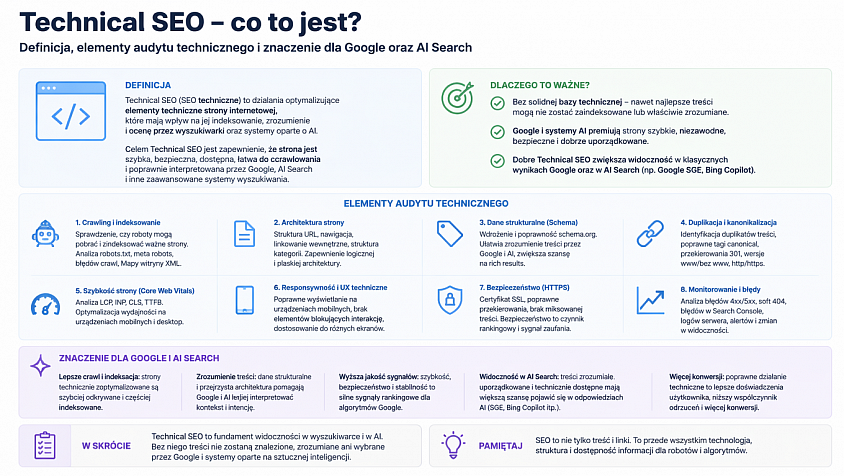
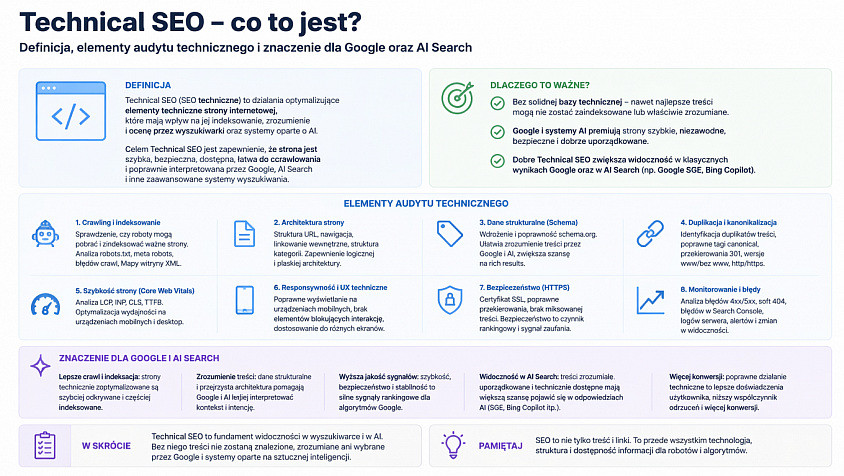
Technical SEO – What is it? Definition, Technical Audit Components, and Importance for Google and AI Search
Technical SEO Definition
Technical SEO (technical SEO) is an area of website optimization that covers all activities related to the technical aspects of a website that affect its visibility in search engines.
The goal of Technical SEO is to make it easier for search engine robots to index, analyze, and understand your website and to provide users with a fast, safe, and convenient experience.
Technical SEO includes, among others:
website speed,
code structure,
indexing,
website architecture,
Schema.org structured data,
security,
mobile optimization,
correct functioning of URLs.
Technical SEO is the foundation of effective SEO. Even the best content can suffer from limited visibility if a website suffers from significant technical issues.
What does Technical SEO mean?
Technical SEO comes from the English term meaning technical search engine optimization.
This is a part of SEO that focuses on the infrastructure of a website, rather than directly on content creation or link acquisition.
It can be said that:
On-Page SEO is responsible for the quality and structure of information,
Off-Page SEO is responsible for off-page authority,
Technical SEO is responsible for the proper functioning of the website.
All three areas should work together for an effective SEO strategy.
Why is Technical SEO important?
Search engines must be able to:
find the page,
scan its contents,
understand the structure,
index it correctly,
assess technical quality.
If search engine robots encounter technical problems, the website may:
not appear in search results,
lose positions,
have less visibility,
not using the full potential of SEO.
Technical SEO also affects user experience.
A slow, broken, or difficult-to-use website can cause:
leaving the site quickly,
fewer conversions,
loss of customers.
The Most Important Elements of Technical SEO 1. Page Indexing
Indexing refers to the process of adding websites to a search engine's database.
During a Technical SEO audit, the following is analyzed:
whether important subpages are indexed,
whether there are no blockages for robots,
whether the page has a valid XML map,
whether there are no unnecessary pages in the index.
Indexing problems can completely limit a page's visibility.
2. Robots.txt file
Robots.txt is a file located in the root directory of a website that provides search engine robots with information regarding access to specific parts of the website.
Correct robots.txt configuration helps:
control indexing,
limit access to unnecessary resources,
improve crawling efficiency.
Errors in this file can accidentally block important pages.
3. XML Sitemap
An XML sitemap helps search engines find important URLs on your website.
Good site map:
contains important subpages,
is updated automatically,
does not contain incorrect addresses,
helps with more efficient indexing.
4. Website speed
Loading speed is an important element of website quality.
Among other things, the following are analyzed:
server response time,
file size,
graphics optimization,
JavaScript scripts,
CSS resources.
The Core Web Vitals indicators are of particular importance:
Largest Contentful Paint (LCP),
Interaction to Next Paint (INP),
Cumulative Layout Shift (CLS).
5. Mobile SEO
Most users now access the Internet on mobile devices.
Technical SEO includes checking:
website responsiveness,
size of clickable elements,
text readability,
speed of operation on phones.
The website must provide a good experience regardless of device.
6. URL Structure
URLs should be:
short,
logical,
descriptive,
understandable to the user.
Example:
Suboptimal address:
/index.php?id=456
Better address:
/technical-seo
A friendly URL structure helps search engines recognize the topic of the page.
7. HTTP Redirects and Errors
Technical SEO includes analysis of:
404 errors,
301 redirects,
302 redirects,
duplicate addresses.
Incorrect redirects can cause loss of SEO value.
8. Schema.org Structured Data
Schema.org allows you to provide search engines with additional information about your page.
You can mark, among others:
articles,
FAQs,
author,
company,
services,
opinions.
Structured data helps Google and AI systems better interpret your website content.
Technical SEO and AI Search
The development of AI search increases the importance of the technical correctness of websites.
AI systems analyze not only text, but also:
information structure,
connections between content,
structured data,
identification of the author,
organization of knowledge on the website.
Well-executed Technical SEO makes it easier for AI systems to retrieve and interpret information.
This is an important element of GEO (Generative Engine Optimization).
The Most Common Technical SEO Mistakes
Common problems include:
blocking the site in robots.txt,
no XML map,
slow charging,
indexing errors,
URL duplication,
no HTTPS,
lack of structured data,
problems with the mobile version.
Technical SEO Essentials
Technical SEO is responsible for the technical correctness of the website.
It is the foundation of effective positioning.
Makes it easier for search engine robots to analyze your website.
Improves user experience.
Supports visibility in Google and AI search engines.
FAQ – Frequently Asked Questions about Technical SEOWhat is Technical SEO?
Technical SEO is the optimization of the technical elements of a website to improve its indexing, speed, and visibility in search engines.
Is Technical SEO more important than content?
No. Technical SEO and valuable content complement each other. The best results come from combining both elements.
How to check Technical SEO errors?
For analysis, you can use SEO tools such as Google Search Console, Screaming Frog, Ahrefs, Semrush and specialized SEO audits.
Does page speed affect SEO?
Yes. Page speed affects both user experience and website quality ratings.
Does Technical SEO help with AI Search?
Yes. The correct technical structure makes it easier for AI systems to analyze and use the information on the page.
Related definitions
SEO
SEO audit
On-Page SEO
Off-Page SEO
Schema.org
Core Web Vitals
GEO
AI Search
Recommended guides
Technical SEO audit step by step
How to improve website speed?
How to prepare a website for Google and AI Search?
The most important SEO ranking factors
Technical SEO Services
Technical optimization of websites
SEO Consultations
Local SEO – What is it? Definition, local SEO, Google Business Profile, and company visibility in the region.
Definition of Local SEO
Local SEO is the process of optimizing a website and a company's online presence, with the goal of increasing visibility in Google's local search results.
Its goal is to reach users looking for products or services in a specific area, such as a city, region or immediate vicinity.
Local SEO allows companies to acquire customers through queries that include location, e.g.:
- website positioning Lublin,
- SEO agency Warsaw,
- car mechanic Krakow,
- restaurant near me,
- marketing services in my area.
Local SEO includes optimizing your website, Google listing, customer reviews, local links, and company data posted in various places on the internet.
What does Local SEO mean?
Local SEO, or Local Search Engine Optimization, is a specialized field of SEO focused on improving the visibility of businesses serving customers in a specific geographic area.
Examples of industries where Local SEO is crucial:
- restaurants,
- stationary stores,
- law offices,
- medical offices,
- service companies,
- beauty salons,
- marketing agencies,
- renovation companies.
Local SEO increases the likelihood that a user will find your business exactly when they are looking for a specific service.
Why is Local SEO important?
More and more people start their search for local services on Google, entering queries like:
- "the best hairdresser Lublin",
- "SEO audit Lublin",
- "construction company Warsaw",
- "restaurant nearby."
Users often find a company before visiting its website by using:
- Google Maps,
- local search results,
- customer reviews,
- company profile.
Therefore, presence in local results is a key element of the marketing strategy of many companies.
Key Elements of Local SEO
- Google Business Profile
Optimizing your company profile on Google is the foundation of local SEO. A complete profile should include:
- company name,
- a detailed description of the activity,
- company category,
- address,
- opening hours,
- phone number,
- website address,
- photos,
- news,
- customer reviews.
Regularly updating your profile increases your visibility in local search results.
- Customer reviews
Positive reviews are a crucial factor in building trust, increasing leads, and distinguishing a company from its competitors. Recommended practices include:
- encouraging customers to leave reviews,
- responding to reviews,
- responses to user questions.
Reviews influence both SEO and customer purchasing decisions.
- Local keywords
In Local SEO, it is crucial to use phrases containing location, e.g.:
- General phrase: "website positioning"
- Local phrase: "website positioning Lublin"
- Long tail phrase: "professional website positioning for companies from Lublin"
Local keywords allow you to reach users who are closer to making a purchasing decision.
- Local website optimization
The page should include elements that help search engines identify the location, such as:
- mention of the name of the city in the content,
- local service subpages,
- contact details,
- Google map,
- LocalBusiness structured data,
- information about the area of operation.
Example: an SEO company may have subpages "Website positioning Lublin", "SEO audit Lublin", "Internet marketing Lublin".
- Local linking and mentions
Links from local sources enhance your business's visibility. These include:
- local news portals,
- company catalogs,
- industry websites,
- business partners,
- local organizations.
Not only the number of links is important, but also their quality and thematic relevance.
Local SEO and "near me" searches
More and more users use mobile queries such as:
- "nearest store",
- "service near me",
- "a company nearby."
Google considers factors such as user location, company profile, reviews, website information, and the consistency of contact information. Therefore, Local SEO is particularly important for businesses operating locally.
Local SEO vs. AI Search and GEO
The development of artificial intelligence is impacting local searches. AI systems analyze:
- company data,
- customer reviews,
- local publications,
- structured data,
- brand authority.
GEO optimization (Generative Engine Optimization) increases your chances of appearing in AI responses for local services.
Example:
The user asks: “What SEO company in Lublin helps small businesses?” The AI system selects the most reliable sources based on available information.
The Most Common Mistakes in Local SEO
- incomplete company profile on Google,
- no customer reviews,
- inconsistent company data on the internet,
- lack of local content,
- no service subpages dedicated to specific locations,
- ignoring mobile devices.
Summary of Key Information About Local SEO
- Local SEO increases your company's visibility in Google's local results,
- is especially important for service companies,
- A Google Business Profile is one of the most important elements of local SEO,
- customer reviews influence trust and visibility,
- Local SEO supports the acquisition of customers from a specific region.
FAQ – Frequently Asked Questions about Local SEO
What is Local SEO?
Local SEO is the optimization of a company's online presence to increase visibility for users looking for local services.
Does every business need local SEO?
Not every one, but for companies serving clients in a specific region, Local SEO is one of the most effective customer acquisition channels.
Does Google Business Profile affect SEO?
Yes. A well-optimized Google business profile is a key element of local visibility.
How long does local positioning take?
The turnaround time depends on the competition, industry, location, and the current status of the website and company profile.
Do Google Reviews Help with Local SEO?
Yes. Reviews increase user trust and support local visibility.
Is Local SEO effective for small businesses?
Yes. Local optimization often allows small businesses to compete with larger brands in a specific area.
Related definitions
- SEO
- Website positioning
- Google Business Profile
- Content Marketing
- Link Building
- GEO
- AI Search
Recommended guides
- How to position your company locally?
- Google Business Profile step by step
- How to acquire customers from Google?
- SEO for small businesses
Local SEO Services
- Local positioning
- SEO audit
- Google Business Card Optimization
- Internet marketing for local businesses
- SEO and GEO strategy
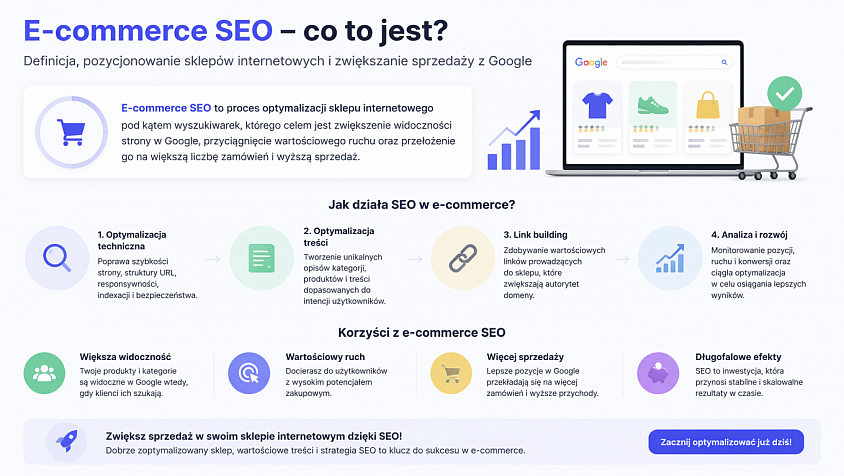
E-commerce SEO – What is it? Definition, SEO for online stores, and increasing sales with Google
E-commerce SEO Definition
E-commerce SEO is the process of comprehensively optimizing an online store for search engines, aimed at increasing the visibility of products, categories, and sales pages in organic search results from Google, Bing, and advanced search systems based on artificial intelligence.
The main goal of E-commerce SEO is to acquire valuable traffic from users actively searching for products, solutions or information related to the store's offer.
Effective SEO for online stores includes:
- technical optimization of the platform,
- optimization of categories and product cards,
- creating substantive and valuable content,
- analysis of users' purchasing intentions,
- link building,
- improving user experience (UX),
- preparing the store for AI-based search.
E-commerce SEO supports sales growth, reduces dependence on paid advertising campaigns, and builds long-term brand visibility.
What does E-commerce SEO mean?
E-commerce SEO is a combination of two key concepts:
- E-commerce – electronic commerce, i.e. the sale of products or services via the Internet,
- SEO (Search Engine Optimization) – optimization for search engines.
In practice, E-commerce SEO involves adapting your online store so that search engines can:
- easy to find products,
- understand their use,
- assess the quality of the offer,
- present the store to users interested in purchasing.
Online store positioning differs from the SEO of a standard company website due to the specific nature of stores, which often have:
- numerous products (often thousands),
- extensive category structures,
- advanced filters,
- product variants,
- dynamically generated pages.
Why is E-commerce SEO important?
Most customers start their online shopping with a search engine, entering queries like:
- product name,
- product category,
- problem to solve,
- product comparisons,
- opinions and recommendations.
Example queries include:
- men's trekking shoes,
- best laptop for work,
- ecological natural cosmetics,
- phone for photography.
A store that ranks high in search results has a much greater chance of acquiring a customer without having to pay for each click.
Key Elements of E-commerce SEO
- SEO audit of an online store
The basis for effective positioning is a detailed analysis of the current state of the store.
An E-commerce SEO audit includes an assessment of:
- category structures,
- product indexing,
- duplicate content,
- page loading speed,
- mobile version,
- technical errors,
- internal linking,
- visibility of competitors.
In large stores, traffic is often lost due to hidden technical problems.
- Product category optimization
Categories are one of the most important sales pages.
Optimization should include:
- unique and extensive category description,
- appropriate headings,
- selection of appropriate key phrases,
- linking to products,
- answers to the most frequently asked questions from customers,
- trust-building elements.
Example:
Instead of the short title "Sports shoes", it is worth creating an extensive page titled "Women's sports shoes - models for running, training and everyday use".
- Product card optimization
The product card is where the user makes a purchasing decision.
The key elements of SEO are:
- unique product description,
- precise name,
- attractive photos,
- technical parameters,
- customer reviews,
- FAQ section,
- structured data compliant with the Product Schema.
A carefully prepared product card is both user- and search-engine-friendly.
- Selection of keywords in E-commerce SEO
Online stores should use a variety of query types:
- product phrases (e.g. "iPhone 16 Pro 256 GB"),
- category phrases (e.g. "Apple smartphones"),
- guide phrases (e.g. "what smartphone to choose for photos"),
- long tail phrases (e.g. "best smartphone for night photography for beginners").
Long tail phrases are characterized by lower competition and higher purchase value.
- Content marketing for online stores
Creating educational content allows you to acquire users even before the purchasing stage.
Examples of valuable materials include:
- shopping guides,
- product rankings,
- comparisons,
- instructions for use,
- answers to customer questions.
Example:
A sports equipment store may publish articles such as:
- How to choose a mountain bike?
- What running equipment should you use for beginners?
- What is the difference between training shoes and running shoes?
Such content increases visibility and supports the sales process.
- Internal linking in the store
In complex stores, a well-designed link structure is crucial.
Internal linking allows you to:
- transferring SEO values between sites,
- making navigation easier for users,
- strengthening important categories,
- increasing the time spent on the site.
Example:
An advisory article should include links to:
- appropriate product categories,
- specific products,
- related guides.
- Structured data for stores
Schema.org implementation is crucial in E-commerce SEO.
It is worth implementing, among others, the following schemes:
- Product,
- Offer,
- Review,
- AggregateRating,
- BreadcrumbList,
- FAQPage.
This allows search engines to better interpret:
- product name,
- price,
- availability,
- opinions,
- user ratings.
E-commerce SEO and AI Search and GEO
Artificial intelligence is significantly changing the way we search for products online.
Users are increasingly turning to AI systems with questions about:
- the best product selection,
- optimal model,
- appropriate solution.
AI systems analyze, among others:
- quality of product descriptions,
- customer reviews,
- store authority,
- technical data,
- guide content.
Therefore, modern E-commerce SEO should take into account:
- detailed and comprehensive product descriptions,
- FAQ sections,
- expert guides,
- structured data,
- building brand reputation.
The Most Common Mistakes in E-commerce SEO
The most common problems include:
- copying manufacturer descriptions,
- no unique category descriptions,
- insufficient content,
- duplication of filter pages,
- unoptimized photos,
- slow operation of the store,
- no customer reviews,
- insufficient internal linking.
Summary of Key Information on E-commerce SEO
- E-commerce SEO increases your store's visibility on Google and other search engines.
- It allows you to acquire customers without having to pay for every click.
- Includes optimization of products, categories, content and technical aspects.
- Supports sales growth and brand recognition.
- Prepares the store to operate effectively in an AI-powered search environment.
FAQ – Frequently Asked Questions about E-commerce SEO
What is E-commerce SEO?
E-commerce SEO is the process of optimizing an online store to increase the visibility of products and categories in search results.
Does an online store need SEO?
Yes. SEO helps stores acquire customers interested in purchasing and reduces reliance on paid advertising.
How long does it take to position an online store ?
The implementation time depends on the size of the store, the level of competition, the number of products and the quality of the implemented activities.
Do product descriptions affect SEO?
Yes. Unique and valuable product descriptions allow search engines to better understand your store's offerings.
Is online store SEO different from standard website SEO?
Yes. Online stores require additional optimization of products, categories, filters, and sales elements.
Does E-commerce SEO support AI Search?
Yes. Detailed product information, reviews, and structured data increase the chances of your store being used by AI systems.
Related definitions
- SEO
- Website positioning
- Technical SEO
- Content Marketing
- Link Building
- GEO
- AI Search
Recommended guides
- How to position an online store?
- SEO for e-commerce step by step
- How to increase store sales with Google?
- Optimizing product pages for SEO
E-commerce SEO services
- Positioning of online stores
- E-commerce SEO audit
- Product and category optimization
- Content marketing for stores
- SEO and GEO strategy
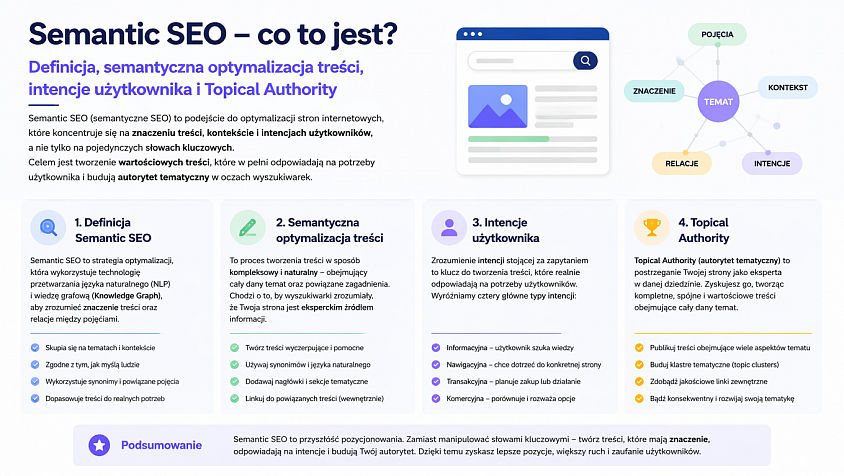
Semantic SEO – What is it? Definition, Semantic Content Optimization, User Intent, and Topical Authority
Semantic SEO Definition
Semantic SEO is an advanced website optimization method that focuses on the meaning, context, and relationships between information, rather than limiting itself to single keywords.
The main goal of Semantic SEO is to create content that comprehensively meets user needs and makes it easier for search engines to understand the topic, context, and relationships between individual concepts.
Modern search engines such as Google and AI systems analyze not only the presence of specific phrases, but also:
- the importance of content,
- related topics,
- user intent,
- the author's expertise,
- information structure.
As a result, Semantic SEO allows you to create pages with higher value for both users and search algorithms.
What does Semantic SEO mean?
The term Semantic SEO comes from the word "semantics", which is the science that deals with the meaning of words, concepts and the relationships between them.
Traditional SEO has been dominated by the approach of repeating specific keywords.
Example of the old approach:
Main phrase: "website positioning"
The text contained exactly the same phrase multiple times.
In Semantic SEO the approach is different.
Search engines analyze the entire context, including:
- what is positioning,
- what are its elements,
- what tools does an SEO specialist use,
- what problems does it solve,
- what are the related concepts.
This makes it possible to assess the value of the entire material.
Why is Semantic SEO important?
Search engine algorithms have become much more advanced.
Google uses natural language analysis technologies such as:
- natural language processing (NLP),
- machine learning,
- models of understanding context.
AI systems also analyze content semantically.
Therefore, simply including keywords multiple times does not guarantee a high ranking.
It is much more important to create a comprehensive response to user needs.
Semantic SEO and User Intent (Search Intent)
A key element of Semantic SEO is understanding search intent.
Users may enter similar phrases but expect different answers.
Example:
Query: "SEO"
Possible intentions:
- learning the definition of SEO,
- learning positioning,
- finding an SEO company,
- purchase of service.
Therefore, content should respond to different stages of the user journey.
Types of search intent
Informational
The user is seeking knowledge.
Example: "What is SEO?"
Relevant content: guide, definition, guide.
Navigation
The user is looking for a specific brand or website.
Example: "Google Search Console"
Transactional
The user is ready to take action.
Example: "SEO audit price"
Commercial
The user compares available solutions.
Example: "best SEO agency reviews"
The most important elements of Semantic SEO
- Comprehensive coverage of the topic
Content should broadly discuss the topic and answer key user questions.
Example: An SEO article should include the SEO definition, SEO process, SEO audit, link building, content marketing, technical SEO, and SEO for AI. This approach builds topical authority. - Topic Cluster and Topical Authority
Semantic SEO is closely related to building topical authority.
Topic Cluster means creating groups of related content.
Example:
Home: SEO
Subpages: SEO Audit, Link Building, Technical SEO, Local SEO, E-commerce SEO, Content Marketing.
All elements are connected by internal linking, which allows search engines to perceive the site as an expert source of information. - Use of related phrases
Semantic SEO is not limited to a single phrase, but uses synonyms, industry terms, related concepts, and user questions.
Example for SEO phrase: website positioning, website optimization, Google Search Console, backlinks, keywords, SERP. - Content structure
Semantic SEO content should have clear headings, topic sections, lists, FAQs, definitions, and examples.
This structure makes it easier for users to read, search engines to analyze, and AI systems to retrieve information.
Semantic SEO and AI Search and GEO
The development of artificial intelligence has increased the importance of semantic SEO.
AI systems such as ChatGPT Search, Gemini and Perplexity analyze:
- the importance of content,
- relationships between concepts,
- credibility of the source,
- completeness of the answer.
Therefore, Semantic SEO is the foundation of GEO (Generative Engine Optimization).
Semantically prepared pages have a greater chance of:
- appearing in AI responses,
- being cited as credible sources,
- acquiring traffic from new search channels.
The Most Common Mistakes in Semantic SEO
- focusing only on one phrase,
- artificial keyword stuffing,
- no answers to user questions,
- creating many short texts instead of complex materials,
- no connections between articles,
- ignoring search intent.
Semantic SEO Key Information Summary
- Semantic SEO focuses on meaning, not just keywords.
- It helps create content with higher substantive value.
- Supports building topical authority.
- It is important for both Google and AI-based search engines.
- Integrates SEO, content marketing and user intent analysis.
FAQ – Frequently Asked Questions about Semantic SEO
What is Semantic SEO?
Semantic SEO is the optimization of content taking into account the meaning, context and connections between information.
Are keywords still important in Semantic SEO?
Yes, but they're just one element. The context of the overall content is crucial.
How is Semantic SEO different from traditional SEO?
Traditional SEO focused on single phrases, while Semantic SEO analyzes the entire topic and its meaning.
Does Semantic SEO help with Google?
Yes. Semantically prepared content better meets user needs and makes it easier for search engines to understand the topic.
Does Semantic SEO affect visibility in AI Search?
Yes. AI systems use analysis of content meaning and context to generate responses.
Related definitions
- SEO
- Content Marketing
- Topic Cluster
- Topical Authority
- EEAT
- GEO
- AI Search
- Search Intent
Recommended guides
- How to create SEO content that aligns with user intent?
- Topic Cluster – The Complete Guide
- How to build thematic authority of a website?
- SEO and AI Search – preparing the website of the future
Semantic SEO Services
- SEO and GEO strategy
- SEO Content Creation
- SEO audit
- Internet marketing
- Building topical authority

Internet Marketing Dictionary - Definitions 1-50
1,(Digital Marketing) Definition:
Digital marketing is a comprehensive set of strategies, activities, and tools used to promote products, services, and brands and build customer relationships online. It includes SEO, Google Ads campaigns, content marketing, social media, email marketing, web analytics, and marketing automation.
Importance in marketing:
Online marketing allows companies to precisely reach specific audiences, measure the effectiveness of their activities, and optimize customer acquisition costs. Unlike traditional forms of advertising, it allows for detailed analysis of user behavior.
Practical application:
- increasing visibility on Google,
- acquiring new customers,
- building an expert brand,
- selling products online,
- automation of marketing processes.
Related concepts:
SEO, SEM, Content Marketing, Social Media Marketing, AI Marketing, Marketing Automation.
FAQs:
Does every company need internet marketing?
Yes. Online presence is currently one of the key elements in building a competitive advantage.
2. SEO (Search Engine Optimization) Definition:
SEO, or search engine optimization, is the process of increasing a website's visibility in the organic search results of Google and other search engines.
Importance in marketing:
SEO allows you to acquire users without having to pay for every ad click. A well-optimized website can generate stable traffic over time.
Practical application:
- technical optimization of the website,
- creating valuable content,
- selection of keywords,
- building domain authority,
- acquiring valuable links.
Related concepts:
Technical SEO, On-page SEO, Off-page SEO, Link Building, Content SEO.
FAQs:
How long does website positioning take?
The first SEO effects may be visible after a few weeks, but full results usually require several months of systematic action.
3. SEM (Search Engine Marketing) Definition:
SEM is search engine marketing that involves activities aimed at increasing a website's visibility in both organic and paid search results.
Importance in marketing:
SEM combines SEO with PPC campaigns, enabling quick customer acquisition and long-term visibility.
Practical application:
- Google Ads,
- SEO,
- remarketing,
- product advertising,
- local campaigns.
Related concepts:
Google Ads, PPC, SEO, SERP.
FAQs:
Does SEM replace SEO?
No. The best results are achieved by combining paid campaigns with organic SEO.
4. Content Marketing Definition:
Content marketing is a strategy of creating and distributing valuable content that attracts audience attention, builds trust, and supports the sales process.
Importance in marketing:
Expert content helps companies increase search engine visibility, build authority, and respond to customer needs.
Practical application:
- blog articles,
- guides,
- ebooks,
- reports,
- infographics,
- video materials.
Related concepts:
SEO Content, Copywriting, Topical Authority, EEAT.
FAQs:
Does content marketing affect SEO?
Yes. High-quality content is one of the key elements of building a website's visibility.
5. AI Marketing Definition:
AI marketing is the use of artificial intelligence to plan, automate, analyze and optimize marketing activities.
Importance in marketing:
AI enables faster content creation, data analysis, communication personalization and process automation.
Practical application:
- content generation,
- chatbots,
- analysis of customer behavior,
- automatic campaigns,
- sales forecasting.
Related concepts:
ChatGPT, Generative AI, GEO, Marketing Automation.
FAQs:
Will AI replace marketing specialists?
AI is a tool to support marketers, but strategy and experience remain essential.
6. GEO (Generative Engine Optimization) Definition:
GEO is content optimization for generative artificial intelligence systems such as ChatGPT, Gemini, Copilot or Perplexity.
Importance in marketing:
GEO increases a brand's chances of appearing in AI-generated responses.
Practical application:
- creating expert content,
- FAQ structure,
- structured data,
- building the author's authority,
- semantic optimization.
Related concepts:
AI SEO, AEO, EEAT, Semantic SEO.
FAQs:
Will GEO replace classic SEO?
No. GEO is an extension of SEO adapted to new methods of searching for information.
7. AEO (Answer Engine Optimization) Definition:
AEO is content optimization for search engines that provide users with specific answers instead of a list of pages.
Importance in marketing:
AEO increases the chances of your brand appearing in featured snippets and AI responses.
Practical application:
- questions and answers FAQ,
- short definitions,
- clear content structure,
- structured data.
Related concepts:
Voice Search SEO, Featured Snippet, GEO.
FAQs:
Why is AEO important?
More and more users are looking for ready-made answers instead of browsing websites on their own.
8. UX (User Experience) Definition:
UX refers to the user experience when using a website, app or digital product.
Importance in marketing:
High-quality UX increases conversions, time spent on site, and customer satisfaction.
Practical application:
- intuitive navigation,
- page loading speed,
- readability of content,
- simple purchasing process,
- adaptation to mobile devices.
Related concepts:
UI, CRO, Core Web Vitals, Mobile UX.
FAQs:
Does UX influence SEO?
Yes. Google considers user experience signals.
9. UI (User Interface) Definition:
UI is the appearance and presentation of interface elements of a website or application.
Importance in marketing:
A professional interface increases brand credibility and makes it easier for users to carry out their intended actions.
Practical application:
- graphic design,
- color selection,
- typography,
- CTA buttons,
- page layout.
Related concepts:
UX Design, Web Design, CRO.
FAQs:
Does website appearance affect sales?
Yes. Professional design increases user confidence and can improve conversion rates.
10. CRO (Conversion Rate Optimization) Definition:
CRO is the process of increasing website effectiveness by optimizing conversion rates.
Importance in marketing:
CRO allows you to acquire more customers from existing traffic without having to increase your advertising budget.
Practical application:
- A/B testing,
- form optimization,
- CTA improvement,
- analysis of user behavior,
- simplifying the purchasing path.
Related concepts:
Landing Page, UX, Analytics, Customer Journey.
FAQs:
Is CRO more important than driving traffic?
Often yes, because more visitors do not automatically guarantee higher sales.
Part 1 – Definitions 11–50 will be prepared in subsequent messages.
Internet Marketing Dictionary - Definitions 11-50
SERP (Search Engine Results Page) – Definition:
SERP is the search results page presented by a search engine after a user enters a query.
Importance in marketing:
A website's position in the SERPs has a direct impact on the number of visits, brand recognition and customer acquisition.
Practical application:
Optimizing your visibility in SERPs includes:
- SEO,
- creating content that meets users' intentions,
- header optimization,
- building domain authority.
SERP elements:
- organic results,
- Google Ads ads,
- Featured Snippets,
- Google Maps,
- graphics and video,
- AI responses.
Related terms: SEO, SEM, Google Search, Featured Snippet, AI Overview.
FAQs:
Why is position in SERPs important?
Most users primarily choose results from the first page of search.
12. Keyword – Definition:
A keyword is a phrase entered into a search engine to find specific information, products or services.
Importance in marketing:
The right selection of keywords is the foundation of an effective SEO and content marketing strategy.
Types of keywords:
- general,
- industry,
- local,
- product,
- long tail,
- informational,
- sales.
Practical application:
Keyword analysis allows you to:
- creating content that meets customer needs,
- increasing organic traffic,
- improving conversions.
Related terms: Keyword Research, SEO, Search Intent, Long Tail Keywords.
FAQs:
Does high search volume always mean the best keyword?
No. Less popular phrases with higher purchase intent are often more valuable.
13. Long Tail Keywords – Definition:
Long tail keywords are complex, multi-word phrases characterized by fewer searches but greater precision.
Importance in marketing:
Long tail phrases allow you to reach users who are closer to making a purchasing decision.
Examples:
- "website positioning for small businesses Lublin"
- "how much does a website SEO audit cost"
Practical application:
They are used in:
- blog articles,
- guides,
- service pages,
- FAQ sections.
Related terms: SEO, Keyword Research, Content Marketing.
FAQs:
Is it worth positioning long tail phrases?
Yes, because they often generate valuable traffic and it is easier for them to achieve high rankings.
14. Search Intent – Definition:
Search Intent determines the user's actual need behind the query entered in the search engine.
Types of intentions:
- informational – the user is looking for knowledge,
- navigational – looking for a specific brand,
- transactional – intends to make a purchase,
- commercial – compares available solutions.
Importance in SEO:
Google is increasingly analyzing user intent, so the mere presence of keywords does not guarantee high rankings.
Practical application:
When creating content, you should respond to:
- what the user is looking for,
- what problem does he want to solve,
- at what stage of the purchasing decision it is.
Related concepts: Semantic SEO, Content Strategy, Customer Journey.
FAQs:
Why doesn't a website rank despite using keywords?
A common cause is that the content does not match the searcher's intent.
15. On-Page SEO – Definition:
On-Page SEO covers all optimization activities carried out directly on the website.
On-Page SEO Elements:
- SEO titles,
- H1-H6 headings,
- meta descriptions,
- content,
- internal linking,
- URL structure,
- image optimization.
Meaning:
Proper website optimization makes it easier for search engines to understand the topic of your website.
Related terms: Technical SEO, Content SEO, Semantic SEO.
FAQs:
Is On-Page SEO alone sufficient?
No. The best results are achieved through a combination of on-page optimization, content, and off-page activities.
16. Off-Page SEO – Definition:
Off-Page SEO is activities carried out outside of your own website, aimed at increasing its authority and visibility.
Key elements:
- link building,
- expert publications,
- Digital PR,
- brand mentions,
- building an online reputation.
Meaning:
Google uses external signals to evaluate a site's popularity and trustworthiness.
Related terms: Backlinks, Domain Authority, Link Building.
FAQs:
Do links still matter for SEO?
Yes, but natural and thematically related links have the greatest value.
17. Technical SEO – Definition:
Technical SEO is the optimization of the technical aspects of a website, enabling search engines to properly index and rank the site.
Includes:
- page loading speed,
- indexation,
- sitemap.xml,
- robots.txt,
- code structure,
- structured data.
Meaning:
Technical issues can limit the visibility of even the best content.
Related terms: Core Web Vitals, Crawl Budget, Indexing.
FAQs:
Is Technical SEO important for small websites?
Yes. Every website must be properly accessible to both users and search engine robots.
18. Link Building – Definition:
Link building is the process of obtaining links to a website from other websites.
Meaning:
Valuable links increase domain authority and can improve search engine rankings.
Methods:
- sponsored articles,
- expert publications,
- industry catalogs,
- Digital PR,
- partnership cooperation.
Related terms: Backlink, Off-Page SEO, Authority.
FAQs:
Does every link support SEO?
No. Low-quality or spammy links can harm your site.
19. Backlink – Definition:
A backlink is a link placed on another website that leads to a specific website.
Meaning:
Backlinks are one of the signals that help search engines assess a domain's popularity and credibility.
Types:
- dofollow,
- nofollow,
- sponsored,
- UGC.
Related terms: Link Building, Domain Authority, SEO.
FAQs:
How many backlinks does a website need?
What is important is not only the number, but above all the quality and thematic relevance of links.
20. Domain Authority – Definition:
Domain Authority determines the level of trust and strength of a website domain in the context of SEO.
Influencing factors:
- content quality,
- domain history,
- external links,
- brand reputation,
- author's experience.
Meaning:
Stronger domains are more likely to achieve high rankings for competitive phrases.
Related terms: EEAT, SEO Authority, Backlinks.
FAQs:
Is Domain Authority an official Google factor?
No. This is a metric developed by SEO tools to assess a domain's potential.
Internet Marketing Dictionary - Definitions 21-50
EEAT (Experience, Expertise, Authoritativeness, Trustworthiness) – Definition:
EEAT is a concept used by Google to evaluate the quality of content, taking into account the author's experience, expertise, authority and credibility.
Importance in marketing:
EEAT allows search engines to assess whether content was prepared by someone with actual experience and competence in a given area.
EEAT elements:
Experience – practical knowledge of the topic,
Expertise – specialized knowledge,
Authoritativeness – the recognition of an author or brand,
Trustworthiness – security and reliability of the information provided.
Practical application:
Building EEAT includes:
- author's website,
- information about experience,
- reference,
- expert publications,
- sources of information.
Related terms: SEO, AI SEO, Content Marketing, Topical Authority.
FAQs:
Does EEAT affect your Google ranking?
Yes, especially for content that requires a high level of trust, such as finance, health, or law.
22. Topical Authority
Definition:
Topical Authority refers to the level of expert coverage of a specific topic by a website.
Meaning:
Google increasingly evaluates websites not only based on individual articles, but also on overall knowledge in a given field.
Building topic authority:
- creating comprehensive guides,
- publishing numerous related articles,
- using internal linking,
- developing thematic clusters.
Example:
An SEO website may publish content related to:
- SEO audits,
- link building,
- Technical SEO,
- AI SEO,
- local SEO.
Related terms: Semantic SEO, Content Cluster, EEAT.
FAQs:
Is one very good article enough to gain authority?
Usually not. Google prefers sites that present both broad and in-depth knowledge.
23. Semantic SEO
Definition:
Semantic SEO is the optimization of content in terms of meaning, context, and connections between concepts, not just individual keywords.
Meaning:
Modern search engines analyze a topic holistically, using artificial intelligence and language models.
Elements of semantic SEO:
- synonyms,
- entities,
- related concepts,
- answers to user questions,
- thematic structure.
Application:
Instead of using the phrase repeatedly:
"website positioning"
it is worth considering:
- SEO,
- Google visibility,
- website optimization,
- organic traffic,
- search engine algorithms.
Related terms: AI SEO, NLP, Entity SEO.
FAQs:
Does keyword stuffing still work?
No. Excessive use of phrases reduces the quality of the content.
24. Entity SEO
Definition:
Entity SEO is the optimization of a website so that search engines recognize specific people, companies, places, products, and concepts.
Meaning:
Google is increasingly understanding the world through entities, not just keywords.
Elements:
- company details,
- author profiles,
- structural information,
- mentions on the internet,
- thematic connections.
Example:
The brand can be recognized as:
"SEO company",
"internet marketing expert",
"author of industry publications".
Related terms: Semantic SEO, Knowledge Graph, EEAT.
FAQs:
Why are entities important for SEO?
They help search engines understand who a company or person is and what topics they are related to.
25. AI SEO
Definition:
AI SEO is the use of artificial intelligence to optimize websites, create content, analyze data, and increase online visibility.
Meaning:
AI enables faster competitive analysis, SEO strategy development and automation of many processes.
Applications:
- keyword analysis,
- generating content ideas,
- SEO audits,
- text optimization,
- monitoring results.
Related terms: GEO, AEO, Generative AI, ChatGPT SEO.
FAQs:
Can AI perform SEO on its own?
AI can automate many activities, but an effective strategy requires knowledge and experience.
26. Generative Engine Optimization (GEO)
Definition:
Generative Engine Optimization is the process of preparing content so that it is easily used by generative AI search engines.
GEO Goal:
Increase the chances of your brand appearing in responses from generative tools such as:
- ChatGPT,
- Gemini,
- Copilot,
- Perplexity.
GEO elements:
- expert content,
- FAQ answers,
- clear definitions,
- structured data,
- the authority of the author.
Related terms: AI Search, AEO, SEO.
FAQs:
Will GEO replace traditional Google SEO?
No. Currently, both approaches should be developed in parallel.
27. Google Search Console
Definition:
Google Search Console is a free Google tool that allows you to monitor your website's visibility in the search engine.
Features:
- click analysis,
- position monitoring,
- detecting indexing errors,
- submitting a sitemap,
- Core Web Vitals analysis.
Meaning:
It is one of the basic tools of every SEO specialist.
Related terms: SEO, Indexing, SERP, Technical SEO.
FAQs:
Does Google Search Console provide complete SEO data?
No, but it offers official information directly from Google.
28. Google Analytics 4 (GA4)
Definition:
Google Analytics 4 is Google's analytics tool for monitoring user behavior on websites and applications.
Analyzes:
- traffic sources,
- user behavior,
- conversions,
- shopping paths.
Meaning:
Enables you to make data-driven marketing decisions.
Related terms: Web analytics, CRO, Data Driven Marketing.
FAQs:
Why is data analysis crucial in marketing?
Because it allows you to effectively invest your budget in activities that bring the best results.
29. Core Web Vitals
Definition:
Core Web Vitals is a set of Google metrics that assess the speed, stability, and user interaction with a website.
The most important parameters:
- LCP – loading speed of the main page element,
- INP – website response time,
- CLS – visual stability.
Meaning:
They influence user experience and the assessment of the quality of the website.
Related terms: Technical SEO, UX, Page Speed.
FAQs:
Do Core Web Vitals determine a website's position?
They are one of many ranking factors.
30. Page Speed
Definition:
Page Speed refers to the loading and performance speed of a website.
Factors affecting speed:
- size of graphics,
- page code,
- hosting,
- scripts,
- cache.
Meaning:
Quick Pages:
- they convert better,
- provide a better user experience (UX),
- are characterized by a lower bounce rate.
Related terms: Core Web Vitals, UX, Technical SEO.
FAQs:
How fast should a page load?
The faster the better, especially on mobile devices.
Internet Marketing Dictionary - Definitions 31-50
1. Indexing
Indexing is the process by which search engine robots analyze a website and add it to their index. Only indexed pages can appear in search results on Google, Bing, and other search engines.
Importance in marketing:
Without proper indexing, even the most optimized website won't appear in search results. Monitoring the indexing process is the foundation of effective SEO.
Practical application:
monitoring indexing status in Google Search Console,
submitting a sitemap (sitemap.xml),
eliminating 404 errors and redirects,
blocking irrelevant subpages from indexing.
Related concepts:
Crawling, Google Search Console, Technical SEO, Robots.txt, Sitemap.xml.
FAQs:
Why doesn't my website appear on Google?
The most common causes are lack of indexation, technical problems or low content quality.
32. Crawling
Crawling is the process by which search engine robots visit websites, analyze their content, and discover new subpages and links.
Importance in marketing:
Regular robot visits enable faster detection of new content and updates on the site.
Practical application:
improving internal linking,
elimination of server errors,
loading speed optimization,
sitemap update.
Related concepts:
Indexing, Crawl Budget, Technical SEO.
FAQs:
Does the Google robot visit the site every day?
No. The frequency depends on the authority of the site, the number of changes, and the quality of the published content.
33. Crawl Budget
Crawl Budget is the number of subpages that a search engine robot is willing to crawl during one or more visits to your website.
Importance in marketing:
Effective crawl budget management allows you to crawl key pages faster and reduces wasted resources on low-value pages.
Practical application:
removing duplicate content,
limiting the number of unnecessary URLs,
improving the linking structure,
server performance optimization.
Related concepts:
Crawling, Robots.txt, Sitemap.xml, Technical SEO.
FAQs:
Should small sites worry about Crawl Budget?
Usually not. The problem mainly affects large websites with thousands of subpages.
34. Sitemap.xml
Sitemap.xml is an XML file containing a list of website URLs that helps search engines find and index your pages.
Importance in marketing:
A sitemap speeds up the indexing of new content and helps robots better understand the structure of the website.
Practical application:
submitting the map to Google Search Console,
automatic update after adding new subpages,
including only valuable URLs.
Related concepts:
Robots.txt, Indexing, Google Search Console.
FAQs:
Should every page have a sitemap.xml?
Yes. This is a recommended SEO practice, especially for complex websites.
35. Robots.txt
Robots.txt is a text file that contains instructions for search engine robots specifying which parts of your website can be crawled and which should be skipped.
Importance in marketing:
Correct file configuration allows you to manage indexing and protect resources that should not be analyzed by search engines.
Practical application:
blocking the administration panel,
exclusion of technical folders,
specifying the location of the sitemap.xml file.
Related concepts:
Indexing, Crawling, Sitemap.xml.
FAQs:
Does robots.txt hide the page from Google?
Not always. It blocks scanning, but doesn't guarantee complete removal from the index.
36. Meta Title
Meta Title is the title of the page displayed in search results and in the browser tab.
Importance in marketing:
It is one of the key elements of on-page SEO, influencing both the page position and the click-through rate (CTR).
Good practices:
approximately 50–60 characters long,
placing the most important keyword at the beginning,
a unique title for each subpage,
incentive to click.
Related concepts:
Meta Description, On-Page SEO, CTR.
FAQs:
Should each subpage have a unique Meta Title?
Yes. Duplicate titles make it harder for search engines to interpret your content.
37. Meta Description
Meta Description is a short description of a page that appears in search results below the title.
Importance in marketing:
Although it is not a direct ranking factor, it influences the number of clicks and the attractiveness of the search result.
Good practices:
approximately 140–160 characters long,
containing the most important information,
call to action (CTA),
unique for each page.
Related concepts:
Meta Title, CTR, SEO.
FAQs:
Does Google always display the prepared Meta Description?
No. Depending on the query, it may generate its own text snippet.
38. H1–H6 Headings
H1–H6 headings are used to logically organize content on a page and indicate the hierarchy of information.
Importance in marketing:
Correct heading structure makes it easier for users to read your content and for search engines to understand its subject matter.
Good practices:
using one H1 heading per page,
subsequent sections marked with H2 headings,
subsections H3–H6,
natural use of keywords.
Related concepts:
On-Page SEO, Semantic SEO, UX.
FAQs:
Can I use multiple H1 headings?
Technically this is possible, but in SEO practice it is recommended to use one main H1.
39. Internal Linking
Internal linking involves creating links between subpages of the same website.
Importance in marketing:
It makes it easier for users to find related content and for search engine robots to better understand the website's structure and the relationships between topics.
Practical application:
linking articles with offers,
building thematic clusters,
transfer of authority between subpages,
improved indexation.
Related concepts:
Topical Authority, Semantic SEO, Crawl Budget.
FAQs:
How many internal links should there be in an article?
There's no single number. It's important that links are natural and lead to valuable, related content.
40. Anchor Text
Anchor Text is clickable link text leading to another page or subpage.
Importance in marketing:
Properly selected anchors help search engines understand the topic of the landing page and improve usability for users.
Good practices:
use of descriptive texts,
avoiding generalities such as "click here",
maintaining naturalness,
differentiating anchors.
Related concepts:
Link Building, Internal Linking, SEO.
FAQs:
Should the anchor contain a keyword?
Yes, as long as it sounds natural and fits the context of the content.
41. Canonical URL
Canonical URL is an address that indicates to search engines the preferred version of a page when similar or identical content exists.
Meaning:
It helps eliminate duplicate content and consolidates ranking signals.
Related concepts:
Duplicate Content, Technical SEO, Indexing.
42. Duplicate Content
Duplicate Content is identical or very similar content appearing at different URLs.
Meaning:
Duplicate content can make it difficult for search engines to select the correct page to display and can weaken your site's visibility.
Related concepts:
Canonical URL, Technical SEO, Indexing.
43. Rich Snippets
Rich Snippets are extended search results that include additional information such as ratings, prices, FAQs, recipes, and events.
Meaning:
They increase the attractiveness of the result in the SERPs and can improve the click-through rate (CTR).
Related concepts:
Schema.org, Structured Data, SERP.
44. Structured Data
Structured data is special markup (most often Schema.org in JSON-LD format) that helps search engines understand the content of a page.
Meaning:
They enable the display of Rich Snippets and improve content understanding by Google and AI systems.
Related concepts:
Schema.org, Rich Snippets, Entity SEO.
45. Schema.org
Schema.org is a common standard for structured data markup developed by major search engines.
Meaning:
It allows you to describe articles, products, organizations, people, events, FAQs, and opinions in a way that is understandable to search engines.
Related concepts:
Structured Data, Rich Snippets, JSON-LD.
46. CTR (Click-Through Rate)
CTR (Click-Through Rate) is a ratio that shows the percentage of users who clicked on a search result or ad compared to the number of its views.
Meaning:
A higher CTR usually indicates a better match between the page title and description and greater user interest.
Related concepts:
Meta Title, Meta Description, Google Ads, SERP.
47. Bounce Rate
Bounce Rate measures the percentage of users who leave a page without making another interaction.
Meaning:
It may indicate issues with content quality, page loading speed, or a mismatch with user intent.
Related concepts:
UX, GA4, CRO.
48. Conversion
A conversion is when a user completes a desired action, such as a purchase, submitting a form, subscribing to a newsletter, or making a phone call.
Meaning:
It is one of the key indicators of the effectiveness of marketing activities.
Related concepts:
CRO, Lead Generation, CTA, Funnel Marketing.
49. CTA (Call to Action)
CTA (Call to Action) is a call to action that encourages the user to perform a specific action.
Examples:
Order a free SEO audit,
Contact an expert,
Download the guide,
Schedule a consultation,
Estimate your project.
Meaning:
A carefully designed CTA increases conversions and guides the user through the purchasing path.
Related concepts:
Landing Page, CRO, UX.
50. Landing Page
A landing page is a specially designed subpage whose main purpose is to encourage the user to perform a specific action – e.g., make a purchase, sign up for a newsletter, or submit a form.
Importance in marketing:
An effective landing page minimizes distractions and focuses attention on the offer and call to action.
Most important elements:
strong headline,
clear value proposition,
benefits for the customer,
social evidence (opinions, references),
clear CTA,
simple contact form.
Related concepts:
CRO, CTA, Lead Generation, Google Ads, UX.
FAQs:
Should every advertising campaign lead to a landing page?
In most cases, yes. A dedicated landing page typically achieves a significantly higher conversion rate than a generic homepage.
Internet Marketing Dictionary - Definitions 51-60
1.Lead Definition
A lead is a person or company that has shown interest in an offer by completing a specific action, such as filling out a contact form, signing up for a newsletter, downloading an e-book, or contacting you by phone.
Importance in marketing
A lead is a potential customer at one stage of the purchasing process. Acquiring high-quality leads is one of the key goals of online marketing.
Practical application
Leads can be obtained using:
contact form,
Google Ads campaign,
Facebook Ads,
webinar,
newsletter,
free audit,
online consultation.
Related concepts
Lead Generation, CRM, Sales Funnel, Conversion.
FAQ
Will every lead become a customer?
No. Sales effectiveness depends on the quality of the lead, the service process, and the tailoring of the offer.
52.Lead Generation Definition
Lead Generation is the process of acquiring potential customers interested in a company's offerings through marketing activities conducted both online and offline.
Importance in marketing
Systematic lead acquisition ensures a constant flow of new sales opportunities and supports company development.
The most popular methods
SEO,
Google Ads,
Content Marketing,
Social Media,
Landing Page,
Email Marketing,
Webinars,
Lead Magnet.
Related concepts
Lead, CRM, Marketing Automation, CRO.
FAQ
How to measure Lead Generation effectiveness?
The most commonly analyzed factors are the number of leads acquired, the cost of acquiring them (CPL) and the conversion rate.
53.Lead Magnet Definition
A lead magnet is valuable material or service offered free of charge in exchange for a user's contact information.
Importance in marketing
Lead Magnet increases the number of newsletter subscriptions and supports the development of a database of potential customers.
Examples
e-book,
PDF guide,
free SEO audit,
checklist,
industry report,
online calculator,
document template,
free consultation.
Related concepts
Lead Generation, Landing Page, E-mail Marketing.
FAQ
Which Lead Magnet is the most effective?
The most effective materials are those that solve specific problems of recipients.
54.Sales Funnel Definition
Sales Funnel is a model illustrating the subsequent stages of the purchasing process – from the first contact with the brand to purchase and customer loyalty.
Typical stages
awareness,
interest,
consideration,
decision,
purchase,
loyalty.
Importance in marketing
The sales funnel allows you to plan marketing activities tailored to each stage of the customer journey.
Related concepts
Customer Journey, Lead, Remarketing, CRO.
FAQ
Does every customer go through the entire funnel?
Not always. For simple products, purchasing decisions can be made very quickly.
55.Customer Journey Definition
Customer Journey is a complete customer journey encompassing all interactions with the brand – from the first contact with the offer to after-sales service.
Importance in marketing
Customer Journey Analysis allows you to identify purchasing barriers and optimize customer experiences.
Stages
brand discovery,
offer analysis,
comparison,
purchase,
service,
recommendation.
Related concepts
UX, Sales Funnel, CRM, Marketing Automation.
FAQ
Why is Customer Journey important?
It allows you to better understand customer needs and increase the effectiveness of marketing activities.
56. Marketing Persona (Buyer Persona) Definition
Buyer Persona is a detailed profile of your ideal customer, developed based on data, research, and observations of real customers.
Importance in marketing
Knowing personas makes it easier to create effective advertising campaigns, content and offers.
Examples of persona elements
age,
position,
goals,
problems,
needs,
budget,
way of making decisions.
Related concepts
Target Group, Customer Journey, Content Marketing.
FAQ
Should a company have more than one persona?
Yes. Most businesses serve multiple customer groups with diverse needs.
57.Target Audience Definition
A target group is a set of people or companies to whom marketing activities are directed.
Importance in marketing
Precisely defining your target group increases the effectiveness of advertising campaigns and reduces unnecessary expenses.
Criteria
age,
location,
interests,
income,
industry,
position,
purchasing behavior.
Related concepts
Buyer Persona, Market Segmentation, Marketing.
FAQ
Are target group and persona the same thing?
No. A target audience describes a broad category of recipients, while a persona represents a specific, model customer.
58.Market Segmentation Definition
Market segmentation involves dividing the market into smaller groups of customers with similar characteristics or needs.
Importance in marketing
Segmentation enables better tailoring of communications, products and offers to customer expectations.
Types of segmentation
demographic,
geographical,
psychographic,
behavioral,
industry.
Related concepts
Buyer Persona, Target Audience, Personalization.
FAQ
Why does segmentation increase marketing effectiveness?
Because different customer groups respond to different messages and offers.
59.Branding Definition
Branding is the process of building brand recognition, image and value in the minds of customers.
Importance in marketing
A strong brand increases trust, facilitates sales, and allows you to stand out from the competition.
Branding elements
name,
logo,
visual identification,
communication,
brand value,
reputation,
customer experience.
Related concepts
Brand Awareness, Employer Branding, Content Marketing.
FAQ
Does branding affect SEO?
Indirectly, yes. A recognizable brand is more likely to receive links, mentions, and brand searches.
60.Brand Awareness Definition
Brand Awareness means the degree of brand recognition among potential customers.
Importance in marketing
Higher brand awareness increases the likelihood that customers will choose its products or services.
How to build Brand Awareness?
SEO,
Content Marketing,
social media,
PR,
advertising,
expert publications,
webinars,
podcasts,
educational films.
Related concepts
Branding, Digital PR, EEAT, Topical Authority.
FAQ
How to measure brand awareness?
The number of searches for the brand name, direct traffic, online mentions, campaign reach and recognition research results are analyzed.
Internet Marketing Dictionary - Definitions 61-70
1.Remarketing Definition
Remarketing is a marketing strategy that involves retargeting ads to people who have previously visited a website, app, or interacted with a brand but did not take the expected action, such as making a purchase.
Importance in marketing
Most users don't make a purchasing decision on their first visit. Remarketing allows you to remind them of your offer, increase brand recognition, and improve your conversion rate.
Practical application
Remarketing can be used to:
- reminders about abandoned shopping carts,
- promoting new products,
- presenting special offers,
- sales of complementary services,
- building customer loyalty.
Related concepts
Retargeting, Google Ads, Meta Ads, Conversion, Sales Funnel.
FAQ
Is remarketing effective?
Yes. Remarketing campaigns often achieve higher conversion rates than ads targeting new audiences.
62.RetargetingDefinition
Retargeting is a form of online advertising that displays personalized ads to users based on their previous online activity, most often using cookies or advertising identifiers.
Importance in marketing
Retargeting allows you to recapture users who have left your website without making a purchase or contacting you.
Application examples
advertisements for products viewed previously,
- reminder about an unfinished order,
- promotions for returning users,
- cross-selling campaigns.
Related concepts
Remarketing, Dynamic Remarketing, Google Ads, Facebook Ads.
FAQ
What is the difference between remarketing and retargeting?
These terms are often used interchangeably. In practice, remarketing more often refers to reconnecting with a customer, for example, via email, while retargeting refers to online advertising.
63.PPC (Pay Per Click) Definition
PPC (Pay Per Click) is an online advertising model in which the advertiser pays only when a user clicks on the ad.
Importance in marketing
PPC allows you to quickly acquire traffic to your website and precisely control your advertising budget.
Most popular platforms
Google Ads,
- Microsoft Advertising,
- Meta Ads,
- LinkedIn Ads,
- X Ads.
Related concepts
CPC, Google Ads, SEM, Quality Score.
FAQ
Is PPC better than SEO?
No. PPC delivers quick results, while SEO builds long-term visibility. The best results are achieved by combining both strategies.
64.CPC (Cost Per Click) Definition
CPC (Cost Per Click) means the cost of a single click on an online advertisement.
Importance in marketing
CPC allows you to assess the effectiveness of a campaign and compare the costs of acquiring traffic from different advertising channels.
Factors influencing CPC
keyword competitiveness,
- advertising quality,
- landing page quality,
- Quality Score,
- bidding strategy.
Related concepts
PPC, Google Ads, CPA, ROAS.
FAQ
Does a lower CPC always mean a better campaign?
No. What matters is whether clicks translate into conversions and sales.
65.CPM (Cost Per Mille) Definition
CPM (Cost Per Mille) means the cost per thousand ad impressions.
Importance in marketing
The CPM model is most often used in campaigns aimed at building brand awareness.
Application
image campaigns,
- display advertising,
- video campaigns,
- promotion of new products.
Related concepts
Brand Awareness, Display Ads, Google Display Network.
FAQ
When is it worth choosing the CPM model?
When the main goal of the campaign is to reach a wide audience, not direct sales.
66.CPA (Cost Per Acquisition) Definition
CPA (Cost Per Acquisition) means the cost of acquiring one customer or performing a specific conversion.
Importance in marketing
CPA is one of the key performance indicators of advertising campaigns.
How to calculate?
CPA = total campaign cost ÷ number of conversions
Related concepts
Conversion, CPL, ROAS, ROI.
FAQ
What CPA is optimal?
It depends on the customer value and the margin achieved on the sale.
67.CPL (Cost Per Lead) Definition
CPL (Cost Per Lead) determines the cost of acquiring one lead, i.e. a potential customer.
Importance in marketing
It allows you to evaluate the effectiveness of campaigns aimed at generating quote requests.
Pattern
CPL = campaign cost ÷ number of leads acquired
Related concepts
Lead Generation, CPA, Conversion.
FAQ
Is a low CPL always beneficial?
No. The quality of leads acquired is much more important than their quantity.
68.ROAS (Return on Advertising Spend) Definition
ROAS is a metric that measures how much revenue was generated for each zloty spent on advertising.
Importance in marketing
ROAS allows you to assess the profitability of advertising campaigns and make decisions about your marketing budget.
Pattern
ROAS = Campaign Revenue ÷ Advertising Cost
Interpretation
ROAS 2 means PLN 2 in revenue for every PLN spent,
ROAS 5 means PLN 5 in revenue for every PLN spent.
Related concepts
ROI, Google Ads, Meta Ads, PPC Campaigns.
FAQ
Does a high ROAS always mean profit?
No. Product, service, and operating costs must also be taken into account.
69. ROI (Return on Investment) Definition
ROI (Return on Investment) determines the return on investment and indicates whether the incurred expenses have generated a profit.
Importance in marketing
ROI is one of the most important indicators for assessing the effectiveness of marketing activities.
Pattern
ROI = (profit – investment cost) ÷ investment cost × 100%
Application
analysis of advertising campaigns,
- SEO project evaluation,
- comparison of marketing channels,
- budget planning.
Related concepts
ROAS, CPA, Marketing Analytics.
FAQ
What is the difference between ROI and ROAS?
ROI takes into account the total profit and all costs, while ROAS only analyzes the ratio of revenue to advertising expenses.
70.Quality Score Definition
Quality Score is a metric used in Google Ads that evaluates the quality of an ad, keywords, and landing page on a scale of 1 to 10.
Importance in marketing
A higher Quality Score can lower your cost-per-click (CPC), improve your ad position, and increase campaign effectiveness.
Factors influencing quality score
advertising relevance,
- expected CTR,
- landing page quality,
- compliance of the content with the user's intention,
- user experience (UX).
Related concepts
Google Ads, PPC, CPC, Landing Page, CTR.
FAQ
How to improve Quality Score?
You need to create relevant ads, choose the right keywords, optimize your landing page, and improve loading speed and user experience.
Internet Marketing Dictionary - Definitions 71-80
1. Google Ads Definition
Google Ads is Google's advanced advertising platform that allows you to display ads in search results, the Google Display Network, YouTube, Gmail, Google Maps, and mobile apps.
Importance in marketing
Google Ads allows you to effectively reach users actively searching for products or services, making it one of the most effective online marketing tools.
The most important types of campaigns
Search campaigns
Performance Max Campaigns
Product campaigns (Shopping)
Display Campaigns
Video Campaigns (YouTube)
Demand Gen Campaigns
Local campaigns
App Campaigns
Advantages
immediate visibility,
precise targeting,
full control over the budget,
advanced analytics.
Related concepts
PPC, CPC, Quality Score, Landing Page, Conversion.
FAQ
Does Google Ads work immediately?
Yes. Ads can appear just minutes after the campaign launches.
72. Microsoft Advertising (Bing Ads) Definition
Microsoft Advertising is an advertising platform that allows you to display ads on the Bing search engine, Microsoft Edge browser, Yahoo, and Microsoft partners.
Importance in marketing
Despite having a smaller market share than Google Ads, it often offers lower costs per click and less competition.
Application
text ads,
remarketing,
product advertising,
local campaigns.
Related concepts
Google Ads, PPC, CPC, SEM.
FAQ
Is it worth investing in ads on Bing?
Yes, especially in the B2B sector and in markets where Bing has a larger share.
73. Meta Ads Definition
Meta Ads is an advertising system that allows you to run campaigns on Facebook, Instagram, Messenger and Audience Network platforms.
Importance in marketing
Meta Ads allows you to precisely reach users based on their interests, behavior, location and demographic data.
Types of advertising
graphics,
carousels,
films,
collections,
Lead Ads forms,
ads in Stories and Reels.
Related concepts
Facebook Ads, Instagram Ads, Remarketing, Lead Generation.
FAQ
Is Meta Ads effective for selling services?
Yes. The platform effectively supports both building brand awareness and generating leads.
74. Facebook Ads Definition
Facebook Ads is an integral part of the Meta Ads platform, allowing you to create ads displayed to Facebook users.
Importance in marketing
Facebook remains one of the largest advertising channels, offering precise audience targeting.
Campaign goals
movement,
sale,
acquiring contacts,
brand recognition,
engagement,
application installations.
Related concepts
Meta Ads, Social Media Marketing, Remarketing.
FAQ
Are Facebook Ads suitable for small businesses?
Yes. Even a small budget can yield satisfying results with proper optimization.
75. Instagram Ads Definition
Instagram Ads are ads published within the Instagram app, managed through the Meta Ads platform.
Importance in marketing
Instagram is particularly effective in promoting visual products, premium services, and building brand image.
Ad formats
Stories,
Reels,
Sponsored posts,
Carousels,
Collections.
Related concepts
Meta Ads, Influencer Marketing, Social Media Marketing.
FAQ
Which industries make the most use of Instagram Ads?
Fashion, cosmetics, gastronomy, tourism, real estate, premium services and e-commerce.
76. LinkedIn Ads Definition
LinkedIn Ads is an advertising platform dedicated mainly to companies operating in the B2B sector.
Importance in marketing
It enables precise targeting of specific professional groups by position, industry, company, experience and location.
Most common uses
B2B lead generation,
employer branding,
webinar promotion,
sales of business services.
Related concepts
B2B Marketing, Lead Generation, Employer Branding.
FAQ
Is LinkedIn Ads more expensive than Google Ads?
Usually yes, but it generates more valuable business contacts.
77. YouTube MarketingDefinition
YouTube Marketing covers promotional activities carried out via the YouTube platform.
Importance in marketing
Video materials build trust, increase brand recognition and support SEO activities.
Forms of action
educational films,
guides,
reviews,
live broadcasts,
YouTube Ads,
Shorts.
Related concepts
Video Marketing, Content Marketing, Google Ads.
FAQ
Do YouTube videos help SEO?
Yes. They can increase the time users spend on your site and generate additional traffic.
78. Video Marketing Definition
Video Marketing involves the use of video materials to promote a brand, products or services.
Importance in marketing
Video content increases audience engagement and facilitates the communication of complex information.
Examples
product presentations,
instructions,
webinars,
interviews,
case studies,
animations.
Related concepts
Content Marketing, YouTube Marketing, Social Media Marketing.
FAQ
Why do videos increase sales?
Because they build trust faster and present the benefits of a product or service more effectively.
79. Social Media Marketing (SMM) Definition
Social Media Marketing is a strategy that uses social media to build a brand, acquire customers, and communicate with audiences.
Most popular platforms
Facebook,
Instagram,
LinkedIn,
TikTok,
X,
YouTube,
Pinterest.
Benefits
increasing recognition,
building community,
lead acquisition,
customer service,
sale.
Related concepts
Content Marketing, Influencer Marketing, Meta Ads.
FAQ
Should every company be present on all social media platforms?
No. It is recommended to focus on the platforms used by your target audience.
80. Influencer MarketingDefinition
Influencer Marketing is a form of promotion based on cooperation with online creators who have a trusted and engaged community.
Importance in marketing
Influencer recommendations increase brand recognition, credibility and sales.
Types of influencers
Nano Influencer
Micro Influencer
Macro Influencer
Mega Influencer
Application
product reviews,
product placement,
competitions,
live broadcasts,
brand ambassadors.
Related concepts
Brand Awareness, Social Media Marketing, UGC, Content Marketing.
FAQ
Is it worth collaborating with micro-influencers?
Yes. Micro-influencers often enjoy higher community engagement and greater trust than creators with millions of followers.
Internet Marketing Dictionary - Definitions 81-90
81. Email Marketing Definition
Email marketing is a marketing strategy based on communicating with current and potential customers via email. Its goal is to build relationships, increase sales, and maintain ongoing contact with your audience.
Importance in marketing
Email marketing is one of the channels with the highest return on investment (ROI). It allows you to reach people who have expressed interest in your brand and consented to receiving messages.
Practical application
newsletters,
sales campaigns,
automatic messages,
abandoned cart reminders,
customer education,
promotions,
surveys and satisfaction studies.
Related concepts
Newsletter, Marketing Automation, Lead Generation, CRM.
FAQ
Is email marketing still effective?
Yes. Carefully planned email marketing campaigns remain one of the most effective sales tools.
82. Newsletter Definition
A newsletter is a regularly sent e-mail containing valuable information, news, tips, promotions or new offers.
Importance in marketing
A newsletter allows you to maintain constant contact with your recipients, build loyalty and increase the number of returning customers.
Good practices
regular shipping,
valuable content,
personalization,
attractive message subject,
a clear call to action (CTA).
Related concepts
E-mail Marketing, Lead Magnet, Marketing Automation.
FAQ
How often should I send the newsletter?
Regularity is key. Many companies send newsletters once a week or once a month.
83. Marketing Automation Definition
Marketing Automation is the use of software to automate marketing activities such as email sending, customer segmentation, lead nurturing, and communication personalization.
Importance in marketing
Automation allows you to save time, increase campaign effectiveness, and deliver the right content to your audience at the right time.
Examples of automation
email sequences,
automatic reminders,
lead scoring,
customer segmentation,
dynamic content.
Related concepts
CRM, Lead Generation, E-mail Marketing, AI Marketing.
FAQ
Is marketing automation only for large companies?
No. Small businesses can also benefit from simple tools that automate communication.
84. CRM (Customer Relationship Management) Definition
CRM is a system used to manage customer relationships and collect information about contacts, sales and cooperation history.
Importance in marketing
CRM streamlines customer service, improves communication between marketing and sales departments, and increases the efficiency of sales activities.
CRM system functions
customer base,
contact history,
offer management,
task planning,
sales reporting,
integration with marketing automation.
Related concepts
Lead, Lead Generation, Sales Funnel, Marketing Automation.
FAQ
Is CRM necessary for a small business?
Yes. Even a small customer base becomes easier to manage with a CRM system.
85. Personalization Definition
Personalization involves adapting content, offers and communication to the individual needs and behavior of users.
Importance in marketing
Personalized messages increase audience engagement, improve conversion rates, and build customer loyalty.
Examples
product recommendations,
personalized emails,
dynamic content on the website,
ads tailored to your interests.
Related concepts
Marketing Automation, AI Marketing, Market Segmentation.
FAQ
Does personalization increase sales?
Yes. A properly tailored offer significantly increases the likelihood of a purchase.
86. Lead Nurturing Definition
Lead Nurturing is the process of building a relationship with a potential customer by regularly providing valuable content until they make a purchasing decision.
Importance in marketing
Not every lead is ready to buy right away. Lead nurturing helps maintain interest and increases the chances of conversion.
Tools
email marketing,
webinars,
expert articles,
newsletter,
marketing automation.
Related concepts
Lead Generation, CRM, Sales Funnel.
FAQ
How long should Lead Nurturing last?
The duration depends on the industry and the length of the purchasing process. In the B2B sector, it can take up to several months.
87. A/B Testing Definition
A/B Testing is a method of comparing two versions of a website, ad, email, or form to determine which one performs better.
Importance in marketing
A/B testing allows you to make decisions based on data, not assumptions.
Most frequently tested elements
headlines,
CTA buttons,
colors,
forms,
page layout,
graphics.
Related concepts
CRO, Landing Page, UX, Analytics.
FAQ
Is it worth testing small changes?
Yes. Even small changes can significantly improve your conversion rate.
88. Call Tracking Definition
Call Tracking is a technology that allows you to measure the effectiveness of marketing campaigns by analyzing telephone calls generated from various traffic sources.
Importance in marketing
Technology allows us to determine which advertising activities generate the most valuable telephone contacts.
Application
Google Ads campaign analysis,
measuring SEO effectiveness,
tracking phone numbers,
offline conversion analysis.
Related concepts
Google Ads, CRM, Conversion, Analytics.
FAQ
Does Call Tracking Affect SEO?
No, provided it is implemented correctly and there are no indexing issues.
89. Heatmap Definition
A heatmap is a graphical visualization of user behavior on a website, showing the places most frequently clicked, scrolled, or viewed.
Importance in marketing
Heatmap analysis allows you to improve website usability and increase conversion efficiency.
What can be analyzed?
clicks,
cursor movement,
scroll depth,
interest in individual sections.
Related concepts
UX, CRO, A/B Testing, Google Analytics.
FAQ
What is a heatmap used for?
It helps you understand how users use your website and which elements need optimization.
90. Conversion Rate Definition
Conversion Rate measures the percentage of users who complete a desired action out of the total number of website visitors.
Pattern
Conversion Rate = (number of conversions ÷ number of visitors) × 100%
Importance in marketing
It is one of the key indicators of the effectiveness of a website and advertising campaigns.
How to increase your conversion rate?
improve UX,
shorten forms,
speed up the website's performance,
use a clear CTA,
conduct A/B tests,
build trust through reviews and testimonials.
Related concepts
CRO, Landing Page, Google Analytics 4, A/B Testing, CTA.
FAQ
What conversion rate is optimal?
This depends on the industry, traffic source, and website purpose. It's recommended to regularly analyze results and strive to systematically improve them.
Internet Marketing Dictionary - Definitions 91-100
91.Content Plan Definition
A content plan is a strategic schedule for developing, publishing, and promoting marketing content. It defines topics, formats, publication dates, target audience, and business goals.
Importance in marketing
A carefully prepared content plan ensures regular publication, builds topical authority, and supports SEO and social media marketing.
Content Plan Elements
article topics,
keywords,
publication channels,
deadlines,
responsible persons,
goals and KPIs.
Related concepts
Content Marketing, Editorial Calendar, SEO, Topical Authority.
FAQ
Why is it worth planning content publication?
Regular publications increase the visibility of the website, improve content management and increase the effectiveness of marketing activities.
92.Editorial Calendar Definition
An editorial calendar is a tool used to schedule the publication of articles, blog entries, social media posts, newsletters, and other marketing materials.
Importance in marketing
It enables consistent communication, eliminates gaps in publications, and improves team work management.
What should it contain?
date of publication,
topic,
author,
keywords,
publication channel,
implementation status.
Related concepts
Content Plan, Content Marketing, Social Media Marketing.
FAQ
Does a small business need an editorial calendar?
Yes. Even a simple schedule helps keep your publications consistent.
93.Copywriting Definition
Copywriting is the creation of marketing, sales, and informational texts designed to attract the recipient's attention and persuade them to take a specific action.
Importance in marketing
Professional copywriting increases the effectiveness of websites, advertisements, emails and promotional materials.
Examples
service descriptions,
offer pages,
advertising,
newsletters,
landing pages,
expert articles.
Related concepts
SEO Copywriting, Content Marketing, CTA, CRO.
FAQ
Are copywriting and content writing the same thing?
No. Copywriting focuses primarily on sales and conversion, while content writing focuses on education and building authority.
94.SEO Copywriting Definition
SEO Copywriting is creating content that is optimized for both users and search engines.
Importance in marketing
It combines an attractive writing style with SEO principles, increasing website visibility and sales effectiveness.
Elements of SEO Copywriting
keyword analysis,
natural semantics,
H1–H6 headings,
internal linking,
calls to action,
responding to user intent.
Related concepts
Semantic SEO, Content Marketing, GEO, AEO.
FAQ
Does SEO Copywriting involve repeating keywords?
No. Modern SEO is based on valuable content and natural language.
95.Storytelling Definition
Storytelling is a marketing technique that involves conveying information through engaging stories that build emotions and strengthen relationships with audiences.
Importance in marketing
Stories are easier to remember than dry facts, so they effectively support brand building and increase customer engagement.
Application
"About Us" page,
case studies,
advertising,
promotional videos,
social media,
presentations.
Related concepts
Branding, Content Marketing, Employer Branding.
FAQ
Why does storytelling work?
Because people make decisions not only based on data, but also on emotions.
96.Case Study Definition
A Case Study is a detailed description of a real project or problem along with a presentation of the actions taken and the results achieved.
Importance in marketing
Case studies build credibility, showcase a company's experience, and help convince potential customers.
Typical structure
problem,
analysis,
solution used,
results,
conclusions.
Related concepts
EEAT, Portfolio, References, Content Marketing.
FAQ
Is it worth publishing Case Studies?
Yes. This is some of the most persuasive sales material.
97.White Paper Definition
A White Paper is an expert document presenting a detailed analysis of a problem, technology or business solution.
Importance in marketing
White Papers are commonly used in B2B marketing as a tool for building authority and acquiring leads.
Typical applications
industry reports,
market analysis,
technological studies,
expert guides.
Related concepts
Lead Magnet, Content Marketing, E-book.
FAQ
How is a White Paper different from an e-book?
A White Paper is more analytical and expert in nature and contains data, research and recommendations.
98.E-book Definition
An e-book is an electronic publication containing knowledge on a specific topic, used both as a digital product and a marketing tool.
Importance in marketing
E-books support building an expert image of the company and effectively support lead acquisition.
Application
Lead Magnet,
customer education,
building a mailing database,
selling knowledge.
Related concepts
Lead Generation, Newsletter, White Paper.
FAQ
Should an e-book be free?
It depends on your strategy. Free e-books work great as lead magnets.
99. Webinar Definition
A webinar is an online seminar conducted live or in the form of a recording, intended to educate, promote products, and build relationships with audiences.
Importance in marketing
Webinars enable the presentation of expert knowledge, answering participants' questions, and effective lead generation.
Benefits
building authority,
customer education,
increasing sales,
developing community.
Related concepts
Lead Generation, Content Marketing, Marketing Automation.
FAQ
Are webinars still popular?
Yes. Especially in the B2B, education, and technology industries.
100.Evergreen Content Definition
Evergreen Content is content that remains relevant and valuable for a long time, regardless of current events or seasonality.
Importance in marketing
Evergreen content generates organic traffic for many months or years, builds website authority and acquires new customers.
Examples
guides,
dictionaries of terms,
instructions,
FAQs,
guides,
checklists.
Good practices
regular updates,
expansion with new information,
linking from new articles,
SEO and AI optimization.
Related concepts
Content Marketing, Topical Authority, SEO, GEO, AEO.
FAQ
Why is Evergreen Content so important?
It provides long-term search engine traffic, lowers user acquisition costs, and strengthens domain authority.
Recommendation for your website
In connection with the creation of the dictionary on the website marketing-internetowy.simdif.com, it is worth expanding the second hundred with concepts related to SEO, AI and modern search, such as:
AI Overviews
ChatGPT Search
Perplexity AI
Google Gemini
Microsoft Copilot
Prompt Engineering
LLMO (Large Language Model Optimization)
Zero-Click Search
Knowledge Graph
Entity Linking
Vector Search
Embeddings
RAG (Retrieval-Augmented Generation)
Multimodal AI
Agentic AI
Internet Marketing Dictionary - Definitions 101-110
101. AI OverviewsDefinition
AI Overviews are synthetic, artificial intelligence-generated summary answers displayed in Google search results. Instead of simply presenting a list of pages, the search engine creates a condensed answer based on multiple authoritative sources.
Importance in marketing
AI Overviews revolutionizes search engine traffic acquisition by emphasizing the importance of creating expert content that can be consumed by AI models.
How to increase your chances of appearing?
publish comprehensive and exhaustive answers,
build the author's authority,
use structured data,
develop Topical Authority,
answer precise user questions.
Related concepts
GEO, AEO, EEAT, SEO, Generative AI.
FAQ
Do AI Overviews replace traditional search results?
No, they complement them, although in many queries they can significantly reduce the number of clicks on classic results.
102. ChatGPT SearchDefinition
ChatGPT Search is an AI-powered search feature that allows you to get answers with links to online sources.
Importance in marketing
Companies are increasingly optimizing their content not only for Google, but also for AI systems that answer user questions.
Good practices
publishing expert guides,
clear and transparent content structure,
FAQ sections,
updating information,
building brand credibility.
Related concepts
GEO, AI SEO, LLMO, AEO.
FAQ
Can ChatGPT recommend websites?
Yes, as long as the content is valuable, credible and answers users' questions.
103. Google GeminiDefinition
Google Gemini is a family of artificial intelligence models developed by Google, used in search, Workspace, and other services.
Importance in marketing
Gemini influences the interpretation of content and the generation of responses for users.
Application
content analysis,
creating marketing materials,
supporting search processes,
work automation.
Related concepts
AI Overviews, Generative AI, GEO.
FAQ
Is it worth optimizing your website for Gemini?
Yes, high-quality content is more likely to be used by AI models.
104. Microsoft CopilotDefinition
Microsoft Copilot is an artificial intelligence system integrated with Microsoft products, the Bing search engine and Microsoft 365.
Importance in marketing
Copilot uses information from the internet to generate responses, so valuable content can increase brand recognition.
Application
information search,
document analysis,
generating texts,
support for office work.
Related concepts
ChatGPT Search, Gemini, GEO.
FAQ
Does Copilot use website content?
Yes, depending on the query, it may use publicly available information as a source of answers.
105. Perplexity AI Definition
Perplexity AI is an artificial intelligence-based search engine that generates answers along with links to the sources used.
Importance in marketing
Perplexity promotes credible and well-documented content, which is why it is increasingly being included in GEO strategies.
Benefits
answers with cited sources,
quick information search,
analysis of multiple pages simultaneously.
Related concepts
ChatGPT Search, AI Search, GEO.
FAQ
Can Perplexity generate traffic to the website?
Yes, if your content is used as a source of answers, users can visit the page.
106. LLM (Large Language Model) Definition
LLM (Large Language Model) is an advanced language model that uses artificial intelligence to understand and generate natural language text.
Importance in marketing
LLMs are the foundation of modern AI systems used for information retrieval, customer service, and content creation.
Examples
GPT,
Gemini,
Claude,
Llama,
Mistral.
Related concepts
Generative AI, ChatGPT, LLMO.
FAQ
Does LLM understand text like a human?
No, the model analyzes linguistic patterns and predicts subsequent text fragments based on training data.
107. LLMO (Large Language Model Optimization) Definition
LLMO is the process of optimizing content for large language models used by artificial intelligence systems.
Importance in marketing
LLMO extends classic SEO with activities that increase the chances of content being used by AI models.
LLMO Elements
expert content,
logical and clear structure,
FAQ sections,
structured data,
reliable sources,
timeliness of information.
Related concepts
GEO, AI SEO, Semantic SEO, AEO.
FAQ
Will LLMO replace SEO?
No, it is an extension of it adapted to generative search.
108. Prompt EngineeringDefinition
Prompt Engineering is the process of designing effective commands (prompts) for artificial intelligence systems to obtain precise and valuable responses.
Importance in marketing
Carefully prepared prompts improve the quality of generated content, analyses and marketing materials.
Application examples
creating articles,
competition analysis,
generating advertisements,
campaign planning,
data analysis.
Related concepts
Generative AI, ChatGPT, AI Marketing.
FAQ
Is Prompt Engineering a new specialization?
Yes, more and more companies are looking for specialists who can effectively use AI models.
109. Zero-Click SearchDefinition
Zero-Click Search is when a user receives an answer without having to visit a website.
Importance in marketing
The increase in the number of responses generated directly in search engines forces a change in the methods of assessing the effectiveness of SEO activities.
Examples
AI Overviews,
Featured Snippets,
Knowledge Panel,
voice responses.
Related concepts
AEO, GEO, AI Search, Featured Snippet.
FAQ
Does Zero-Click Search Mean the End of SEO?
No, it only requires adapting the strategy to new forms of information presentation.
110. Knowledge Graph Definition
Knowledge Graph is a knowledge base used by Google to understand relationships between people, companies, places, products, and other entities.
Importance in marketing
A brand's presence in the Knowledge Graph increases its credibility and facilitates the presentation of information in search results.
How to increase your chances?
ensuring consistent company data,
use of structured data,
maintaining profiles on reliable websites,
publishing expert materials,
building a strong brand.
Related concepts
Entity SEO, Schema.org, EEAT, Semantic SEO.
FAQ
Can any company be included in the Knowledge Graph?
Yes, provided there is appropriate description in reliable sources and a strong online presence.
Internet Marketing Dictionary – Definitions 111–120
111. Entity LinkingDefinition
Entity Linking is the process of identifying and linking entities (people, companies, places, products, events and concepts) with appropriate knowledge bases used by search engines and artificial intelligence systems.
Importance in marketing
Entity Linking allows search engines to better understand the context of published content, which increases its credibility and the chances of being used by AI systems.
Practical application
clear presentation of the author,
precise description of the brand,
use of structured data,
consistent use of proper names,
building entity authority.
Related concepts
Entity SEO, Knowledge Graph, Semantic SEO, Schema.org.
FAQ
Why is Entity Linking important?
Because it allows search engines to distinguish specific people, companies, and concepts from others with similar names.
112. Vector Search Definition
Vector Search is a search technology based on the analysis of content similarity in meaning, instead of simple keyword matching.
Importance in marketing
Vector search allows AI systems to better understand user intent and find content with similar meanings, even if they do not contain identical phrases.
Application
AI search engines,
product recommendations,
chatbots,
knowledge systems.
Related concepts
Embeddings, Semantic SEO, LLM, Generative AI.
FAQ
Does Vector Search replace traditional search?
No. Increasingly, both solutions are used in parallel.
113. EmbeddingsDefinition
Embeddings are mathematical representations of text, images, or other data in the form of vectors that enable AI models to analyze meaning similarity.
Importance in marketing
Embeddings are the foundation of modern AI search engines, content recommendation systems, and semantic search.
Application examples
searching for similar documents,
chatbots,
personalization,
product recommendations.
Related concepts
Vector Search, LLM, Semantic SEO.
FAQ
Do embeddings store full text?
No. They represent the meaning of data in numerical form, which allows their similarity to be compared.
114. RAG (Retrieval-Augmented Generation) Definition
RAG (Retrieval-Augmented Generation) is a technique that combines the generation of responses by a language model with the retrieval of current information from external knowledge sources.
Importance in marketing
RAG allows AI systems to provide more precise and timely answers by leveraging trustworthy documents and websites.
Application
corporate chatbots,
knowledge base,
customer service,
AI search engines.
Related concepts
LLM, Vector Search, Embeddings, AI Search.
FAQ
Why is RAG important?
Reduces the risk of AI models generating outdated or incorrect information.
115. Multimodal AI definition
Multimodal AI is artificial intelligence models capable of simultaneously analyzing different types of data, such as text, images, audio, video, and documents.
Importance in marketing
It enables the creation of advanced search systems, multimedia analysis and the automation of numerous marketing processes.
Application examples
analysis of product photos,
generating image descriptions,
visual search,
film analysis.
Related concepts
Generative AI, Computer Vision, LLM.
FAQ
Will Multimodal AI replace classic text models?
No. It is their extension with the ability to process various types of data.
116. Agentic AI definition
Agentic AI are artificial intelligence systems capable of independent planning, decision-making and carrying out complex tasks to achieve specific goals.
Importance in marketing
AI agents can automate marketing campaigns, analyze data, manage content, and support customer service.
Application examples
campaign planning,
automatic content publishing,
competition analysis,
advertising management.
Related concepts
Marketing Automation, AI Marketing, Generative AI.
FAQ
Does Agentic AI operate completely autonomously?
Can perform many tasks independently, but requires supervision and precise definition of goals.
117. AI SearchDefinition
AI Search is a modern method of searching for information that uses artificial intelligence models to understand queries and generate answers instead of just presenting a list of links.
Importance in marketing
The development of AI Search requires the creation of more expert and comprehensive content that can be used by generative systems.
Examples
ChatGPT Search,
Google AI Overviews,
Perplexity,
Microsoft Copilot.
Related concepts
GEO, LLMO, AEO, SEO.
FAQ
Will AI Search Change SEO?
Yes. Increasing emphasis will be placed on the quality, reliability, and completeness of information.
118. Voice Search OptimizationDefinition
Voice Search Optimization is the optimization of content for voice searches performed using voice assistants and mobile devices.
Importance in marketing
Voice queries are typically longer and more natural, which requires a different approach to content creation.
Good practices
answering questions,
use of natural language,
extensive FAQ,
fast page loading,
local SEO.
Related concepts
AEO, FAQ, Local SEO, AI Search.
FAQ
Is voice search still growing?
Yes. More and more users are using voice assistants on smartphones and smart devices.
119. Search Experience Optimization (SXO) Definition
SXO (Search Experience Optimization) is a strategy that integrates SEO, UX, and conversion optimization (CRO), aimed at providing users with an optimal experience on the website.
Importance in marketing
SXO believes that a high Google ranking is just the beginning. It's equally important that users quickly find the information they need and perform the desired action.
SXO Elements
SEO,
UX,
Core Web Vitals,
CRO,
clear information architecture,
valuable content.
Related concepts
SEO, UX, CRO, Core Web Vitals.
FAQ
Does SXO replace SEO?
No. SXO develops SEO with a focus on user experience and business efficiency.
120. Search Generative Experience (SGE) Definition
Search Generative Experience (SGE) is a search concept that uses generative AI to create comprehensive answers to user queries, eliminating the need to browse multiple websites.
Importance in marketing
SGE is transforming the way search results are presented, emphasizing the importance of expert content, credible sources, and AI optimization.
How to prepare a website for SGE?
create complete guides,
develop dictionaries of terms,
use structured data,
build the author's authority,
update content regularly.
Related concepts
AI Overviews, GEO, LLMO, AEO, AI Search.
FAQ
Does SGE affect traffic from Google?
Yes. Generative responses can reduce clicks on traditional results, so it's worth optimizing content for AI systems as well.
Internet Marketing Dictionary – Definitions 121–130
121. First-Party Data
Definition
First-Party Data is data collected directly by a company from its users and customers, with their informed consent. It comes from proprietary channels such as its website, online store, contact forms, CRM system, or newsletter.
Importance in marketing
Given the limitations on the use of third-party cookies, first-party data is becoming one of the most valuable marketing resources. It is characterized by greater precision, reliability, and compliance with applicable data protection regulations.
Examples
data from contact forms,
purchase history,
newsletter subscriptions,
activity on the website,
customer preferences.
Related concepts
CRM, Marketing Automation, GDPR, Personalization.
FAQ
Why is First-Party Data so important?
They enable effective marketing activities regardless of external data providers.
122. Third-Party Data
Definition
Third-party data is data obtained from external entities that have no direct relationship with the user. It is primarily used for precise advertising targeting.
Importance in marketing
For a long time, they have been the foundation of behavioral advertising, but their role is gradually declining due to technological changes and privacy regulations.
Application
advertising targeting,
market research,
audience segmentation.
Related concepts
Cookies, Privacy Sandbox, First-Party Data.
FAQ
Will Third-Party Data Disappear Completely?
Their use will be increasingly limited, which is why companies are investing in the development of their own data.
123. Cookies
Definition
Cookies are small files saved in the user's browser that enable the storage of information about the user's activity on the website.
Importance in marketing
Cookies support traffic analysis, content personalization and the implementation of advertising and remarketing campaigns.
Types
session,
constantly,
analytical,
marketing,
functional.
Related concepts
Google Analytics 4, Remarketing, Consent Mode.
FAQ
Does every website have to inform about cookies?
Yes. In most cases, it is necessary to inform the user and obtain appropriate consent in accordance with applicable law.
124. Consent Mode
Definition
Consent Mode is a Google solution that allows you to adapt the operation of analytical and advertising tools to the consents provided by the user.
Importance in marketing
Ensures compliance with personal data protection regulations while enabling the collection of some analytical data.
Benefits
compliance with regulations,
higher data quality,
integration with Google Ads and GA4,
conversion modeling.
Related concepts
GDPR, Google Analytics 4, Cookies.
FAQ
Does Consent Mode replace the cookie banner?
No. This is a technical mechanism that works with the consent management platform.
125. GDPR
Definition
GDPR (General Data Protection Regulation) is an EU regulation regulating the processing of personal data of European Union citizens.
Importance in marketing
GDPR affects marketing campaigns, data collection and communication with customers.
The most important rules
legality of processing,
clarity,
data minimization,
information security,
the right to delete data.
Related concepts
Consent Mode, Cookies, CRM, Newsletter.
FAQ
Does GDPR apply to small businesses?
Yes. The regulations apply to all controllers processing personal data.
126. KPIs (Key Performance Indicators)
Definition
KPIs are key performance indicators used to assess the effectiveness of marketing activities and the achievement of business goals.
KPI examples
number of leads,
organic traffic,
conversion rate,
ROI,
ROAS,
average order value,
number of new customers.
Importance in marketing
KPIs enable you to monitor progress and make data-driven decisions.
Related concepts
Google Analytics 4, Dashboard, Marketing Analytics.
FAQ
Should all companies use the same KPIs?
No. Indicators should be selected individually, taking into account business goals and the specific nature of the activity.
127. Marketing Dashboard
Definition
A marketing dashboard is an interactive panel presenting key performance indicators of marketing campaigns in one place.
Importance in marketing
It facilitates the analysis of results, identification of trends and making quick and accurate decisions.
Typical elements
website traffic,
conversions,
traffic sources,
ROI,
ROAS,
customer acquisition cost,
sale.
Related concepts
KPI, Google Analytics 4, Looker Studio.
FAQ
Should the dashboard be updated automatically?
Yes. Automatic reporting saves time and minimizes the risk of errors.
128. Looker Studio
Definition
Looker Studio (formerly Google Data Studio) is a free Google tool for creating interactive marketing reports and dashboards.
Importance in marketing
It enables the integration of data from various sources and its presentation in a transparent form.
Integrations
Google Analytics 4,
Google Ads,
Search Console,
Google Sheets,
BigQuery,
CRM.
Related concepts
Dashboard, KPI, Marketing Analytics.
FAQ
Is Looker Studio free?
Yes. The basic version of the tool is available free of charge.
129. Attribution Model
Definition
An attribution model defines how conversion value is assigned to each user touchpoint with a brand.
The most popular models
Last Click,
First Click,
Linear,
Time Decay,
Position Based,
Data Driven.
Importance in marketing
It helps you assess which marketing channels actually impact sales.
Related concepts
Google Analytics 4, Conversion, Customer Journey.
FAQ
Which attribution model is best?
There is no one-size-fits-all solution. Data-Driven Attribution models are increasingly being recommended.
130. Data-Driven Marketing
Definition
Data-Driven Marketing is an approach based on data analysis, not intuition. Campaign, budget, and strategy decisions are made based on actual results.
Importance in marketing
Data analysis allows you to increase the efficiency of your operations, optimize costs, and quickly respond to changes in customer behavior.
Data sources
Google Analytics 4,
CRM,
Google Ads,
Search Console,
sales systems,
social media.
Related concepts
Marketing Analytics, KPI, Dashboard, Business Intelligence.
FAQ
Why is data-driven marketing more effective?
Because it allows you to make decisions based on measurable indicators, not assumptions.
