
Marketing Guides – Blog about SEO, internet marketing, social media and brand building with practical tips.
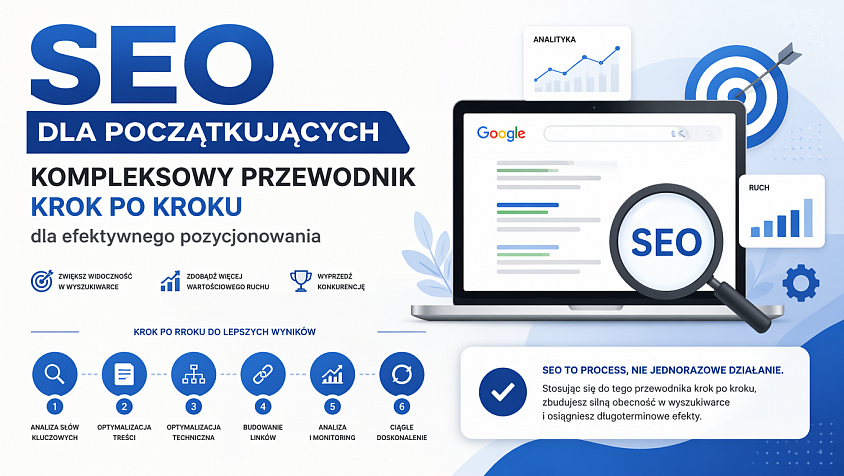
SEO for Beginners – A Comprehensive Step-by-Step Guide to Effective SEO
SEO (Search Engine Optimization) is the process of optimizing a website to increase its visibility in Google and other search engine results. Effectively implemented SEO activities allow you to acquire valuable organic traffic, increase brand recognition, and generate more customers without the need for ongoing investments in paid advertising.
Modern SEO is more than just placing keywords on a page. Search engine algorithms evaluate content quality, user experience, site speed, domain authority, and search intent.
GEO (Generative Engine Optimization) is also gaining increasing importance—optimizing content for AI tools like ChatGPT, Gemini, Claude, and Perplexity. This means creating content that is not only efficiently indexed by search engines but also frequently cited and used by AI systems.
How does SEO work?
To understand SEO , it's worth knowing the three basic stages of how search engines function:
- Crawling
Google robots visit websites and analyze their content. - Indexing
The collected data is saved in the search engine index. - Ranking
The algorithm decides which pages best respond to a specific user query.
The goal of SEO is to convince the algorithm that your website is the best answer to a given query.
Step 1: Choosing the right keywords
Keywords are the foundation of any SEO strategy.
Example:
Main Phrase: SEO for Beginners
Related phrases:
- how SEO works
- learning SEO step by step
- website optimization
- website positioning
- SEO for companies
- SEO basics
How to find keywords?
Tools such as the following can be used for analysis:
- Google Keyword Planner
- Ahrefs
- Semrush
- Senuto
- Ubersuggest
- Google Search Console
It is worth considering:
- monthly number of searches,
- level of competition,
- user intent,
- business potential of the phrase.
Step 2: Creating valuable content
Content remains a key element of effective SEO.
Google rewards content that is:
- exhausting,
- current,
- expert,
- reliable,
- helpful for the user.
The EEAT Principle
Google evaluates content based on:
- Experience – the author has practical experience in a given topic,
- Expertise – the content presents professional knowledge,
- Authoritativeness – the website builds its position as an expert,
- Trustworthiness – information is reliable and trustworthy.
Step 3: On-Page SEO Optimization
On-Page SEO covers all activities performed directly on the website.
Page Title (Title Tag)
Example:
SEO for Beginners – A Complete Step-by-Step Guide
Best practices:
- 50–60 characters long,
- placing the most important phrase at the beginning,
- an attractive message encouraging you to click.
Meta Description
Example:
Learn the basics of SEO step by step. Learn how to optimize your website, gain organic traffic, and improve your Google rankings.
Optimal length: 140–160 characters.
H1-H6 headings
The structure should be logical:
- H1 – main topic,
- H2 – main sections,
- H3 – subsections.
URLs
Correct:
example.pl/seo-dla-poczatkujacych
Inappropriate:
example.pl/post?id=123456
Step 4: Technical SEO
Technical SEO is responsible for the proper functioning of the website.
Key elements:
- Charging speed
Google prefers fast websites. Image compression, caching, code optimization, and fast hosting are key considerations. - Responsiveness
The website must work properly on smartphones, tablets and computers. - SSL certificate
The website address should start with https:// . - XML sitemap
It makes it easier for search engine robots to find all subpages. - Robots.txt
Allows you to control robots' access to selected resources.
Step 5: Internal Linking
Internal linking makes it easier for users and search engine robots to navigate your website.
Benefits:
- better indexation,
- longer time spent on the website,
- transferring SEO power between subpages.
Example:
An article about SEO may link to materials about content marketing, analytics, or technical optimization.
Step 6: Building external links
Links leading to your website are one of the most important ranking factors.
Effective methods of acquiring links:
- expert publications,
- guest posting,
- industry reports,
- own research,
- infographics,
- digital PR.
What matters most is the quality of links, not their quantity.
Step 7: Local SEO
If you run a local business, local SEO can significantly increase your customer base.
Key activities:
- Google Company Profile optimization,
- collecting customer opinions,
- consistent NAP data (name, address, telephone number),
- local keywords,
- creating local content.
Examples:
"SEO Agency Warsaw"
"Dentist Krakow"
"Mechanic Gdansk"
Step 8: Analyzing SEO Results
SEO requires systematic monitoring of results.
Most important tools:
- Google Search Console
Allows you to analyze the number of clicks, impressions, average position and crawl errors. - Google Analytics
It allows you to examine organic traffic, user behavior, conversions and traffic sources.
What is GEO (Generative Engine Optimization)?
GEO is content optimization for AI systems that generate answers.
More and more users are using tools such as:
- ChatGPT,
- Gemini,
- Claude,
- Perplexity,
- Copilot.
AI models select sources that are:
- reliable,
- current,
- well structured,
- rich in context.
How to optimize content for GEO?
- Answer questions directly
Instead of: "SEO is an important part of marketing."
Write: "SEO is the process of increasing a website's visibility in search engine results by optimizing content, technology, and domain authority." - Use FAQ sections
AI models readily use content that answers specific questions.
Example:
How long does SEO take?
The first SEO results usually appear after 3–6 months, although in competitive industries the process may take longer. - Use data and statistics
Content that includes numbers, research, and specific examples is cited more often. - Build your authorship
Publish author information, professional experience, certifications, and case studies. - Create comprehensive content
AI models prefer comprehensive articles over superficial posts.
The most common mistakes beginners make in SEO
- Keyword stuffing
Excessive use of phrases can negatively impact your page rankings. - Ignoring user intent
Knowing a keyword is not enough – you need to understand what the user is actually looking for. - Copying content
Duplicate content reduces a page's visibility in search results. - No mobile optimization
Most internet traffic now comes from mobile devices. - Neglecting Technical SEO
Even the best content won't rank high if the site is slow or has indexing problems.
Summary
SEO is a long-term process of increasing a website's visibility in search results. An effective strategy includes keyword research, creating valuable content, technical optimization, link building, and analysis of results.
In 2026, success also requires the inclusion of GEO, or optimization for artificial intelligence systems. Content should be expert, comprehensive, credible, and answer specific user questions. Combining SEO and GEO allows for increased visibility both on Google and in AI-generated responses, which is becoming a key source of traffic and building brand authority.
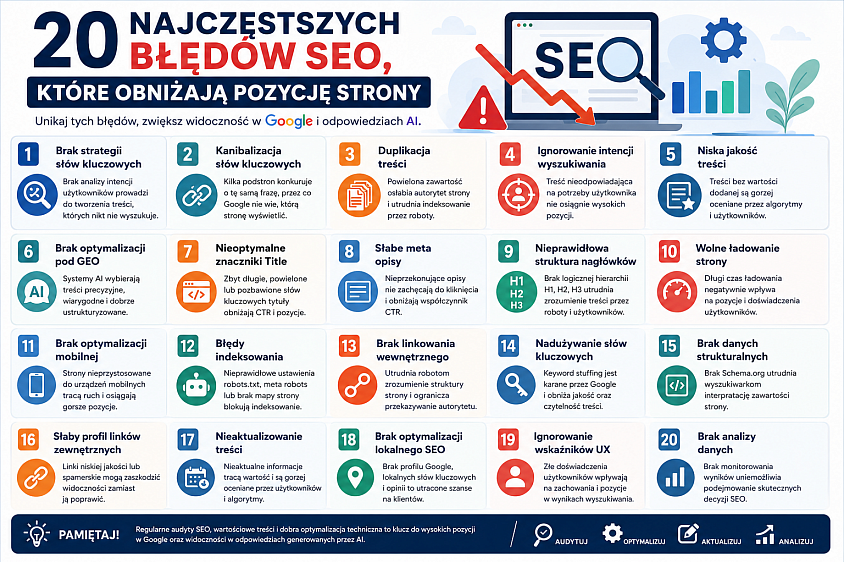
The 20 Most Common SEO Mistakes That Lower Your Website's Ranking in Search Engines
Introduction
Website positioning is a process that requires systematic optimization and error elimination, which can significantly reduce a website's visibility in search results. With the development of artificial intelligence and generative search engines, the importance of not only classic SEO (Search Engine Optimization) but also GEO (Generative Engine Optimization)—content optimization for AI systems that generate user responses—is growing.
Even a carefully designed website can lose organic traffic due to seemingly minor technical omissions, content structure errors, or poor optimization efforts. Below, we present the 20 most common SEO mistakes that negatively impact your Google rankings and limit your chances of appearing in responses generated by AI models.
1. Lack of keyword strategy
Publishing content without analyzing user intent results in content that isn't searched for. Effective SEO begins with identifying keywords with appropriate search volume and matching them to your audience's needs.
How to fix?
- Conduct detailed keyword research.
- Analyze user questions and needs.
- Create topic clusters instead of individual articles.
2. Keyword cannibalization
Cannibalization occurs when multiple pages compete for the same phrase, making it difficult for Google to choose the correct page to display.
Solution:
- Merge similar content.
- Use 301 redirects.
- Designate one main page for a specific phrase.
3. Duplicate content
Duplicate content weakens your site's authority and makes it harder for crawlers to index it.
Most common causes:
- Copying product descriptions.
- Duplicate URL versions.
- No canonical tags.
4. Ignoring search intent
Even the best optimized content will not achieve high rankings if it does not meet the actual needs of the user.
Types of intentions:
- Informational
- Navigation
- Transactional
- Commercial
Content should be precisely tailored to the search intent.
5. Low quality content
Algorithms are becoming increasingly effective in assessing the substantive value of published materials.
Avoid:
- Content created solely for keywords.
- Articles with no added value.
- Shallow studies.
6. Lack of GEO optimization
AI systems prefer sources that provide precise, reliable and well-structured information.
GEO good practices:
- Answer users' questions directly.
- Use headings in the form of questions.
- Create FAQ sections.
- Indicate data sources and expertise.
7. Suboptimal Title Tags
The Title tag is one of the key factors influencing a page's visibility.
Mistakes:
- Title too long.
- Missing keyword.
- Duplicate titles on multiple subpages.
8. Weak meta descriptions
Meta description does not directly affect ranking, but it increases click-through rate (CTR).
Good meta description:
- 140–160 characters.
- Contains the main phrase.
- Encourages you to click.
9. Incorrect heading structure
The lack of a logical hierarchy of H1, H2, and H3 makes it difficult for search engine robots to understand the content.
Recommendations:
- Use one H1 heading.
- Keep H2 and H3 structure logical.
- Clear division of topics.
10. Slow page loading
Site speed is an official ranking factor.
Most common problems:
- Large, suboptimal images.
- Inefficient code.
- Excessive JavaScript.
11. Lack of mobile optimization
Google uses Mobile-First indexing.
Consequences:
- Higher bounce rate.
- Lower positions in search results.
- Worse user experience.
12. Indexing errors
Some pages may be unintentionally blocked from indexing.
Check:
- Robots.txt file.
- Robots meta tags.
- XML sitemap.
13. No internal linking
Internal links make it easier for search engines to understand the structure of a website.
Benefits:
- Better indexing.
- Increased time spent by the user on the website.
- More effective transfer of authority.
14. Overusing keywords
Keyword stuffing is an outdated and ineffective SEO technique.
Instead:
- Use synonyms.
- Use semantic phrases.
- Write in natural, understandable language.
15. No Schema.org structured data
Structured data helps search engines interpret page content.
Recommended implementations:
- FAQ Schema.
- Article Schema.
- Product Schema.
- Local Business Scheme.
16. Poor external link profile
Links leading to your website remain one of the most important ranking factors.
Avoid:
- Buying low-quality links.
- Link exchange systems.
- Spam directories.
17. Failure to update content
Unrefreshed materials lose their value over time.
Update:
- Statistical data.
- Links.
- Examples and case studies.
18. Lack of local SEO optimization
For many local businesses, this is a key channel for customer acquisition.
Key elements:
- Company profile on Google My Business.
- Consistent NAP data (Name, Address, Phone).
- Local keywords.
- Customer reviews.
19. Ignoring UX Metrics
User experience indirectly affects SEO effectiveness.
Monitor:
- Time spent on the site.
- Bounce rate.
- User paths.
- Conversions.
20. Lack of data analysis
Without regular monitoring of results, it is difficult to make accurate optimization decisions.
Recommended tools:
- Google Search Console.
- Google Analytics.
- Ahrefs.
- Semrush.
- Screaming Frog.
How to avoid SEO mistakes and increase website visibility?
Effective SEO requires a combination of high-quality content, technical optimization, and building domain authority. Furthermore, the growing importance of AI-powered search engines highlights the need to implement GEO principles, i.e., creating expert, well-structured content that directly answers user questions.
Regular SEO audits, content updates and data monitoring allow you to quickly identify problems and maintain high website visibility both in Google and in the responses generated by AI systems.
FAQ
What SEO mistakes most often lower a website's ranking?
The most common are duplicate content, slow page loading, lack of mobile optimization, incorrect internal linking, and ignoring search intent.
Will GEO replace traditional SEO?
No. GEO is an extension of SEO, focusing on increasing the visibility of your content in AI-generated responses.
How often should you perform an SEO audit?
For most companies, a comprehensive audit at least quarterly and ongoing monitoring of key indicators are recommended.
Does page speed affect Google rankings?
Yes. Loading speed and Core Web Vitals are ranking factors and have a significant impact on user experience.
