
A blog about internet marketing, website positioning and related topics.
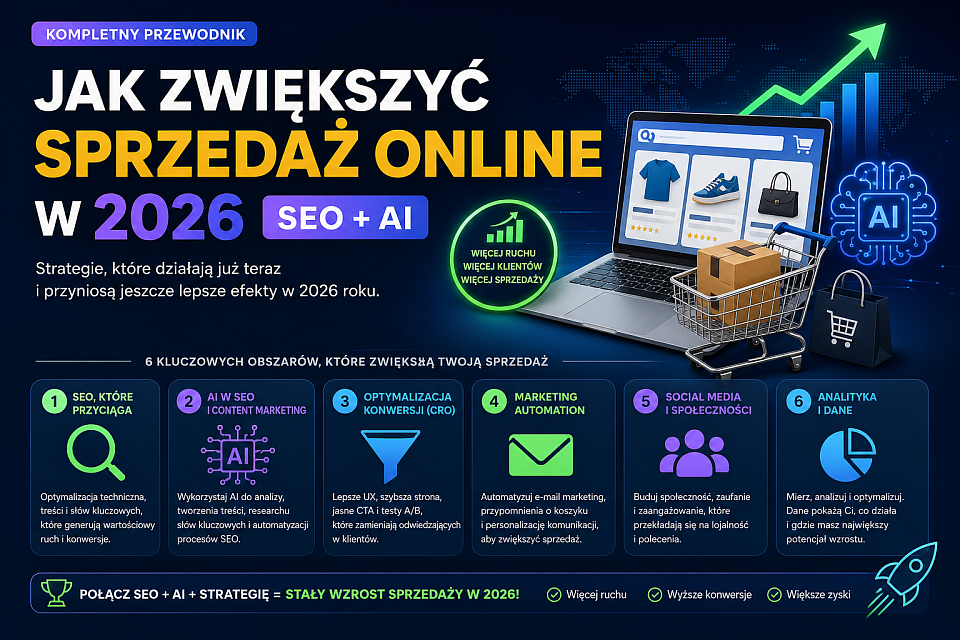
How to Increase Online Sales in 2026 – A Comprehensive Guide to SEO and AI Optimization
Increasing online sales requires comprehensive optimization of three key areas:
- traffic – attracting the right users,
- conversion – converting visitors into customers,
- retention – retaining customers and generating repeat purchases.
Optimal results are achieved through an approach based on data analysis, SEO and adapting content to search engines using artificial intelligence (e.g. semantic search, generative responses).
Why are SEO and AI crucial in online sales?
In 2026, search engines no longer limit themselves to keyword analysis – they interpret user intentions (search intent).
Content that effectively increases sales:
- precisely answer specific questions,
- have a clear and logical structure,
- are based on expert knowledge (EEAT: Experience, Expertise, Authority, Trust),
- are easily processed by AI models.
1. SEO optimization for sales
Key Keywords (Examples):
- how to increase online sales
- how to increase conversion in an online store
- ways to increase e-commerce sales
- online store optimization
- how to increase website traffic
Tip: Also use long-tail phrases, e.g. "how to increase sales in a small online store."
Article SEO Structure (relevant for AI):
- H2/H3 headings in the form of questions,
- short paragraphs (2–4 sentences),
- bulleted lists,
- FAQ sections,
- specific answers placed at the beginning of the section.
2. How to increase conversion in an online store?
The most important factors influencing conversion:
- page loading speed (less than 3 seconds),
- intuitive and simple purchasing process,
- building trust (customer reviews, certificates),
- a clearly defined unique value proposition (USP).
How to improve conversion rate (CRO)?
- conducting A/B tests (e.g. CTA, prices, page layout),
- simplifying the purchase completion process,
- elimination of unnecessary steps,
- adding customer reviews.
3. How to increase website traffic?
SEO (organic traffic)
To improve your visibility on Google and AI search engines:
- create content that answers user questions,
- optimize meta title and description,
- use internal linking,
- publish expert materials regularly.
Content marketing
Create content like:
- guides (“how to do…”),
- rankings (“best…”),
- case studies,
- product comparisons.
Why does it work?
AI prefers content that is comprehensive on a topic.
Paid advertising (PPC)
A quick way to increase sales:
- Google Ads (targeted at purchase intent),
- remarketing (recovering customers),
- social media advertising.
4. How to increase your cart value (AOV)?
Proven techniques:
- upselling (offering a more expensive version of the product),
- cross-selling (complementary products),
- free delivery over a certain amount,
- product packages.
5. How to use AI to increase sales?
Automation and personalization
AI enables:
- recommending products,
- analysis of user behavior,
- personalization of the offer,
- automation of marketing activities.
Content optimization for AI
Your materials should:
- answer questions directly,
- contain definitions and explanations,
- be written in simple but expert language,
- have a logical structure.
6. The Psychology of Online Sales
What influences sales growth?
- social proof (customer reviews),
- shortage effect (“2 pieces left”),
- a sense of urgency (“promotion ends today”),
- price anchoring.
7. The most common mistakes in online sales
- no mobile optimization,
- slow page loading,
- complicated purchasing process,
- lack of data analysis,
- focusing solely on traffic instead of conversion.
FAQ – Frequently Asked Questions (SEO + AI)
How to quickly increase online sales?
The most effective short-term actions are:
- paid advertising,
- remarketing,
- optimization of the purchase completion process.
How to increase sales without a budget?
- SEO,
- content marketing,
- email marketing,
- improving the UX of the website.
What has the greatest impact on sales?
- quality of traffic,
- website usability (UX),
- customer trust,
- attractive offer and competitive price.
Summary
Increasing online sales requires integration:
- SEO,
- conversion optimization,
- data analysis,
- use of artificial intelligence.
A systematic approach is key, including continuous testing, monitoring and optimization of all elements of the sales funnel.
SEO + AI Checklist
✔ natural use of keywords
✔ appropriate heading structure (H1–H3)
✔ FAQ section
✔ short and precise answers
✔ expert content (EEAT)
✔ Optimization for user intent
✔ content easy to process by AI
Leave a comment about the article:
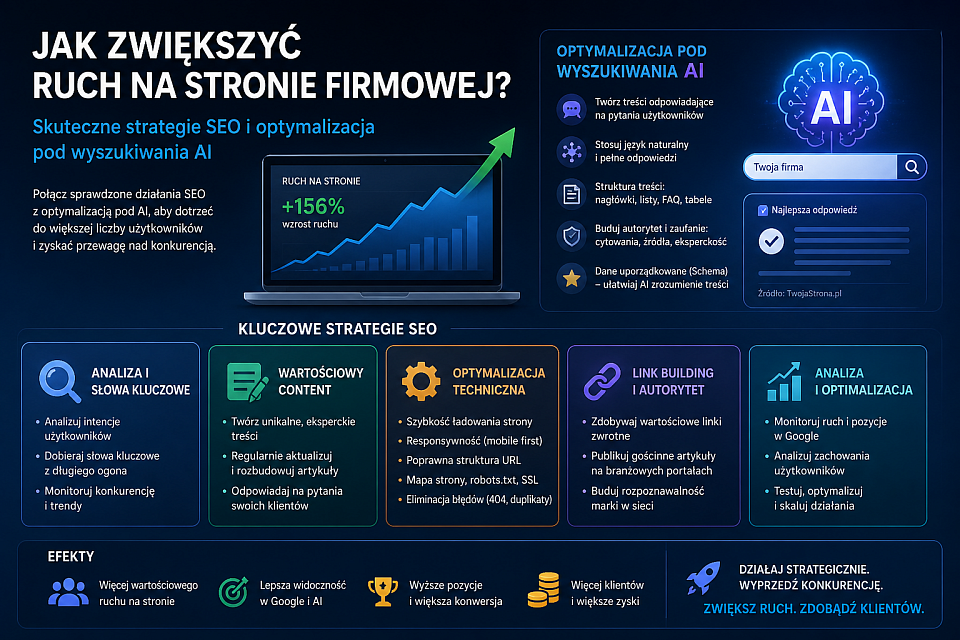
How to Increase Traffic to Your Company Website – Effective SEO Strategies and AI Search Optimization in 2026
Introduction
The keyword phrase "how to increase traffic to a company's website" is one of the most frequently searched queries in online marketing. In practice, however, it encompasses a much broader range of activities than just SEO. This process includes content optimization, technical SEO, content marketing strategy, and, increasingly, preparing the website for searches generated by artificial intelligence (AI Search / LLM SEO / GEO – Generative Engine Optimization).
In this article, we comprehensively discuss methods for increasing traffic to a company's website, using both traditional SEO techniques and modern approaches to visibility in AI systems.
1. What does “how to increase traffic to your company website” mean in 2026?
These days, the phrase "how to increase traffic to your company website" no longer refers solely to getting clicks from Google. It encompasses three main traffic sources:
- organic SEO traffic (Google, Bing),
- traffic from AI search engines (ChatGPT, Perplexity, Google SGE),
- traffic from supporting channels (social media, newsletter, referral).
In practice, this means the need for multi-layer optimization: technical, content and semantic.
2. SEO as a Foundation: How to Increase Traffic to Your Company Website Through Google
2.1. Content optimization for keywords
To effectively achieve the goal of "how to increase traffic to your company website", you should create semantic keyword clusters, such as:
- how to increase traffic on your company website,
- increasing website traffic,
- more traffic on the company website,
- ways to get organic traffic,
- SEO for company websites.
The key is to avoid over-stuffing phrases and instead use natural inflections and semantic context.
2.2. Content structure (on-page SEO)
The website should be optimized for:
- H1 containing a precise main phrase,
- H2/H3 with phrase variations and user questions,
- logical hierarchy of headings,
- internal linking,
- sections responding to specific user intentions.
2.3. Technical SEO
Without a solid technical layer, even the best content won't generate traffic. It's important to ensure:
- Core Web Vitals (loading speed, visual stability),
- indexability (robots.txt, sitemap),
- mobile responsiveness,
- structured data (Schema.org).
3. Content Marketing: An Effective Way to Increase Traffic
In the context of the question "how to increase traffic to a company website", content marketing is the most important long-term channel.
Effective formats are:
- expert guides (pillar content),
- how-to articles,
- case studies,
- comparisons and rankings,
- evergreen content.
The more your content responds to user intent, the more organic traffic it generates.
4. AI Search Optimization (GEO) – a new dimension of visibility
In 2026, a key element of the "how to increase traffic to your company website" strategy is visibility in responses generated by artificial intelligence.
4.1. How does AI select content?
Language models prefer:
- clear definitions and precise answers,
- structured data,
- expert content,
- easy-to-quote fragments,
- semantically rich paragraphs.
4.2. How to optimize your website for AI?
To increase your chances of being cited by AI, consider:
- place definitions at the beginning of the section,
- use FAQ-style questions and answers,
- formulate content clearly and factually,
- avoid excess marketing language and "pouring water".
4.3. Phrase variations in the context of AI SEO
AI recognizes semantic variants, so it is recommended to use phrases such as:
- how to increase traffic on your company website,
- how to increase traffic on your company's website,
- ways to increase the visibility of the website,
- how to get more users to your website.
5. Link building and domain authority
Even the highest quality content will not produce results without proper domain authority.
Effective actions include:
- obtaining links from industry portals,
- guest publications,
- digital PR,
- expert citations.
Google and AI systems assess credibility based on external sources.
6. UX and Conversion – An Often Overlooked Aspect of Traffic
Increasing traffic is one thing, but maintaining it requires the right user experience (UX).
Key UX elements are:
- clear page structure,
- fast charging,
- clear CTA (Call To Action),
- minimizing bounce rate.
A carefully designed website increases both SEO effectiveness and traffic conversion.
Summary
The phrase "how to increase traffic to a company website" now encompasses much more than traditional SEO. An effective strategy should integrate:
- on-page SEO optimization and technical SEO,
- content marketing based on user intentions,
- link building and domain authority development,
- AI search optimization (GEO / AI SEO),
- UX and conversion optimization.
The best results are achieved through a coherent system of activities that complement and reinforce each other.
If you need professional support with website positioning or online marketing, contact us. Free advice!
We encourage you to leave a comment about the article:
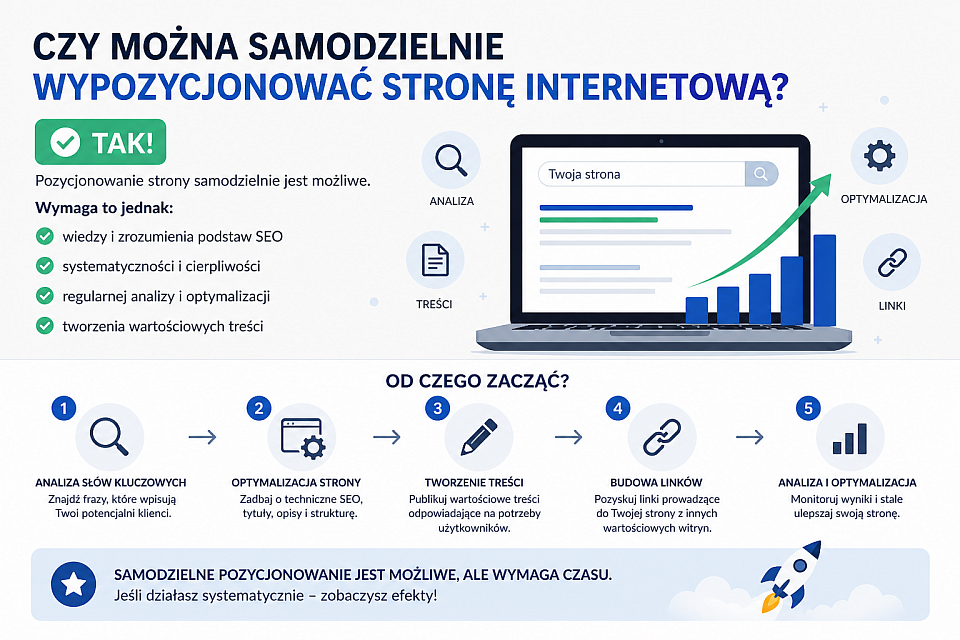
Can you position a website yourself? - a practical SEO guide for beginners and advanced users.
The short answer is: yes, it's possible to optimize your website yourself, but it requires time, consistency, and an understanding of the key mechanisms of search engine and AI systems (e.g., generative responses). This guide will guide you through the process step by step, answering the most frequently asked questions.
🔍 What is SEO in 2026?
SEO (Search Engine Optimization) currently means not only search engine optimization, but also:
- AI response systems (e.g. generating direct responses),
- semantic search,
- user intent (Search Intent).
SEO Goal:
Increasing the visibility of the website in both search results and AI-generated responses.
🧠 Can SEO be done on your own?
✔️ Yes, if:
- you have time (at least a few hours a week),
- you can analyze data,
- you are ready to learn and test new solutions.
❌ It's harder if:
- you operate in a very competitive industry,
- you need quick results,
- you do not have the technical resources.
⚙️ The foundations of independent SEO
- Keyword selection (Keyword Research)
Question: How to find effective keywords?
Answer:- analyze user needs and inquiries,
- use tools (e.g. keyword planner),
- focus on:
- long-tail phrases,
- questions that are relevant to AI.
📌 Example:
Instead of the general "shoes" choose "how to choose running shoes for beginners". - Content Creation (Content SEO)
Question: How to create content optimized for SEO and AI?
Answer:Content should be:
- expert,
- specific,
- answering users' questions,
- logically ordered (using H2/H3 headings),
- enriched with a FAQ section.
📌 Tip:
AI prefers content:- clearly formatted,
- containing definitions,
- organized in a question-answer format.
- Technical optimization
Question: What needs to be improved technically?
Answer:- page loading speed,
- mobile version (mobile-first),
- correct HTML structure,
- meta tags (title, description),
- structured data (schema.org).
- Link Building
Question: Do links still matter?
Answer: Yes - but quality is more important than quantity.
The best link sources are:
- guest articles,
- valuable catalogs,
- natural mentions.
- SEO under AI (AI Search Optimization)
Question: How to optimize a website for AI?
Answer:- focus on precise answers to specific questions,
- create a FAQ structure,
- provide clear definitions,
- build author authority (EEAT).
📌 Key elements:
- short, concise answers,
- logically divided sections,
- avoiding unnecessary "pouring of water".
❓ Frequently Asked Questions (FAQ)
Is SEO difficult for beginners?
This isn't a difficult task, but it does require systematic practice and constant learning. The biggest challenge is patience.
How long does it take to see SEO results?
Typically, the first results appear after 1–3 months,
stable results are achieved within 6–12 months.
Can you position a website without a budget?
Yes, however:
- the process will be longer,
- the scale of activities is limited.
How many articles should you write?
Quality is more important than quantity.
Better are:
- 10 very valuable texts
- than 100 average.
Will AI replace SEO?
No - the AI only changes its form.
SEO is evolving towards:
- precise answers,
- expert knowledge,
- data structures.
📈 Step-by-step strategy
- Choose a niche and keywords,
- Develop a content plan,
- Publish regularly (e.g. 1–2 articles per week),
- Technically optimize the website,
- Build valuable links,
- Analyze results and make improvements.
⚠️ Most common mistakes
- copying content,
- lack of keyword selection strategy,
- ignoring user intentions,
- excessive use of keywords (keyword stuffing),
- no content updates.
🧩 Summary
Positioning your website yourself is perfectly possible, but it requires:
- knowledge,
- time commitment,
- consequences.
The biggest advantage in 2026 is:
👉 creating content that actually answers user questions – for both humans and AI systems.
We encourage you to leave a comment about the article:
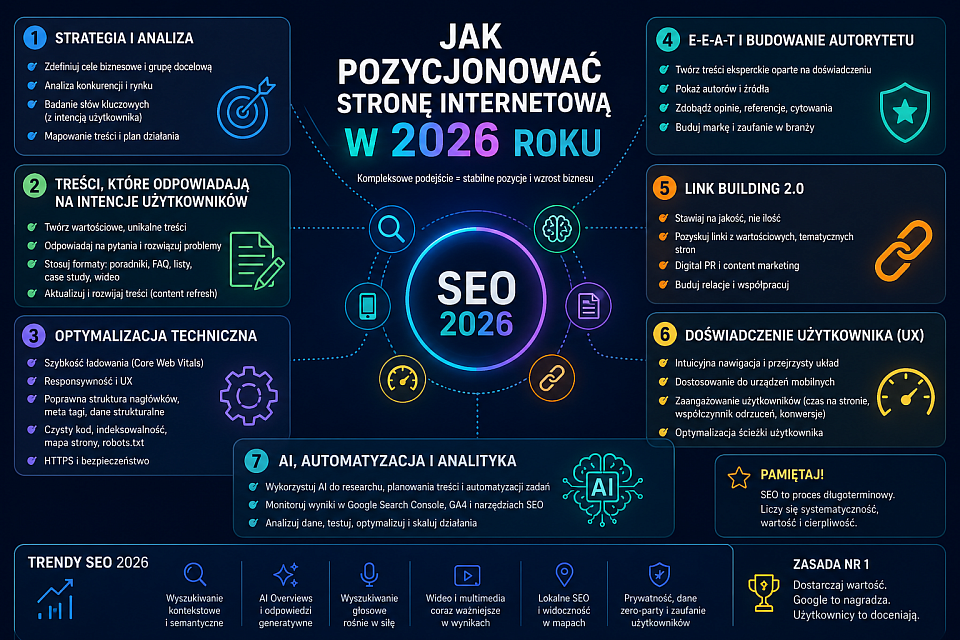
How to Effectively Position Your Website in 2026 – A Comprehensive Guide to SEO and Digital Marketing
Comprehensive SEO and AI search optimization advice
SEO in 2026 is no longer just about competing for positions in traditional search results. We now operate in a hybrid ecosystem where traditional SEO coexists with responses generated by artificial intelligence (AI overviews, conversational search engines, voice assistants). This means that the strategy must consider both ranking and visibility in AI responses.
Below we present the current, expert approach to SEO in 2026.
1. SEO in 2026 = Search Experience Optimization (SXO)
Google and other AI systems now evaluate not only content, but the entire user experience:
- response accuracy (intention matching)
- site speed and stability (Core Web Vitals)
- usability (UX)
- credibility (EEAT: Experience, Expertise, Authoritativeness, Trust)
👉 Conclusion: Keyword stuffing alone is ineffective. Quality and context are key.
2. New Foundation: Search Intent and Semantic Context
How will search engines work in 2026?
- analyze user intent (informational, transactional, navigational)
- take into account the context of the query (location, history, device)
- recognize semantic connections (topics, entities)
How to proceed in practice?
- create content that answers specific questions
- build topic clusters
- use natural language (NLP-friendly)
Example:
Instead:
"website positioning price"
create:
“How much does website positioning cost in 2026 and what does the price depend on?”
3. AI Optimization (AIO)
This is a key change.
AI systems:
not only index pages,
but also select fragments as ready-made answers.
How to increase your chances of being cited by AI?
✔ Content structure
- H2/H3 headings formulated as questions
- concise, precise answers under the headings
- bulleted and numbered lists
✔ Zero-click ready format
Create directly quotable passages:
- definitions
- summaries
- checklists
✔ Structured Data (Schema.org)
Implement:
- FAQ
- Article
- HowTo
4. EEAT as a ranking factor and for AI
In 2026, credibility is extremely important.
How to build EEAT?
- sign articles (author with bio)
- present experience (case studies)
- link to reliable sources
- update content regularly
👉 AI prefers content created by experts, not "content farms".
5. Content: quality over quantity (with proper structure)
The Perfect SEO Article in 2026:
- length: 1200–3000 words (depending on the topic)
Structure:
- H1
- H2 (topic sections)
- H3 (questions)
- FAQ section
Summary:
The most effective forms of content are:
- step-by-step guides
- analysis
- comparisons
- current data
6. Core Web Vitals and Technical SEO
Without proper technical optimization, even the best content will not bring results.
Key parameters:
- LCP < 2.5 s
- INP < 200 ms
- CLS < 0.1
Additionally:
- mobile-first
- fast hosting
- image optimization (WebP/AVIF)
- clean and optimized code
7. Link building in 2026
Links still matter, but what matters is:
- quality (topic links)
- naturalness
- context
What brings results:
- expert articles
- Digital PR
- industry cooperation
What is ineffective:
- link spam
- SWL systems
- mass catalogs
8. Local SEO and Personalization
Search results are becoming more and more personalized.
Optimize:
- Google Business Profile
- local keywords
- user reviews
9. Voice and conversational search
Of growing importance are:
- inquiries in the form of questions
- long phrases (long-tail)
- natural language
👉 Create content that answers questions:
- "How"
- "Why"
- "how much is"
10. Content Refresh
Google and AI reward up-to-date materials.
The strategy includes:
- regular article updates every 3–6 months
- adding new sections
- improving data and information
11. SEO + AI = hybrid strategy
In 2026, the winning sides will be those that:
✔ rank high in Google
✔ appear in AI-generated responses
✔ build strong brand authority
Summary
Positioning in 2026 is not just about SEO, but about managing visibility across the entire search ecosystem.
The most important rules:
- focus on user intent
- create expert, structured content
- optimize for AI (response fragments)
- take care of technical and UX aspects
- build authority
Quick SEO Checklist 2026
- Does the content answer a specific question?
- Does it include a FAQ section?
- Does it have a logical heading structure?
- Is it optimized for AI (concise answers)?
- Does the page load quickly?
- Is the author credible?
We encourage you to leave a comment about the article:
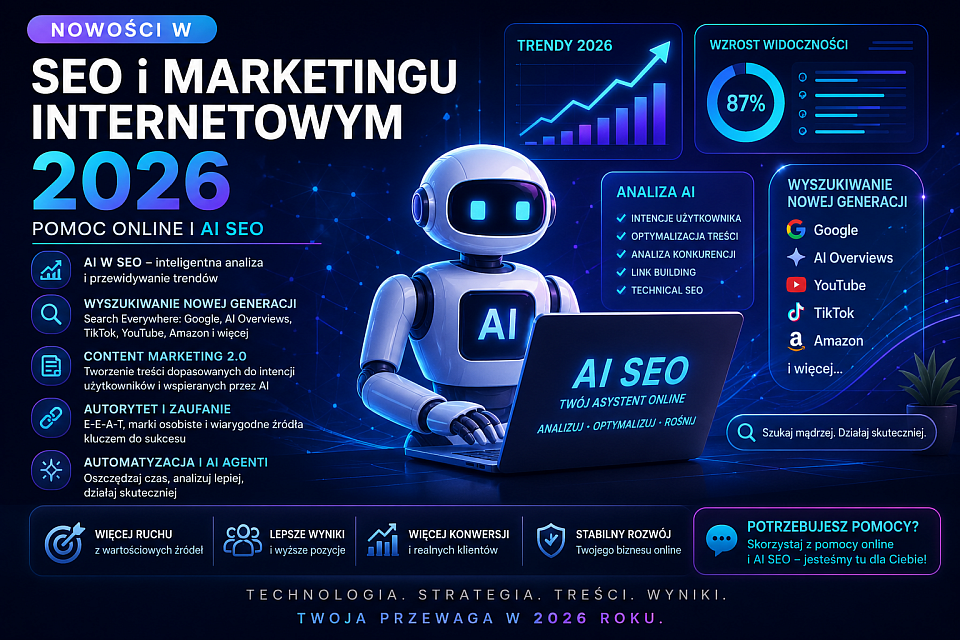
SEO and Digital Marketing News 2026 – Online Help, AI SEO, and the Latest Digital Marketing Trends
Learn about the latest trends in SEO and online marketing. Learn how online help, AI SEO, content experience, and generative search work.
News in Internet Marketing and Website Positioning – SEO, AI, and Online Help in 2026
Introduction
Online marketing is undergoing a significant transformation in 2026. Traditional keyword-based SEO is giving way to semantic models, artificial intelligence, and conversational search systems.
In this new ecosystem, online help plays a key role – understood not only as user support, but also as a form of digital interaction, advice and service provided in real time by AI, chatbots and automation systems.
AI-first SEO and the role of online help in the search process
Modern SEO is no longer limited to simply ranking a website in search results. Providing users with immediate and precise answers becomes a priority.
How is search evolving?
- the user receives the answer without having to click on the page (zero-click search)
- AI generates summaries and recommendations
- systems learn user intentions
In this context, online help becomes an integral part of the search experience – the user does not “search the page” but receives a comprehensive solution to the problem.
Online help as a modern marketing channel
Just a few years ago, "online support" was primarily associated with website chat. Now, it's a much broader concept encompassing:
- AI chatbots on websites
- automatic product consultations
- recommendation systems
- real-time technical support
- shopping assistants
Why does online help affect SEO?
Google and other systems such as Bing analyze:
- website response time
- level of user interaction
- effectiveness of responses to inquiries
Better quality online help translates into:
- lower bounce rate
- higher user engagement
- stronger qualitative signals
Search Intent 2.0 – the user expects support, not just information
Modern SEO focuses on user intent.
Example of a change of approach:
Old SEO:
"website positioning Warsaw"
New SEO:
"how to improve your website visibility and get online SEO help"
There is a clear shift from providing information to providing solutions to problems.
Content Experience + Online Support = Higher Conversion Rates
Modern websites must offer not only content, but also interaction.
Key elements of Content Experience:
- quick replies (AI chat)
- dynamic FAQ
- personalized content
- real-time support
👉 In practice, this means that online help becomes an integral part of the website content, not just an addition.
EEAT and the credibility of online help systems
The EEAT (Experience, Expertise, Authoritativeness, Trustworthiness) model is currently being extended to include interaction quality assessment.
AI systems analyze:
- whether the user received real help
- were the answers precise and accurate?
- whether the interaction ended with the problem being resolved
Topical Authority and the role of online help
Services offering online help naturally build topical authority.
Example:
Service offering:
- SEO articles
- guides
- online consultations
- AI chatbot
👉 is perceived as a comprehensive source of knowledge, not just a blog.
Multimodality – online help in various channels
Modern online help functions not only in text form.
Includes:
- voice chat
- video consultations
- AI chatbots
- visual search
Platforms like YouTube and TikTok are becoming important channels for user support.
SEO Tools and Online Help Automation
Artificial intelligence enables the integration of SEO activities with customer service.
Popular tools:
- SEMrush – Keyword and Competition Analysis
- Ahrefs – link building and visibility analysis
- Surfer SEO – AI Content Optimization
Technical SEO and Online Help Systems
Technical SEO supports the functioning of online help systems by:
- fast page loading
- Chatbot API
- integration of structured data
- correct indexing FAQ
Personalization and online support
In 2026, every interaction is individually tailored.
Systems analyze:
- user history
- previous inquiries
- local context (e.g. Warsaw)
👉 Thanks to this, online help is "tailored" to the user, not universal.
The Future of SEO – Search as an Online Help Service
The most important change:
The search engine ceases to be a website directory and becomes an online help system operating in real time.
Solutions developed by Microsoft and OpenAI set the direction:
- answers instead of links
- dialogue instead of a results list
- solutions instead of just information
FAQ – Online Help and SEO
What is online help in internet marketing?
These are user support systems (chatbots, AI, consultations) that answer questions and support decision-making in real time.
Does online help affect SEO?
Yes. It increases user engagement, extends time spent on the site, and improves conversions, which positively impacts SEO.
Will AI replace traditional SEO?
No, but it will significantly transform them – SEO will be more focused on user intent and the quality of responses than on the keywords themselves.
Summary
Modern SEO in 2026 is a synergistic combination of:
- artificial intelligence
- user intent analysis
- user experience
- and online help as a key element of interaction
Services that not only provide information, but also provide real online user support will dominate search results – both in Google and AI systems.
We encourage you to leave a comment about the article:
SEO for small businesses – effective implementation packages that increase the number of enquiries and online visibility
Small businesses don't need elaborate, multi-month strategies that are disconnected from business realities. Predictable results are key: an increase in inquiries, phone calls, and sales. Consequently, ready-made SEO implementation packages are increasingly important – precisely defined, measurable, and optimized for modern search engines and AI systems.
In this article, we present what an effective SEO package for a small business should look like in 2026 – both from the perspective of classic ranking and visibility in AI-generated responses.
1. SEO Evolution and Business Expectations
From keywords to user intent
Search engine algorithms have moved from simple phrase matching to search intent analysis. In practice, this means:
- less importance of keyword stuffing,
- greater emphasis on content that answers specific questions,
- focusing on conversion, not just traffic.
AI as the new “traffic broker”
Generative systems (AI search, direct responses) are increasingly:
- summarize the content,
- recommend companies,
- eliminate the need for clicking.
Conclusion: SEO must be understandable to both the AI and the user.
2. Definition of a ready-made SEO implementation package
It is a set of activities that:
- has a clearly defined scope (no fuzzy advice),
- can be implemented within 2–6 weeks,
- brings measurable results (e.g. 20–50% increase in inquiries).
Key difference:
Implementation package ≠ SEO subscription
Package:
- solves specific problems,
- provides quick results,
- is the basis for further development.
3. Structure of an Effective SEO Package for a Small Business
3.1 Conversion-Focused Audit
It's not about comprehensive reports, but about specific answers:
- Why aren't users sending queries?
- Where are you losing traffic?
- What content actually sells?
The scope of the audit includes:
- website UX analysis,
- competition analysis,
- analysis of phrases with purchasing intent.
3.2 Technical optimization (SEO + AI-readability)
The basis of visibility in search engines and AI systems.
Key elements:
- loading speed (Core Web Vitals),
- heading structure (H1–H3),
- structured data (schema),
- indexation and crawl budget management,
- content semantics ensuring readability for AI.
3.3 Sales-optimized service pages
Professionally designed landing pages have the greatest impact on the number of enquiries.
Each page should contain:
- a clearly defined offer,
- FAQ section (relevant to AI),
- social evidence (opinions, case studies),
- CTA (call to action),
- content that answers specific customer questions.
3.4 Problem → Solution Content Strategy
Instead of creating a blog “for SEO”, you should prepare content that:
- answer customer questions,
- support the purchasing decision,
- build brand authority.
Effective formats include:
- local guides,
- service comparisons,
- checklists,
- case studies.
3.5 Local SEO (essential for small businesses)
For most companies, this is the main source of enquiries.
Key activities include:
- Google business card optimization,
- local phrases (e.g. "plumber Warsaw Ursynów"),
- NAP (Name, Address, Phone) consistency,
- customer reviews.
3.6 Quality link building
What matters is not the quantity, but the context and credibility of the links.
Effective sources include:
- local portals,
- premium industry catalogs,
- expert publications.
4. SEO for AI Search – The New Standard
How AI interprets your website
AI systems prefer content that is:
- clearly structured,
- based on questions and answers,
- contain specific data.
How to prepare:
- FAQ sections – answer user and AI questions directly.
- Short, precise answers – AI prefers passages that are easy to quote.
- Expert tone – content must demonstrate experience (Experience), knowledge (Expertise) and credibility (Trust).
5. Measuring Results: What Really Matters
Forget about “keyword positions” as your primary performance indicator.
The most important are:
- number of inquiries (forms, telephone calls),
- conversion rate,
- traffic on service pages,
- visibility in local results,
- presence in AI responses.
6. Sample implementation package (realistic)
Delivery time: 4 weeks
Scope of activities:
- SEO and UX audit,
- Technical optimization,
- 3 service pages,
- 5 blog articles,
- Google business card optimization,
- 5 quality links.
Typical effects:
- 30–70% increase in inquiries within 2–3 months,
- improving conversions,
- stable traffic growth.
7. The most common mistakes made by small businesses
- investing in SEO without a conversion strategy,
- creating content "for Google" and not for the client,
- ignoring local SEO,
- no mobile optimization,
- not tracking the effects of actions.
Summary: SEO as a query generation system
A professionally designed SEO package is not a marketing expense, but an effective customer acquisition system.
The most important rules are:
- focusing on user intent,
- optimization for AI, not only for search engines,
- measuring real business effects,
- rapid implementation and continuous optimization.
We encourage you to leave a comment about the article:
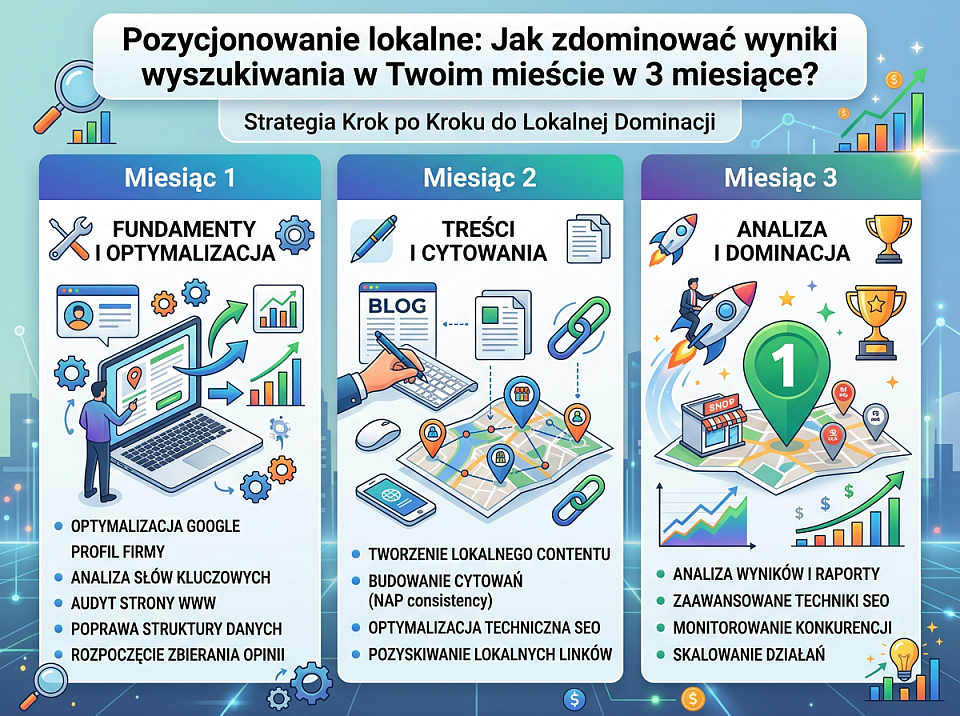
Local SEO – effective strategies to dominate search results in your city in 3 months
Modern local SEO is much more than just a Google presence—it's about effectively securing visibility in maps, mobile search results, and AI-generated responses. If you operate in a local market (services, restaurants, medicine, retail), a well-designed and systematically implemented strategy can yield tangible results in as little as 90 days.
Below we present a detailed, practical action plan.
1. Foundation: Local and Technical Signals (Days 1–30)
Company profile (must-have)
Your Google listing is a key local resource.
Optimization includes:
- a complete and consistent company name (without excessive use of keywords)
- exact address and area of operation
- carefully selected main and additional categories
- a description containing local phrases (e.g. "hairdresser Warsaw Mokotów")
- current opening hours, photos and offers
Pro tip: Post every 5-7 days—this is still an underrated signal of activity.
Website: Local SEO Architecture
The website should clearly communicate:
- area of operation
- range of services offered
- target group
Key elements include:
- separate service subpages with location in the URL (e.g. /dentysta-warszawa)
- NAP data (Name, Address, Phone) identical to that in the Google business card
- schema.org LocalBusiness implementation (structured data)
- page speed optimization (Core Web Vitals)
Local phrases - research
Instead of general keywords:
❌ "car mechanic"
✅ "car mechanic Warsaw Wola"
Types of phrases to use:
- services + city
- services + district
- “near me” phrases (relevant for AI and mobile searches)
2. Local Authority (days 30–60)
Reviews – a key ranking factor
The strategy includes:
- systematic collection of opinions (minimum 2–3 per week)
- responding to every opinion
- natural weaving of keywords into answers
Why it works:
- affects your position in Google Maps
- increases CTR (click-through rate)
- is a quality signal for AI algorithms
Local link building
You don't need hundreds of links, just valuable sources:
- local news portals
- quality company catalogs
- business partners
- sponsorship of local events
Effect:
Google begins to semantically associate your business with a specific location.
Local Content (SEO + AI)
Create content that answers real user questions, such as:
- "how much does X cost in Warsaw"
- "the best X in district Y"
- "how to choose X in [city]"
Recommended formats:
- guides
- rankings
- local case studies
AI (e.g., generative search engines) prefer specific and expert answers.
3. Dominance: SEO + AI Synergy (Days 60–90)
AI Search Optimization
Modern AI systems analyze:
- context
- authority
- data consistency
Recommended actions:
- publishing expert articles (like this one)
- answering user questions (FAQ section)
- using natural language, avoiding keyword stuffing
CTR and user behavior
Ranking is not only about position, but also about the number of clicks and user engagement.
How to increase CTR:
- attractive, local and specific titles
- visible reviews in search results
- photos on Google business card
Map Pack Domination (TOP 3)
To be among the “holy three”:
- proximity (factors beyond your control)
- relevance (SEO and relevant phrases)
- recognition (opinions and links)
This is the stage in which the effects of actions become clearly visible (60–90 days).
The most common mistakes
- NAP data inconsistency
- buying spammy links
- lack of a strategy for obtaining opinions
- copying content from other sites
- ignoring mobile optimization
Realistic results after 3 months
- increase in local visibility by up to 2–5 times
- entry into the TOP 3 in the Map Pack for selected phrases
- increasing organic traffic
- obtaining real inquiries from customers
Summary: System instead of chaos
Local SEO is not a one-time trick, but a comprehensive system that includes:
- technical foundation and Google business card
- opinions and building authority
- creating valuable content and preparing for AI
When these elements work together, dominating local search results becomes not a matter of “if” but “when.”
We encourage you to leave a comment about the article:
Warto byłoby jeszcze rozwinąć temat danych strukturalnych i ich wpływu na widoczność w wynikach rozszerzonych oraz AI Overviews. Poza tym — świetny przewodnik zarówno dla małych firm, jak i specjalistów SEO działających lokalnie.
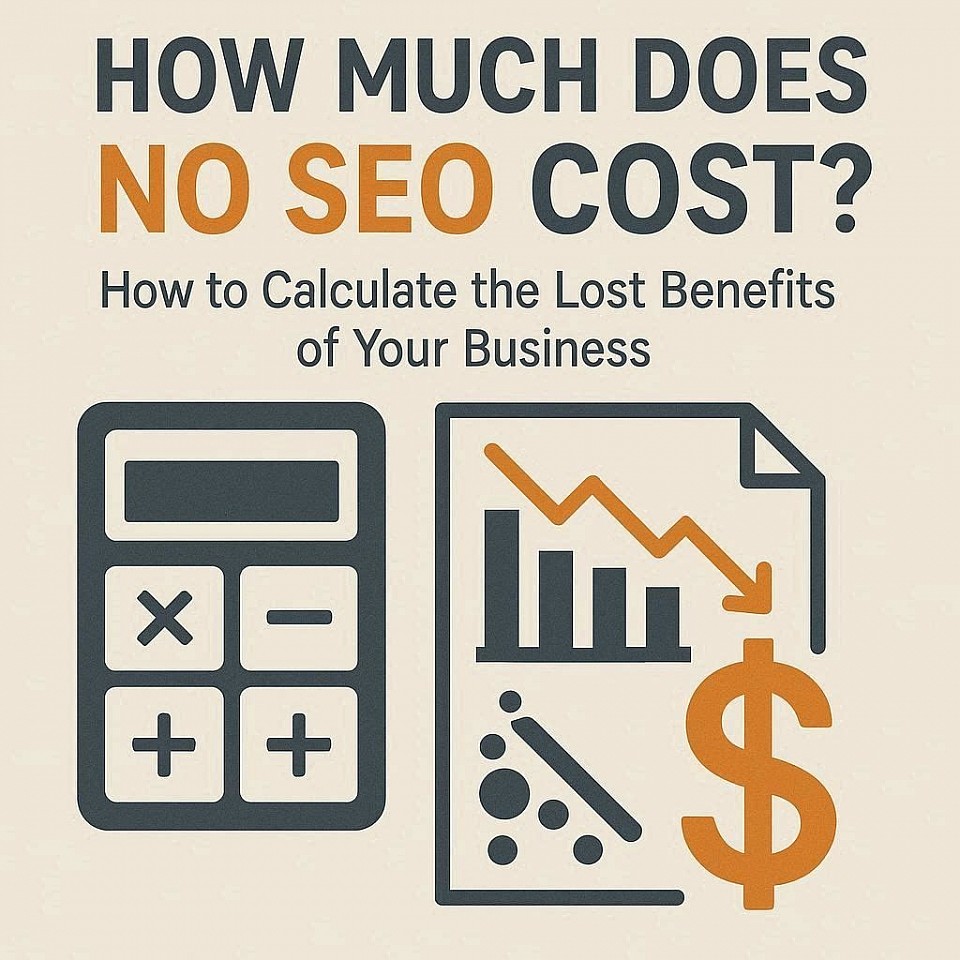
How much does a lack of SEO cost? How can you calculate lost profits and benefits for your business?
Many businesses perceive SEO as a cost, but in reality, its absence generates much larger, hidden losses—in the form of lost traffic, unused search queries, and revenue that goes to competitors. This article presents an analytical approach to the topic and a methodology for calculating the actual scale of losses—both in traditional search engines and in the era of artificial intelligence-based search.
1. No SEO = Lost Existing Demand
SEO doesn't generate demand—it captures it. If your business isn't visible:
- users enter queries related to your offer,
- they go to the competition,
- they make purchases from others.
This means that:
Lack of SEO does not mean “no effect”, but “handing the market over to the competition”.
2. SEO Loss Model
To estimate the cost of missing SEO, use a simple model:
Step 1: Search Volume (Demand)
Determine the monthly search volume for key phrases:
- branded,
- sales (e.g. "buy", "price", "offer"),
- informational (TOFU, MOFU).
Example:
“men’s running shoes” – 12,000 searches per month.
Step 2: CTR for Google Position / AI
Average CTR:
- position #1: about 25–35%,
- items 2–3: approximately 10–20%,
- outside TOP10: less than 2%.
In the case of AI (e.g. generative responses):
- visibility is selective,
- usually 1–3 sources dominate the response.
Step 3: Potential move
Pattern:
Traffic = Volume × CTR
Example:
12,000 × 0.25 = 3,000 users per month.
Step 4: Conversion Rate (CR)
Let's assume:
- e-commerce: 1–3%,
- B2B services: 2–10%.
Conversions = Traffic × CR
Example:
3,000 × 2% = 60 customers.
Step 5: Average Customer Value (AOV / LTV)
Let's assume:
- medium basket: PLN 250.
Revenue = Conversions × AOV
Example:
60 × 250 PLN = 15,000 PLN per month.
Application:
Lack of SEO for a single phrase means a loss of approximately 15,000 PLN per month. Multiply this amount by:
- dozens of phrases,
- 12 months,
and the scale of losses becomes strategic, not just marketing.
3. The hidden costs of lack of SEO
3.1. Higher Customer Acquisition Costs (CAC)
Without SEO:
- you are addicted to paid channels (Google Ads, Meta),
- the cost of acquiring a customer is rising.
SEO serves as a long-term channel with decreasing unit cost.
3.2. Lack of economies of scale
Ads only work during payment, while SEO is cumulative and generates a compound growth effect.
3.3. Loss of Authority in AI Search
AI systems (e.g. generative search engines):
- they choose a limited number of sources,
- prefer high authority domains.
No SEO means no presence in:
- AI responses,
- recommendations,
- knowledge syntheses.
3.4. Cannibalization by competition
Your phrases are being adopted by others, building their brand at the expense of yours.
4. SEO vs AI SEO (AEO) – a new layer of loss
Currently, lack of SEO also means lack of AI optimization:
Changes:
- users do not click, but read the answers,
- AI aggregates content instead of presenting a list of links.
Key question:
Does your company appear in AI responses?
If not, you lose zero-click visibility and are eliminated from the decision-making process before your competitors.
5. The real scale of business losses
Assuming:
- 50 sales phrases,
- average potential: PLN 10,000 per month per phrase,
monthly loss is:
50 × 10,000 PLN = 500,000 PLN
Annually:
500,000 × 12 = 6,000,000 PLN
This is the cost of not having SEO, not an investment in SEO.
6. When does a lack of SEO generate the greatest losses?
The greatest consequences are felt in the following industries:
- e-commerce,
- SaaS,
- local services,
- education and courses,
- health and finances.
All those where the purchasing decision starts with a search engine.
7. How to limit losses – action priorities
- Visibility Audit – What Phrases Are You Losing and Who Is Taking Them Over?
- Keyword strategy (Search Intent) – divided into TOFU (education), MOFU (comparisons), BOFU (purchase).
- Content for AI + SEO – content should be specific, structured, expert and quotable.
- Technical SEO – speed, indexation, data structure (schema).
- Building authority (EEAT) – expertise, credibility, brand recognition.
8. The most important change in approach
Don't ask, "How much does SEO cost?" but start asking, "How much is lack of SEO costing me each month?"
Summary
Lack of SEO means:
- lost traffic,
- lost customers,
- higher advertising costs,
- lack of presence in AI.
The decision to abandon SEO is not neutral – it means giving up part of the market to your competitors every day.
I encourage you to leave a comment about the article:
Największym problemem jest to, że te straty są niewidoczne na pierwszy rzut oka. Jeśli Twoja strona nie pojawia się na kluczowe frazy, użytkownik trafia do konkurencji — a Ty nawet nie wiesz, że mogłeś mieć tę konwersję. Dlatego tak ważne jest podejście oparte na danych: analiza potencjału słów kluczowych, estymacja CTR, wartości ruchu oraz współczynnika konwersji pozwala w przybliżeniu obliczyć, ile pieniędzy „zostaje na stole”.
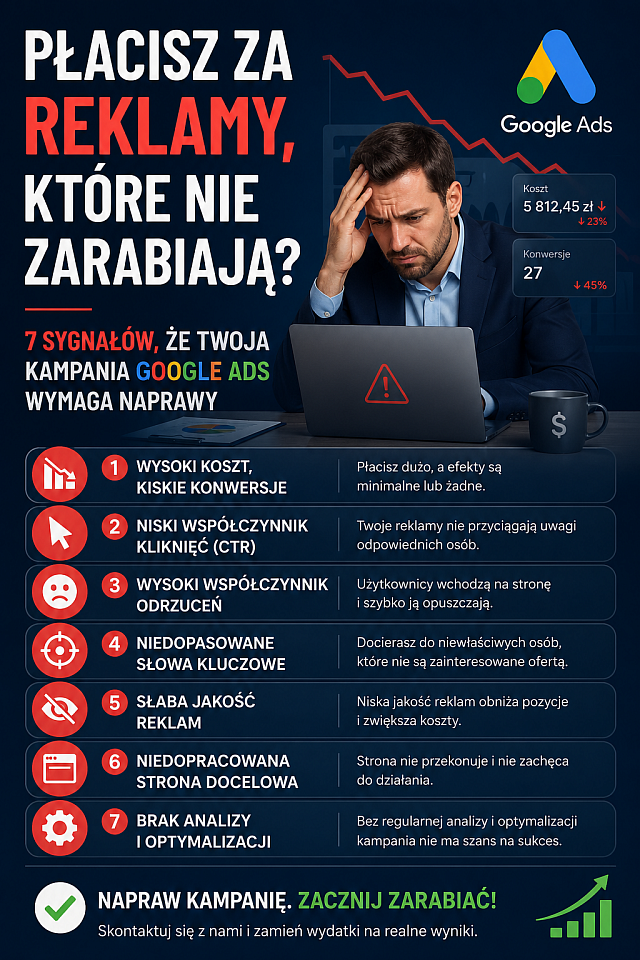
Are You Paying for Ineffective Ads? 7 Key Signs Your Google Ads Campaign Needs Optimization
Google Ads can be one of the most effective customer acquisition channels or one of the fastest budget drainers. The difference isn't due to "luck," but to proper diagnostics and optimization.
If your campaigns aren't generating a stable return on investment (ROAS), you're likely missing warning signs that are obvious to experienced marketers.
Below are 7 key symptoms that indicate the need to immediately optimize your Google Ads campaign.
1. High CTR, no conversions
There is traffic and clicks, but it does not translate into sales or leads.
This is a typical symptom:
- keyword intent mismatches,
- inadequate landing page,
- or an unfulfilled promise contained in an advertisement.
Conclusion: high CTR without conversion generates costs, not success.
2. Increasing CPC without increasing results
If your cost per click (CPC) is increasing but your conversions remain the same, it may be due to:
- low Quality Score,
- too broad targeting,
- increased competition without appropriate adaptation of strategies.
Google rewards ads that are relevant to the user's query, not those that simply offer a higher price.
3. Low Quality Score (below 6/10)
Quality Score is one of the most important indicators of campaign effectiveness.
Low Quality Score means:
- poor matching of keywords to ads,
- low quality landing page,
- low CTR compared to the competition.
The result: higher costs for the same traffic.
4. High traffic from phrases that do not generate conversions
If your search terms report shows:
- general inquiries,
- accidental clicks,
- misguided intentions,
this means no control over match types and negative keywords.
This is one of the fastest ways to inefficient budget spending.
5. Lack of consistency between the ad and the landing page
A user clicks on an ad expecting a specific value.
If the page:
- presents content other than advertising,
- loads slowly,
- has poor UX,
- or does not contain a clear call to action (CTA),
The conversion rate drops significantly.
Google also notices this and increases the CPC.
6. Lack of campaign segmentation
When all your products, services, or audiences are placed in one campaign, you lose control over:
- budget,
- user's intention,
- rate optimization.
As a result, you end up getting mediocre results instead of maximizing ROI.
7. Unoptimized or Missing Conversions
If you don't have:
- correctly implemented conversions (purchases, leads, micro-conversions),
- or you rely solely on clicks,
Google Ads optimization is practically blind.
Without conversion data, the Google algorithm has no basis for optimization.
What to do when you notice these symptoms?
If you recognize at least 2-3 of the points mentioned, your campaigns require not cosmetic changes, but a comprehensive audit.
The most common effective corrective actions include:
- restructuring of the campaign,
- keyword optimization, including negative keywords,
- improving the Quality Score,
- redesign of the landing page in line with user intent,
- implementation of full conversion tracking,
- A/B testing of ads and landing pages.
Summary
Google Ads isn't "not working"—it's working exactly as configured.
If you are paying for traffic that does not generate revenue, the problem is not with the advertising system, but with:
- matching intentions,
- campaign structure,
- and lack of data-driven optimization.
The sooner you identify these problems, the sooner you can stop financing clicks instead of acquiring customers.
We encourage you to leave a comment about the article:
Szczególnie istotne są wskazane sygnały ostrzegawcze, takie jak wysoki koszt konwersji, niski współczynnik CTR czy brak spójności między reklamą a stroną docelową. To właśnie te elementy mają kluczowy wpływ na wynik jakości (Quality Score), a w konsekwencji na koszt kliknięcia i efektywność całej kampanii.
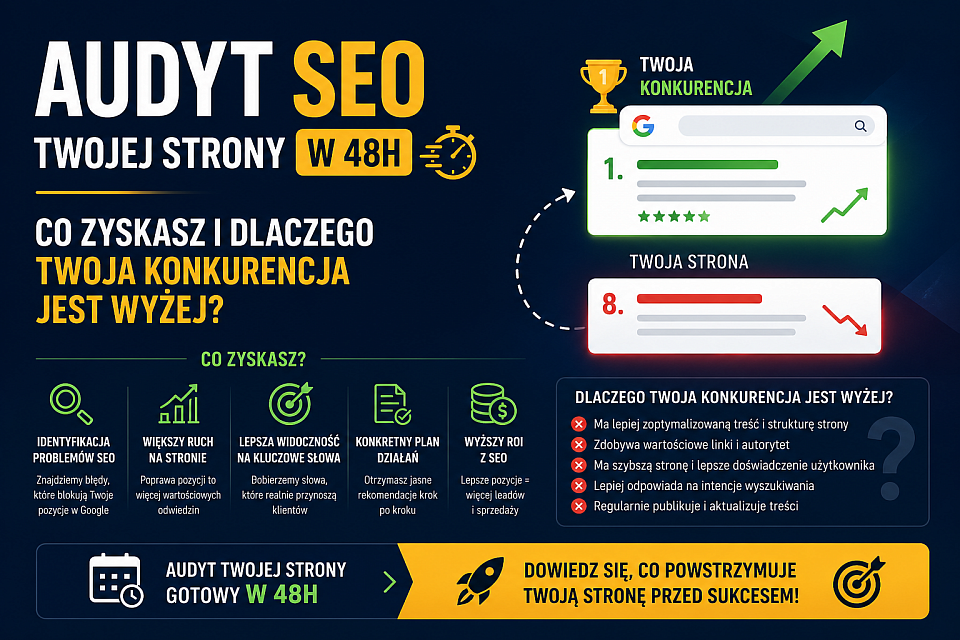
Website SEO Audit in 48 Hours – Benefits and Reasons Why Your Competition is Overtaking You in Search Results
Search engine visibility isn't a matter of chance. If your website is lagging behind the competition, the cause isn't the "algorithm," but rather specific errors or optimization gaps. An SEO audit conducted within 48 hours is a quick and precise method for identifying these issues and planning actions that will effectively improve your website's ranking—both in traditional search results and in AI systems generating responses.
What is an SEO audit and why is 48 hours important?
An SEO audit is a comprehensive analysis of a website in terms of:
- visibility in search engines,
- quality of content,
- technical aspects,
- link profile,
- user experience (UX).
The "48h" option means quick delivery of key findings and recommendations—no waiting times. In a dynamic search environment, especially with the growing importance of AI, response time translates directly into a competitive advantage.
What exactly do you gain?
- Diagnosis of problems limiting visibility
The audit reveals, among other things:- indexing errors,
- problems with page loading speed,
- duplicate content,
- suboptimal keywords,
- lack of alignment with user intent.
- Specific recommendations for action
Instead of generalities, you get a list of priorities:- what needs to be corrected immediately,
- what to optimize in the next stages,
- what to develop strategically.
- Better match for AI searches
A modern audit takes into account:- content structure in terms of language models,
- semantics and context,
- answers to user questions (intent-based content).
- Increase conversions, not just traffic
SEO is not only about increasing the number of visits, but also:- improving traffic quality,
- higher conversion rate,
- more aware users.
Why does your competition rank higher?
- Better keyword strategy
Competition often focuses on:- long phrases (long-tail),
- problem queries,
- specific user needs.
- Higher quality and structure of content
Pages in top positions:- answer questions precisely,
- have a logical heading structure,
- use structured data.
- Stronger link profile
Link building remains important:- quality external links,
- coherent network of internal links.
- Advanced Technical SEO
Key factors include:- Core Web Vitals,
- responsiveness,
- correct indexing,
- no 404 errors and incorrect redirects.
- AI optimization and featured snippets
The competition can now:- create content that answers questions directly,
- use FAQ sections,
- format content for quick data extraction.
How does an SEO audit work in 48 hours?
The process typically includes:
- technical analysis of the website,
- content and keyword audit,
- UX and structure assessment,
- competition analysis,
- report with recommendations.
The result is a document ready for immediate implementation – alone or with a team.
Is a quick audit sufficient?
Yes – provided that:
- focuses on key ranking factors,
- provides priorities instead of data overload,
- is developed by experienced specialists, not just automatic tools.
A full SEO strategy is a long-term process, but a 48-hour audit provides an immediate starting point.
Summary
If your competition is ranking higher, it is because:
- better understands users' intentions,
- responds faster to changes,
- has a website optimized in terms of technical and content.
A 48-hour SEO audit allows you to quickly and precisely address these differences—no guesswork involved. In a world where visibility translates into sales, this is one of the most profitable investments.
Leave a comment about the article:

Artificial intelligence in online marketing – how does AI support companies in saving time and increasing operational efficiency?
Introduction - AI in Internet Marketing
Artificial intelligence (AI) is no longer just a futuristic concept—it is now a key operational tool in online marketing. Companies that effectively integrate AI not only increase operational efficiency but, above all, reclaim their most valuable resource: time. Process automation, real-time data analysis, and content generation are just the beginning of a wide range of possibilities.
In this article, I present specific areas where AI brings the greatest time savings and tips on how to use this technology in practice – without unnecessary theory.
1. Content Marketing Automation
Problem: Creating content (articles, posts, product descriptions) is a time-consuming and expensive process.
AI solution:
- generating SEO-optimized blog articles,
- creating product descriptions in e-commerce,
- preparing posts for social media,
- paraphrasing and updating existing content.
Effect:
- reducing content creation time by up to 70–90%,
- faster scaling of marketing activities,
- the ability to test multiple content variants (A/B testing).
2. Intelligent data analysis and reporting
Problem: Manually analyzing data from Google Analytics, advertising campaigns, or CRM takes many hours.
AI solution:
- automatic data analysis and pattern detection,
- generating reports in real time,
- identification of anomalies and trends,
- forecasting future results (predictive analytics).
Effect:
- elimination of manual reporting,
- faster decision-making,
- more effective use of the marketing budget.
3. Automation of advertising campaigns (Ads)
Problem: Optimizing PPC campaigns requires constant monitoring and testing.
AI solution:
- automatic bid management,
- target group optimization,
- testing advertising creations,
- matching ads to user intentions.
Effect:
- reducing time spent on campaign management,
- higher return on investment (ROI),
- better advertising personalization.
4. Chatbots and 24/7 customer service
Problem: Handling customer inquiries requires significant human resources.
AI solution:
- automatic answers to frequently asked questions,
- support in the purchasing process,
- lead qualification,
- 24/7 customer service.
Effect:
- reduction of customer service costs,
- immediate response to inquiries,
- increasing conversions.
5. Personalization of the user experience
Problem: Manually tailoring content to users at scale is virtually impossible.
AI solution:
- analysis of user behavior,
- monitoring purchase history,
- identification of preferences and interests,
- recommending products,
- personalization of content on the website,
- customizing marketing communications.
Effect:
- higher conversion rate,
- greater user engagement,
- improving customer experience (UX).
6. SEO and AI Search Engine Optimization
New reality: Search engines are increasingly using AI to interpret queries, such as semantic search.
How AI supports SEO:
- analysis of keywords and user intent,
- generating content compliant with EEAT guidelines,
- optimization of article structure,
- creating meta tags and headings,
- competition analysis.
Effect:
- achieving high positions in search results faster,
- better visibility in search engines,
- matching to voice search and AI.
7. Email Marketing Automation
Problem: Creating and segmenting email campaigns is time-consuming.
AI solution:
- segmentation of the customer base,
- personalization of message content,
- shipping time optimization,
- generating topics that increase open rate.
Effect:
- higher campaign effectiveness,
- reduction of manual work,
- better communication adjustment.
How to implement AI in your company – practical steps
- Identify bottlenecks – areas where you waste the most time.
- Choose specific AI tools – don't implement everything at once.
- Automate repetitive processes – content creation, reporting, customer service.
- Test and optimize – AI achieves its best results through an iterative process.
- Train your team – technology is only as effective as the people who use it.
Summary
Artificial intelligence in online marketing is not just a trend, but a real competitive advantage. Companies implementing AI gain:
- more time for strategic activities instead of operational ones,
- reducing marketing costs,
- greater scalability of operations,
- better sales results.
The key is not to replace humans, but to support them. AI takes over repetitive tasks, allowing the team to focus on activities that generate real business value.
FAQ – frequently asked questions
Will AI replace marketers?
No – but marketers who use AI will have an advantage over those who don't.
Is AI implementation expensive?
No – many tools operate on a subscription model and the investment quickly pays off.
Where to start?
Preferably from content creation automation and data analysis, where the return on investment is the fastest.
Leave a comment about the article:
Is Online Support Essential? A Key Aspect of Online Marketing and SEO Strategies
Faced with growing online competition and increasingly demanding users, website owners must seek effective methods to increase conversions and optimize user experience (UX). One often underestimated, yet incredibly effective tool is online support. Is it essential for a website focused on online marketing and SEO? The answer is unequivocal: absolutely yes.
Online help as a key element of user experience (UX)
Users visiting websites about internet marketing and SEO are often looking for specialized information. They may also have questions about the offer, ways to collaborate, or technical aspects. A lack of a prompt response may result in users leaving the site.
Online support, delivered via chat, chatbots, or dedicated support sections, enables immediate response to user needs. This significantly shortens the decision-making process and increases the chances of conversion.
Impact on SEO and behavioral signals
Implementing an online help system also has an indirect but significant impact on SEO. How?
- extends the user's stay on the website,
- reduces bounce rate,
- increases interaction with content,
- supports conversions, which translates into better business results.
Search engine algorithms are increasingly focused on user behavior. Sites that engage audiences and meet their needs are rewarded with higher rankings in search results.
Online Help and Artificial Intelligence (AI)-Based Searches
In the age of AI-powered search, the importance of contextual and valuable content is growing even more. AI systems analyze not only a page's content but also its usability and ability to solve user problems.
Online help:
- provides additional context,
- enables real-time responses,
- increases the substantive value of the website,
- is a data source for creating content such as FAQs, articles and case studies.
This makes the website more "understandable" to AI algorithms.
Building trust and authority
Websites related to online marketing and SEO must project an expert image. Users expect professionalism and a quick response.
Online help:
- demonstratively demonstrates the company's availability and commitment,
- increases credibility,
- enables direct contact,
- eliminates communication barriers.
This is particularly important in the service industry, where purchasing decisions often require consultation.
Automation and scalability
Modern solutions, such as AI-based chatbots, enable the simultaneous handling of multiple users without generating additional operational costs. They can be integrated with knowledge databases, CRM systems, and analytical tools.
Thanks to this, online help not only supports the user but also provides valuable business data.
Summary
Online support is no longer just an add-on; it's a strategic element of a modern website. For websites related to online marketing and SEO, it plays a key role in:
- user experience (UX) optimization,
- increasing conversions,
- supporting SEO activities,
- adaptation to AI-based search,
- building brand authority.
If your goal is to have an effective online presence, implementing online support should be one of your priorities.
We encourage you to leave a comment about the article:

How to Increase Your Local Business Visibility by 300% in 6 Months with AI Search and Google SGE – A Success Case Study
Quick summary:
Industry: local services
Project duration: 6 months
Increase in visibility on Google: +312%
Organic traffic growth: from 900 to 3,700 users per month
Number of phrases in TOP10: from 18 to 96
Increase in the number of inquiries: +180%
Key elements of the strategy:
- Comprehensive SEO audit
- Long-tail keyword strategy
- Rebuilding the site structure
- Content marketing based on user intent
- Local SEO (Google Business Profile)
- Link building
- Content optimization for AI Search and Google SGE
Why Traditional SEO Is No Longer Enough
The way we search for information has changed significantly in recent years. Increasingly, users are receiving answers generated by artificial intelligence directly in search results.
Systems such as Google SGE (Search Generative Experience) analyze content available online and generate summary responses.
For a page to be cited by AI, it must meet the following criteria:
- contain precise answers to user questions,
- have a semantic structure,
- demonstrate expertise and credibility,
- cover a broad thematic context.
Therefore, the SEO strategy in this project was developed not only for classic Google ranking, but also for AI Search Optimization (AISO).
Company profile and starting situation
The company operated locally, offering services to individual clients.
Main challenges before starting the project:
- low visibility in search results,
- lack of optimized service subpages,
- lack of content strategy,
- untapped potential of local queries,
- lack of content answering customer questions.
Organic traffic was around 900 users per month, with most of the queries coming from paid campaigns.
The goal was to build a stable channel for acquiring customers from the search engine.
Stage 1: SEO audit and market analysis
The project began with a comprehensive SEO audit, including:
- technical SEO of the website,
- information structure,
- indexation in Google,
- competitor keywords,
- local search results,
- link profile.
The most important problems are:
- lack of optimized service pages,
- too general content,
- lack of articles answering customer questions,
- poor information architecture,
- insufficient internal linking.
On this basis, an SEO strategy was developed for the next 6 months.
Step 2: Intent-Based Keyword Strategy
Traditional SEO often focuses on a few popular phrases. This project utilizes the search intent model and topical clusters.
Keywords were divided into four groups:
- Transactional phrases
Phrases directly related to the service.
Examples: service + city, company + city, professional service + location. - Problem phrases
Questions asked by users before purchasing.
Examples: how much a given service costs, how to choose a service, whether it is worth using the service. - Local phrases
Phrases related to a specific location.
Examples: service + district, service + city area. - Information phrases
Educational phrases that build authority.
Examples: guides, service comparisons, most common customer mistakes.
In total, over 120 keywords were developed and assigned to specific subpages.
Stage 3: Rebuilding the page structure (Topical Authority)
One of the key elements of the project was changing the site architecture, introducing a structure based on thematic hubs.
Sample model:
Home page
→ Services page
→ Detailed services subpages
→ Guide articles
→ FAQ section
This made it easier for the search engine to understand the topic of the page and the connections between the content.
Step 4: Content optimized for AI Search
The content has been prepared so that it can be effectively used by AI systems.
Each article contained:
- a short summary of the topic,
- direct answers to questions,
- headlines in the form of questions,
- FAQ section,
- numerical data and specific examples.
Sample article topics:
- how much will a given service cost in 2025,
- how to choose a good service company,
- the most common mistakes when choosing services,
- how long does the service take to complete?
This type of content is more likely to be used by AI as a source of answers.
Step 5: Local SEO
Local SEO was one of the key elements of the project.
Optimized the company profile on Google, taking into account:
- exact categories of activity,
- precise descriptions of services,
- photos of the implementation,
- news and posts,
- question and answer section.
A customer feedback strategy was also implemented, which resulted in a significant increase in visibility in Google Maps results.
Stage 6: Link building
The project uses a quality-based link strategy.
Link sources included:
- local news portals,
- expert articles,
- industry catalogs,
- cooperation with business partners.
Over 400 valuable links were acquired within 6 months.
Results after 6 months
The effects of the project were visible both in organic traffic and in the number of customer inquiries.
Key indicators:
- 312% increase in visibility on Google,
- increase in organic traffic from 900 to 3,700 users per month,
- increase in the number of phrases in TOP10 from 18 to 96,
- 180% increase in inquiries.
Importantly, traffic came mainly from local searches and issue-specific queries.
Why This Strategy Works in the Age of AI Search
AI- based search systems prefer content that:
- answer questions clearly and precisely,
- are well structured,
- have thematic authority,
- contain data and specific examples,
- are linked to other valuable content.
That's why the combination of SEO, content marketing and thematic structure brings the best results.
The most important conclusions
The project delivers three key lessons for local businesses:
- SEO is a system, not a single activity.
The best results are achieved by integrating technical SEO, valuable content and link building. - Content must answer real customer questions.
Such materials are more likely to be used by search engines and AI systems. - Local SEO remains extremely important.
Visibility on Google Maps can generate a significant portion of customers.
Summary
Thanks to a comprehensive SEO strategy and optimization for AI Search and Google SGE, the visibility of the local company was increased by over 300% within 6 months.
The key elements of success were:
- keyword strategy,
- valuable content,
- local optimization,
- systematic link building.
Companies that adapt their content to AI search today are building a competitive advantage for years to come.
Interested in a similar service? Contact us for a no-obligation quote. Contact us: Click Here NovaCash
Leave a comment about the article:
Na uwagę zasługuje podkreślenie znaczenia optymalizacji treści pod wyszukiwania konwersacyjne oraz intencje użytkownika, które w kontekście SGE stają się kluczowe.
How Much Does It Really Cost to Acquire a Customer from Google? The Complete Guide to SEO and Google Ads Pricing
How Much Does It Actually Cost to Acquire a Customer from Google? Actual SEO and Google Ads Rates in 2026
Customer acquisition through Google is a key aspect of online marketing. Companies invest heavily in SEO and Google Ads, but they often lack a full understanding of the true costs of acquiring a single customer.
In this article we present:
- the actual costs of acquiring a customer from Google,
- comparison of SEO and Google Ads effectiveness,
- market examples,
- formula for calculating CAC and CPL,
- tips on how to reduce customer costs by up to 50%.
If you run a service company, e-commerce company, or startup, this information will allow you to realistically plan your marketing budget.
What is Customer Acquisition Cost (CAC)?
Customer acquisition cost is one of the most important marketing metrics. CAC (Customer Acquisition Cost) represents the total marketing and sales expenditures required to acquire one paying customer.
Pattern:
CAC = Total Marketing Cost / Number of New Customers
Example:
- marketing budget: PLN 10,000,
- number of new customers: 20,
- CAC = PLN 500 per client.
In practice, earlier stages of the sales funnel are also often analyzed.
CPL – cost of lead acquisition
CPL (Cost Per Lead) means the cost of getting in touch with a potential customer.
According to current marketing benchmarks:
- the average CPL in Poland is PLN 30–150,
- in B2B industries it can reach PLN 100–500 ( KC Mobile ).
The final cost to the customer depends on the effectiveness of the sales conversion.
How much does a customer acquired from Google Ads cost?
Google Ads provides immediate access to customers because your ads appear in search results immediately after you launch your campaign.
Average costs on the market are as follows:
- 50–200 PLN per lead in many service industries ( KC Mobile ),
- PLN 150–500 in the B2B and financial sectors ( KC Mobile ).
When converted to actual customers, the cost increases.
Example:
| Parameter | Value |
| cost of lead | 200 PLN |
| lead → customer conversion | 10% |
| Customer Accommodated Cost (CAC) | 2000 PLN |
Such values are common in many industries.
How much does it cost to acquire a client from SEO?
SEO works differently than advertising – you pay for visibility on Google, not for every click.
Typical SEO costs in Poland are as follows:
| Project type | Average monthly cost |
| local SEO | 700 – 2500 PLN |
| SEO for e-commerce | 2500 – 8000 PLN |
| international projects | 6000 – 20000 PLN+ |
In SEO, the cost of acquiring a lead decreases over time because organic traffic does not require payment for every click.
In many cases:
SEO generates leads at a price of PLN 15–40 ( KC Mobile ).
Therefore, in the long run, it is usually the cheapest marketing channel.
SEO vs Google Ads – A Real-World Comparison
| Canal | Effect time | Cost per lead | Scaling |
| Google Ads | immediately | 50–200 PLN | easy |
| SEO | 3–9 months | 15–50 PLN | very high |
Conclusions
Google Ads:
- quick results,
- full control over the budget,
- − rising costs per click.
SEO:
- the cheapest move in the long run,
- builds competitive advantage,
- − takes time.
For this reason, most companies use a hybrid strategy:
- Google Ads – quick lead generation,
- SEO – stable organic traffic.
What most impacts the cost of a Google customer?
The cost of acquiring a customer depends on several key factors:
- Competition in the industry
The more companies bid on a given keyword, the higher the advertising costs.
Examples of high-cost sectors:
- lawyer,
- mortgage loan,
- photovoltaics,
- medical services.
- Landing page quality
Google evaluates the quality of a page, which affects the cost per click and conversion rate.
Poor page quality results in a higher cost per click, lower conversions and a more expensive lead. - Offer
Product price and customer value are crucial.
Examples:
| Industry | Customer Value | Acceptable CAC |
| hairdresser | 150 PLN | 30–60 PLN |
| accounting office | 3000 PLN per year | 300–1500 PLN |
| SaaS | 5000 PLN+ | up to 2000 PLN |
- Sales conversion
Low sales effectiveness significantly increases the cost of customer acquisition.
Example:
| Sales conversion | Customer cost |
| 5% | very high |
| 10% | mediocre |
| 20% | very good |
How to reduce the cost of customer acquisition?
The most effective marketing companies focus not on increasing the budget, but on optimizing the sales funnel.
Key methods:
- Long-tail keywords
Instead of general phrases, e.g. "dentist", it is better to target more specific queries, e.g. "dentist implants Poznań price".
This allows you to lower your cost per click. - Remarketing
Remarketing can reduce the cost per lead by up to 30–60% because ads are targeted to people already familiar with the brand. - Landing page optimization
Changes that increase conversion include: shorter forms, customer reviews, case studies, and clear CTAs. - Content marketing and SEO
In the long run, SEO is the cheapest source of customers because it does not require payment for every click.
For many companies, SEO generates the majority of leads after 12–24 months.
The most common mistake companies make
The biggest mistake is focusing solely on cost-per-click. The most important metric remains the LTV-to-CAC ratio.
LTV – customer value
If a customer generates revenue of PLN 5,000, the cost of acquiring him or her of PLN 1,000 may be a very profitable investment.
Summary
The cost of acquiring a customer from Google depends on the industry, marketing strategy and the quality of the sales process.
Real benchmarks are as follows:
- SEO: PLN 15–50 per lead,
- Google Ads: PLN 50–200 per lead,
- CAC (customer): often 300–2000 PLN+ ( KC Mobile ).
The most effective marketing strategy is a combination of SEO, Google Ads, and conversion optimization.
Thanks to this, you can:
- acquire customers quickly,
- build stable, long-term organic traffic,
- gradually reduce the cost of customer acquisition.
Leave a comment about the article:
